
What is an ETF? CompleteBeginner’s Guide (2026)

Introduction
If you’re looking for a simple, low-cost, and diversified way to invest in the stock market, you’ve probably come across the term ETF. Over the last decade, Exchange Traded Funds (ETFs) have become one of the fastest-growing investment products worldwide. Whether you’re a beginner starting your investment journey or an experienced investor seeking diversification, ETFs can be a smart addition to your portfolio.
Unlike traditional mutual funds, ETFs are traded on stock exchanges just like individual stocks, allowing investors to buy and sell them throughout the trading day. They combine the diversification benefits of mutual funds with the flexibility of stocks, making them an attractive investment option for long-term wealth creation.
In this comprehensive beginner’s guide, you’ll learn what an ETF is, how it works, its different types, benefits, risks, taxation, and how to start investing in ETFs in India. By the end of this guide, you’ll have a clear understanding of whether ETFs are the right investment choice for your financial goals.SEBI – Securities and Exchange Board of India
What is an ETF?
An Exchange Traded Fund (ETF) is an investment fund that holds a collection of assets such as stocks, bonds, gold, commodities, or other securities. Instead of buying each asset individually, investors purchase units of the ETF, gaining exposure to an entire portfolio through a single investment.
ETFs are listed on stock exchanges and can be bought or sold during market hours just like ordinary shares. Most ETFs are designed to track the performance of a specific market index, such as the Nifty 50 or Sensex, although some focus on sectors, commodities, international markets, or investment themes.
For example, if you invest in a Nifty 50 ETF, your investment represents ownership in a fund that mirrors the Nifty 50 Index. As the index rises or falls, the value of your ETF generally moves in the same direction, making ETFs an efficient and transparent investment vehicle.
Because ETFs offer diversification, lower expense ratios, high liquidity, and transparency, they have become increasingly popular among both beginner and professional investors around the world.AMFI – Association of Mutual Funds in India
How Does an ETF Work?
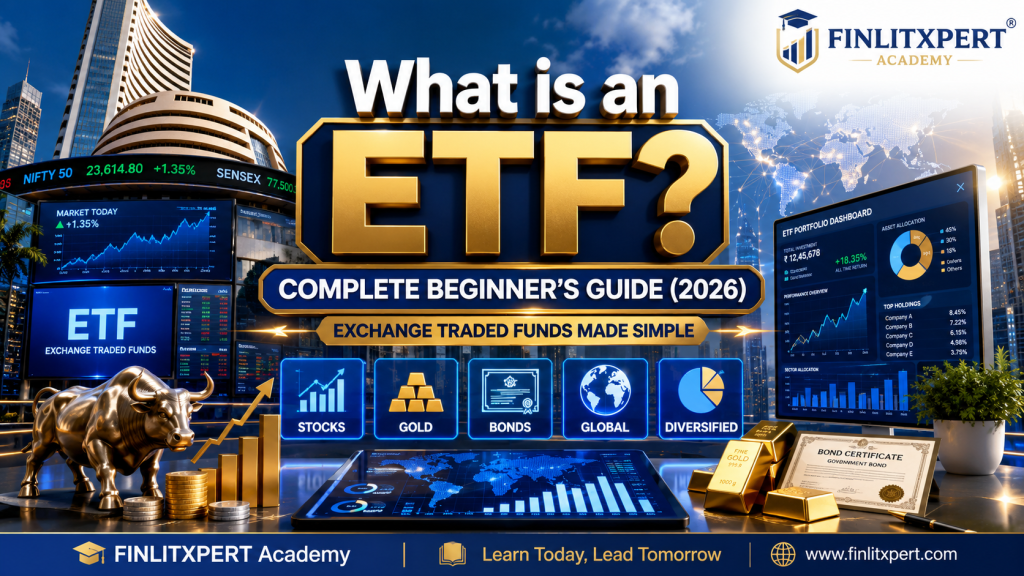
An Exchange Traded Fund (ETF) works by pooling money from multiple investors and investing that money in a predefined basket of assets such as stocks, bonds, gold, commodities, or other securities. Each ETF follows a specific investment objective, with many aiming to track the performance of a market index like the Nifty 50, Sensex, Nifty Bank, or global indices.
When you buy one unit of an ETF, you are not purchasing shares of a single company. Instead, you are buying a small ownership interest in an entire portfolio of investments. This diversification helps reduce the impact of poor performance from any one asset while providing exposure to a broader market or investment theme.
Unlike traditional mutual funds, ETFs are listed on stock exchanges. Investors can buy and sell ETF units throughout the trading day at market prices, just like shares of listed companies. The market price of an ETF changes continuously based on supply, demand, and the value of its underlying assets.
An ETF is managed by an Asset Management Company (AMC). The fund manager’s role is usually not to actively select stocks but to ensure that the ETF closely tracks its benchmark index. For example, a Nifty 50 ETF holds the same companies in approximately the same weightings as the Nifty 50 Index. If the composition of the index changes, the ETF portfolio is adjusted accordingly to maintain alignment.
Large institutional participants, known as Authorized Participants (APs), play an important role in keeping an ETF’s market price close to its Net Asset Value (NAV). They create or redeem ETF units in large blocks whenever significant price differences arise between the ETF’s market price and the value of its underlying assets. This process helps maintain price efficiency and is one of the key reasons ETFs generally trade very close to their actual portfolio value.
Because ETFs are passively managed in most cases, they usually have lower expense ratios than actively managed mutual funds. Lower costs mean that more of your investment remains invested over the long term, which can positively influence overall returns.
Another important feature of ETFs is transparency. Most ETF providers disclose their portfolio holdings regularly, allowing investors to know exactly where their money is invested. This level of transparency helps investors make informed decisions and understand the fund’s exposure.
For long-term investors, ETFs provide a convenient way to build diversified portfolios with a single investment. Whether your goal is wealth creation, retirement planning, portfolio diversification, or exposure to specific sectors or international markets, ETFs offer a flexible, cost-effective, and efficient investment solution.https://www.finlitxpert.com/finlitxpert-course-registration/
Quick Example: How an ETF Works
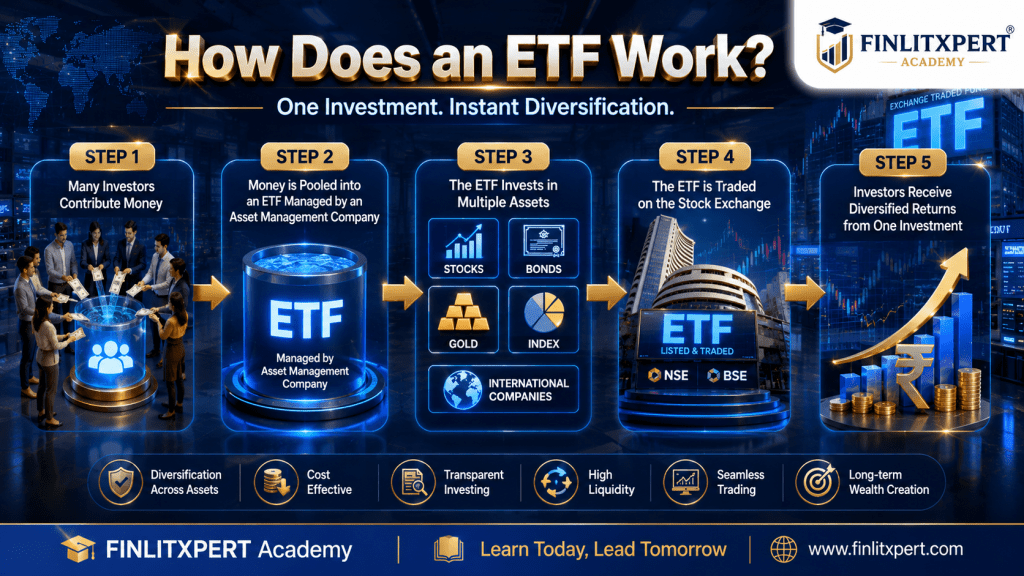
Suppose you want to invest in India’s top 50 companies.
Instead of purchasing shares of all 50 companies individually—which would require significant capital and multiple transactions—you can simply buy one unit of a Nifty 50 ETF.
Your investment is automatically spread across all the companies included in the Nifty 50 Index according to their respective weightings.
If the index performs well over time, the value of your ETF investment generally increases as well. Similarly, if the index declines, the ETF’s value may also decrease.
This simple structure allows investors to achieve broad diversification through a single investment while avoiding the complexity of managing dozens of individual stocks.https://www.finlitxpert.com/
Key Takeaways
- An ETF pools money from many investors.
- The fund invests in a basket of securities.
- ETF units are traded on stock exchanges like regular shares.
- Most ETFs track a benchmark index.
- Authorized Participants help keep ETF prices close to their Net Asset Value (NAV).
- ETFs generally have lower costs than actively managed mutual funds.
- Investors receive instant diversification through a single investment.
- ETFs are suitable for both beginner and experienced investors.
History of ETFs
The history of Exchange Traded Funds (ETFs) reflects one of the most significant innovations in modern investing. ETFs were created to combine the diversification benefits of mutual funds with the flexibility of stock trading. Today, they have become one of the fastest-growing investment products in the world, with trillions of dollars invested across thousands of ETFs covering almost every asset class.
The first successful ETF was launched in Canada in 1990. However, the ETF industry gained global recognition in 1993 when the SPDR S&P 500 ETF Trust (commonly known as SPY) was introduced in the United States. This pioneering ETF was designed to track the S&P 500 Index, allowing investors to gain exposure to 500 of the largest U.S. companies through a single investment. SPY remains one of the most actively traded ETFs in the world and demonstrated how ETFs could offer simplicity, transparency, and liquidity.
Following the success of SPY, asset management companies introduced ETFs covering different market indices, sectors, commodities, bonds, currencies, and international markets. Investors no longer needed to purchase dozens of individual securities to build diversified portfolios. Instead, they could invest in a single ETF that matched their financial goals or investment strategy.
During the early 2000s, ETF adoption accelerated rapidly due to increasing investor awareness, lower management costs, and the growing popularity of passive investing. Institutional investors appreciated ETFs for portfolio management and hedging, while retail investors found them easy to understand and affordable for long-term wealth creation.
In India, the ETF market began to develop in the early 2000s with the launch of benchmark index ETFs. Over time, Indian Asset Management Companies introduced a wide variety of ETFs, including Nifty 50 ETFs, Sensex ETFs, Gold ETFs, Bharat Bond ETFs, CPSE ETFs, Banking ETFs, and international ETFs. These products enabled Indian investors to access diversified portfolios while keeping investment costs relatively low.
Government initiatives also contributed to the growth of ETFs in India. Products such as the CPSE ETF and Bharat Bond ETF encouraged retail participation and highlighted the advantages of low-cost investing. At the same time, the increasing use of online trading platforms and demat accounts made ETF investing more accessible than ever before.
Today, ETFs are used by individual investors, financial advisors, pension funds, insurance companies, and institutional investors around the world. They are widely regarded as an efficient investment vehicle because they provide diversification, transparency, liquidity, and lower expense ratios compared to many actively managed investment products.
As global financial markets continue to evolve, ETFs are expected to play an even greater role in helping investors build long-term, diversified portfolios. Whether investing in equities, fixed income, commodities, or international markets, ETFs have become an essential tool for modern investing.https://www.finlitxpert.com/

ETF Timeline
1990
- First successful ETF launched in Canada.
1993
- SPDR S&P 500 ETF (SPY) launched in the United States.
Late 1990s
- ETFs expanded to include different market indices.
2000–2010
- Rapid growth in sector, bond, commodity, and international ETFs.
Early 2000s (India)
- Introduction of benchmark index ETFs.
2015–Present
- Strong growth in Gold ETFs, Bharat Bond ETFs, CPSE ETFs, and international ETFs.
Today
- Thousands of ETFs are available globally, managing trillions of dollars in investor assets.
Why ETFs Became So Popular
ETFs have become increasingly popular because they offer several advantages that appeal to both new and experienced investors:
- Low investment costs compared to many actively managed funds.
- Instant diversification through a single investment.
- Real-time trading on stock exchanges.
- High transparency, with regular disclosure of portfolio holdings.
- Easy access to domestic and international markets.
- Flexibility to invest in equities, bonds, gold, commodities, and thematic sectors.
- Suitable for long-term investing, retirement planning, and portfolio diversification.
These features have made ETFs one of the preferred investment vehicles for millions of investors worldwide.
Types of ETFs
Exchange Traded Funds (ETFs) are available in various categories, each designed to meet different investment objectives and risk profiles. Some ETFs track broad market indices, while others focus on specific sectors, commodities, bonds, international markets, or emerging investment themes.
Choosing the right ETF depends on your financial goals, investment horizon, and risk tolerance. Understanding the different types of ETFs is essential before investing, as each category serves a unique purpose within a diversified portfolio.https://www.finlitxpert.com/finlitxpert-traderx-live-2026/
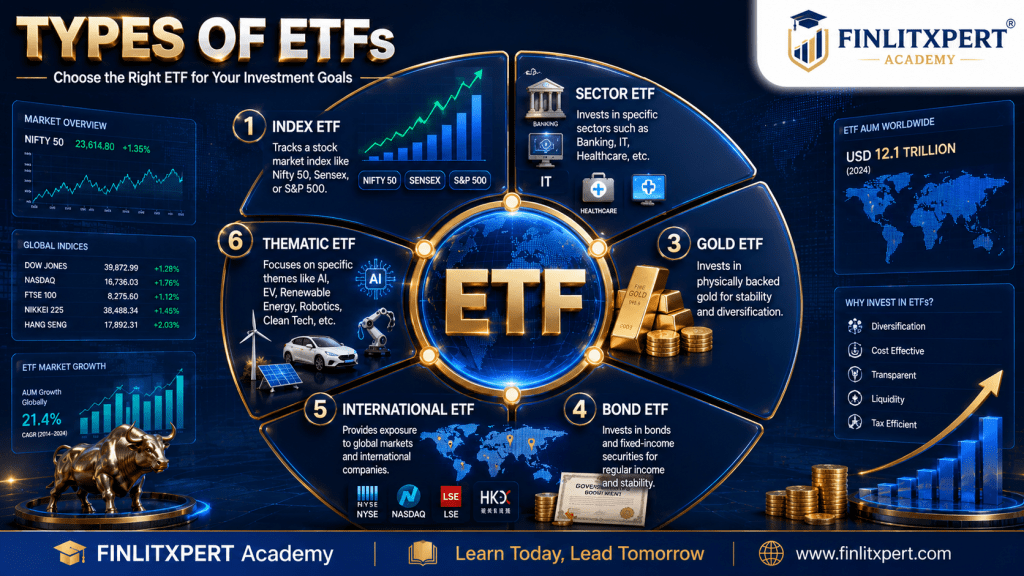
Let’s explore the most common types of ETFs available to investors.
Index ETFs
Index ETFs are the most popular type of Exchange Traded Funds. They are designed to replicate the performance of a specific market index, such as the Nifty 50, Sensex, Nifty Next 50, or Nifty Bank.
Instead of trying to outperform the market, an Index ETF simply mirrors the composition and weightage of its benchmark index. This passive investment approach results in lower management costs and consistent performance relative to the index.
For example, if you invest in a Nifty 50 ETF, your money is automatically invested across the 50 companies that make up the Nifty 50 Index. As the index rises or falls, the ETF generally moves in the same direction.
Index ETFs are ideal for long-term investors who want broad market exposure, diversification, and low-cost investing without actively selecting individual stocks.
Examples in India:
- Nippon India ETF Nifty 50 BeES
- SBI Nifty 50 ETF
- UTI Nifty ETF
- ICICI Prudential Nifty ETF
These ETFs track the Nifty 50 Index and aim to deliver returns similar to the benchmark.
Sector ETFs
Sector ETFs invest exclusively in companies belonging to a particular industry or business sector. Instead of tracking the overall stock market, these ETFs focus on a specific segment of the economy.
Popular sector ETFs include Banking ETFs, IT ETFs, Healthcare ETFs, Energy ETFs, FMCG ETFs, Infrastructure ETFs, and Pharma ETFs.
Sector ETFs allow investors to benefit from the growth potential of industries they believe will outperform the broader market. However, because these ETFs concentrate investments within a single sector, they generally carry higher risk than diversified Index ETFs.
They are best suited for investors with moderate to high risk tolerance who have a strong conviction about the future performance of a specific industry.
Examples:
- Nifty Bank ETF
- Nifty IT ETF
- PSU Bank ETF
- Healthcare ETF
Gold ETFs
Gold ETFs invest in physical gold or gold-related assets and are designed to track the price of gold. Each unit of a Gold ETF represents ownership in gold held by the fund.
Unlike purchasing physical gold, Gold ETFs eliminate concerns about storage, purity, insurance, and security. Investors can buy or sell Gold ETFs easily through their demat and trading accounts during market hours.
Gold ETFs are often used as a hedge against inflation, economic uncertainty, and market volatility. Many financial advisors recommend allocating a portion of an investment portfolio to gold for diversification and risk management.
Gold ETFs are particularly suitable for investors seeking stability during periods of market uncertainty.https://www.finlitxpert.com/
Examples:
- Nippon India Gold ETF
- SBI Gold ETF
- HDFC Gold ETF
- ICICI Prudential Gold ETF
Bond ETFs
Bond ETFs invest primarily in fixed-income securities such as government bonds, treasury bills, state development loans, and high-quality corporate bonds. These ETFs are generally considered lower-risk investments compared to equity ETFs.
Bond ETFs aim to provide regular income while preserving capital. They are popular among conservative investors, retirees, and individuals seeking relatively stable returns with lower market volatility.
Interest rate movements can affect bond prices, so Bond ETFs may experience fluctuations. However, they remain an effective option for portfolio diversification and income generation.
For investors looking to balance risk within their portfolios, Bond ETFs can serve as an important asset allocation tool.https://www.finlitxpert.com/finlitxpert-course-registration/
Examples:
- Bharat Bond ETF
- SBI Bond ETF
- Government Securities ETF
International ETFs
International ETFs allow investors to gain exposure to companies and markets outside India. These ETFs may track major global indices such as the S&P 500, NASDAQ-100, FTSE 100, Nikkei 225, or MSCI World Index.
By investing in International ETFs, investors can diversify geographically and participate in the growth of global companies without opening foreign brokerage accounts.
International ETFs also help reduce dependence on a single country’s economy and provide access to industries and companies that may not be available in domestic markets.
However, investors should also consider currency fluctuations, geopolitical events, and global economic conditions when investing internationally.https://www.finlitxpert.com/finlitxpert-course-registration/
Examples:
- Motilal Oswal NASDAQ 100 ETF
- Mirae Asset NYSE FANG+ ETF
- International S&P 500 ETFs
Thematic ETFs
Thematic ETFs focus on long-term investment themes rather than traditional sectors. These ETFs invest in companies expected to benefit from emerging global trends such as Artificial Intelligence (AI), Electric Vehicles (EVs), Clean Energy, Robotics, Cybersecurity, Renewable Energy, Digital Transformation, and ESG (Environmental, Social, and Governance).
Because thematic investing is based on future growth opportunities, these ETFs can experience higher volatility than broad market ETFs. While they offer significant long-term growth potential, they also carry greater investment risk.
Thematic ETFs are generally suitable for investors with a long investment horizon who want exposure to innovative industries shaping the future of the global economy.https://www.finlitxpert.com/finlitxpert-traderx-live-2026/
Examples:
- AI & Robotics ETFs
- Clean Energy ETFs
- Electric Vehicle ETFs
- ESG ETFs
Comparison Table
| ETF Type | Primary Investment | Risk Level | Suitable For |
|---|---|---|---|
| Index ETF | Market Index | Low to Moderate | Beginners |
| Sector ETF | Specific Industry | Moderate to High | Experienced Investors |
| Gold ETF | Physical Gold | Moderate | Portfolio Diversification |
| Bond ETF | Government & Corporate Bonds | Low | Conservative Investors |
| International ETF | Global Markets | Moderate | Global Diversification |
| Thematic ETF | Emerging Industries | High | Long-Term Growth Investors |
- Index ETFs are ideal for beginners.
- Sector ETFs focus on individual industries.
- Gold ETFs provide exposure to gold without owning physical metal.
- Bond ETFs are suitable for conservative investors seeking relatively stable income.
- International ETFs help diversify investments across global markets.
- Thematic ETFs target future growth industries but involve higher risk.
A diversified portfolio may include multiple ETF categories depending on your investment goals and risk appetite.
Benefits of Investing in ETFs
Exchange Traded Funds (ETFs) have become one of the most popular investment options among both beginner and experienced investors. Their growing popularity is driven by a combination of affordability, diversification, transparency, and flexibility. Unlike investing in individual stocks, where returns depend on the performance of a single company, ETFs provide exposure to a diversified portfolio through a single investment.
Whether your goal is long-term wealth creation, retirement planning, portfolio diversification, or passive investing, ETFs offer several advantages that make them an excellent addition to an investment portfolio. Below are the key benefits of investing in ETFs.https://www.finlitxpert.com/
Instant Diversification
One of the biggest advantages of ETFs is instant diversification. Instead of investing in a single stock, an ETF spreads your investment across multiple securities. For example, a Nifty 50 ETF invests in the 50 companies that make up the Nifty 50 Index.
Diversification helps reduce company-specific risk because poor performance by one company may be offset by stronger performance from others. This makes ETFs a safer option than investing all your money in a few individual stocks, especially for beginners.
Lower Investment Cost
Most ETFs are passively managed, meaning they simply track a benchmark index instead of relying on active stock selection. As a result, ETFs generally have lower expense ratios than actively managed mutual funds.
Lower management costs allow more of your money to remain invested, which can significantly improve long-term returns through the power of compounding. Cost efficiency is one of the primary reasons ETFs have gained widespread popularity around the world.
Easy Buying and Selling
ETFs are listed on stock exchanges and can be bought or sold throughout the trading day, just like shares of publicly listed companies. Investors can place market orders or limit orders depending on their preferred trading strategy.
This flexibility allows investors to respond quickly to market conditions without waiting until the end of the trading day, unlike traditional mutual funds that are typically priced only once daily based on their Net Asset Value (NAV).
High Transparency
Most ETF providers regularly disclose the securities held within their portfolios. This transparency allows investors to clearly understand where their money is invested and how the fund aligns with its stated investment objective.
Knowing the underlying holdings helps investors make informed decisions and provides greater confidence in the investment process compared to products with less frequent portfolio disclosure.
Professional Management
Although many ETFs follow a passive investment strategy, they are still managed by professional Asset Management Companies (AMCs). These fund managers ensure that the ETF accurately tracks its benchmark index and maintains the correct allocation of underlying assets.
Investors benefit from professional portfolio management without the higher costs often associated with actively managed investment funds.
Suitable for Long-Term Wealth Creation
ETFs are well suited for long-term investing because they provide broad market exposure at relatively low costs. Investors who remain invested over many years may benefit from market growth and the power of compounding.
Many financial planners recommend low-cost index ETFs as a core component of long-term investment portfolios for goals such as retirement planning, children’s education, and wealth creation.
Access to Different Asset Classes
ETFs provide investors with access to a wide range of asset classes through a single investment platform. Depending on the ETF selected, investors can gain exposure to equities, government bonds, corporate bonds, gold, silver, international markets, real estate investment themes, and emerging technologies.
This flexibility makes it easier to build a diversified portfolio tailored to individual financial goals and risk tolerance.https://www.finlitxpert.com/finlitxpert-course-registration/
Tax Efficiency
Many ETFs are considered relatively tax-efficient because portfolio turnover is often lower than that of actively managed funds. Lower turnover may reduce taxable events within the fund, depending on the market and applicable tax regulations.
However, investors should always understand the tax treatment of ETFs in their country and consult a qualified tax professional or financial advisor for guidance specific to their circumstances.
Ideal for Passive Investors
ETFs are an excellent choice for investors who prefer a passive investment strategy. Rather than attempting to predict short-term market movements or select winning stocks, passive investors aim to participate in the long-term growth of the overall market.
This disciplined approach helps reduce emotional decision-making and encourages consistent investing over time.
Beginner-Friendly Investment Option
For new investors, ETFs offer a simple and convenient way to begin investing. Instead of researching dozens of individual companies, beginners can start with a diversified ETF that tracks a well-established market index.
This simplicity allows investors to focus on building good financial habits while gaining exposure to the broader market from the very beginning of their investment journey.

Summary Table
| Benefit | Why It Matters |
|---|---|
| Instant Diversification | Reduces company-specific risk |
| Lower Costs | Improves long-term returns |
| Liquidity | Buy and sell during market hours |
| Transparency | Know exactly what you own |
| Professional Management | Efficient index tracking |
| Long-Term Growth | Supports wealth creation |
| Multiple Asset Classes | Easy portfolio diversification |
| Tax Efficiency | Potentially fewer taxable events* |
| Passive Investing | Simple, disciplined investing |
| Beginner Friendly | Easy entry into the stock market |
*Tax treatment depends on the investor’s jurisdiction and applicable tax laws.
Key Takeaways
- ETFs provide instant diversification through a single investment.
- Most ETFs have lower expense ratios than actively managed mutual funds.
- ETFs can be traded throughout the day on stock exchanges.
- They offer transparency, professional management, and access to multiple asset classes.
- ETFs are well suited for long-term wealth creation and passive investing.
- For many beginners, a broad-market Index ETF can be an effective starting point for building a diversified investment portfolio.
Risks of ETF Investing
Although Exchange Traded Funds (ETFs) offer diversification, lower costs, and flexibility, they are not risk-free investments. Like all market-linked investment products, ETFs are affected by market movements and other factors that can influence their performance.
Understanding these risks is essential before investing. A well-informed investor is better prepared to choose suitable ETFs, build a balanced portfolio, and stay focused on long-term financial goals rather than reacting to short-term market fluctuations.
Let’s explore the major risks associated with ETF investing and how you can manage them effectively.
Market Risk
Market risk is the most common risk associated with ETFs. Since most ETFs track stock market indices or other market-linked assets, their value generally rises and falls with the overall market.
For example, if the Nifty 50 Index declines due to economic uncertainty, geopolitical events, or weak corporate earnings, a Nifty 50 ETF is also likely to decline in value.
While diversification can reduce company-specific risk, it cannot eliminate overall market risk. Investors should be prepared for short-term volatility and maintain a long-term investment perspective.https://www.finlitxpert.com/finlitxpert-traderx-live-2026/
Tracking Error
Tracking error refers to the difference between the performance of an ETF and the benchmark index it aims to replicate. Ideally, an ETF should closely match the returns of its underlying index, but small differences may occur.
Tracking errors can result from management expenses, transaction costs, cash holdings, dividend timing, or changes in the index composition.
A lower tracking error generally indicates a more efficient ETF. Before investing, compare the historical tracking error of similar ETFs if this information is available from the fund provider.
Liquidity Risk
Although ETFs are traded on stock exchanges, not all ETFs have the same level of trading activity. Some ETFs experience lower trading volumes, making it more difficult to buy or sell units quickly at the desired price.
Low liquidity may lead to wider bid-ask spreads, increasing transaction costs for investors.
To reduce liquidity risk, consider ETFs with higher average trading volumes and sufficient market participation.
Sector Concentration Risk
Sector ETFs invest in companies from a single industry, such as banking, information technology, pharmaceuticals, or energy. While this provides targeted exposure, it also increases concentration risk.
If the chosen sector experiences an economic slowdown, regulatory changes, or declining business performance, the ETF may underperform the broader market.
Investors should avoid allocating an excessively large portion of their portfolio to a single sector ETF unless it aligns with their overall investment strategy and risk tolerance.https://www.finlitxpert.com/finlitxpert-course-registration/
Currency Risk (International ETFs)
International ETFs provide exposure to foreign markets, but they also introduce currency risk. Changes in exchange rates between the Indian Rupee (₹) and foreign currencies can affect investment returns.
Even if the underlying international market performs well, an unfavourable movement in exchange rates may reduce returns when converted back into Indian Rupees.
Investors should understand that international investing involves both market performance and currency fluctuations.
Interest Rate Risk (Bond ETFs)
Bond ETFs are generally considered less volatile than equity ETFs, but they are not free from risk. One of the primary risks affecting bond ETFs is interest rate risk.
When interest rates rise, existing bond prices typically decline, which can reduce the value of Bond ETFs. Conversely, falling interest rates often support higher bond prices.
The impact depends on the types of bonds held by the ETF and their maturity profile.
Commodity Price Risk (Gold & Commodity ETFs)
Commodity ETFs, including Gold ETFs, are directly influenced by changes in commodity prices. Factors such as inflation, global demand, central bank policies, geopolitical tensions, and supply disruptions can significantly affect commodity prices.
Although Gold ETFs are often considered a hedge during uncertain times, their prices can still experience periods of volatility.
Investors should view commodity ETFs as part of a diversified portfolio rather than relying on them as a single investment strategy.
Passive Investment Limitation
Most ETFs follow a passive investment strategy by tracking a benchmark index. While this approach keeps costs low, it also means the ETF is unlikely to outperform the market before fees.
If the benchmark index performs poorly, the ETF is expected to deliver similar performance.
Investors seeking to outperform the market may consider other investment strategies, but they should also understand that these often involve higher costs and potentially greater risk.

How to Reduce ETF Investment Risks
Although risks cannot be completely eliminated, investors can take practical steps to manage them effectively:
- Invest with a long-term perspective.
- Diversify across different asset classes and ETF categories.
- Avoid concentrating too much money in a single ETF or sector.
- Review the ETF’s expense ratio, tracking error, and liquidity before investing.
- Rebalance your portfolio periodically to maintain your desired asset allocation.
- Invest according to your financial goals and risk tolerance rather than reacting to short-term market movements.
Following these principles can help investors build a more resilient and balanced investment portfolio.
Summary Table
| Risk | Description | How to Manage |
|---|---|---|
| Market Risk | ETF value moves with the market | Invest for the long term |
| Tracking Error | ETF differs slightly from its benchmark | Choose ETFs with consistently low tracking error |
| Liquidity Risk | Difficulty buying or selling at desired prices | Prefer ETFs with healthy trading volumes |
| Sector Concentration Risk | Heavy exposure to one industry | Diversify across sectors |
| Currency Risk | Exchange rate fluctuations affect returns | Understand global investment risks |
| Interest Rate Risk | Bond prices can fall when rates rise | Match bond ETFs to your investment horizon |
| Commodity Price Risk | Commodity prices can be volatile | Use commodity ETFs as part of a diversified portfolio |
| Passive Strategy Risk | ETF generally matches, not beats, the benchmark | Set realistic long-term expectations |
Key Takeaways
- ETFs are diversified investments, but they still involve market-related risks.
- Different ETF categories carry different types of risks.
- Understanding tracking error, liquidity, and concentration risk can help you make more informed investment decisions.
- Diversification, disciplined investing, and a long-term approach are effective ways to manage ETF-related risks.
- Always choose investments that align with your financial goals, investment horizon, and risk tolerance.
ETF vs Mutual Fund
Exchange Traded Funds (ETFs) and Mutual Funds are two of the most popular investment vehicles available to investors. Both pool money from multiple investors and invest in a diversified portfolio of assets such as stocks, bonds, or other securities. However, despite these similarities, they differ significantly in terms of trading, pricing, costs, management style, transparency, and investment flexibility.
Understanding these differences is important because the right choice depends on your financial goals, investment experience, risk tolerance, and preferred investing style. While ETFs are generally known for their lower costs and real-time trading, Mutual Funds often provide features such as Systematic Investment Plans (SIPs) and active portfolio management.https://www.finlitxpert.com/finlitxpert-course-registration/
Let’s compare ETFs and Mutual Funds in detail.
Trading Method
The most significant difference between ETFs and Mutual Funds is how they are traded.
ETFs are listed on stock exchanges and can be bought or sold throughout the trading day, just like shares of listed companies. Investors can place market orders, limit orders, or stop-loss orders depending on their trading strategy.
Mutual Funds, on the other hand, are not traded on stock exchanges. Instead, units are purchased or redeemed directly through the Asset Management Company (AMC) or authorized platforms. Transactions are executed at the Net Asset Value (NAV) calculated after the market closes each trading day.
As a result, ETFs offer greater flexibility for investors who prefer real-time trading.
Pricing
ETF prices fluctuate continuously during market hours based on supply and demand, while also reflecting the value of the underlying portfolio.
Mutual Funds have a single NAV calculated at the end of each trading day. Regardless of when an investor places an order during the day, the transaction is processed using the applicable closing NAV, subject to the fund’s cut-off timings.
This makes ETFs more suitable for investors who want intraday buying and selling opportunities.
Investment Cost
Most ETFs follow a passive investment strategy, which generally results in lower expense ratios because there is less active portfolio management.
Actively managed Mutual Funds typically have higher expense ratios due to research, portfolio management, and stock selection costs. However, index mutual funds may also have relatively low expenses.
Over the long term, lower costs can contribute positively to investment returns because a larger portion of your money remains invested.
Management Style
Most ETFs are passively managed and aim to replicate the performance of a benchmark index rather than outperform it.
Many Mutual Funds are actively managed, where professional fund managers research securities and make investment decisions in an attempt to outperform the benchmark. While active management may generate higher returns in some market conditions, there is no guarantee that it will consistently beat the market after accounting for fees and expenses.
Transparency
ETFs are generally considered highly transparent because many ETF providers regularly disclose their portfolio holdings. Investors can easily understand which securities the ETF owns and how the portfolio is allocated.
Mutual Funds also disclose their portfolios, but disclosures are typically less frequent than those of many ETFs. Investors should review the fund’s official disclosures to understand its investment holdings and strategy.
Minimum Investment
One advantage of ETFs is that investors can usually start by purchasing as little as one ETF unit, provided they have a demat account and trading account.
Mutual Funds often allow investors to begin investing through a Systematic Investment Plan (SIP) with relatively small periodic contributions, making them accessible for disciplined long-term investing.
The minimum investment amount varies depending on the specific ETF, Mutual Fund scheme, and investment platform.https://www.finlitxpert.com/finlitxpert-traderx-live-2026/
Liquidity
Because ETFs trade on stock exchanges, investors can buy or sell them during market hours whenever there are willing buyers and sellers.
Mutual Fund units are redeemed through the AMC at the applicable NAV rather than through exchange-based trading. Both investment options generally provide liquidity, but the process differs.
Suitable Investors
ETFs are often preferred by investors who want lower costs, transparency, passive investing, and the flexibility of real-time trading.
Mutual Funds may appeal to investors who prefer professional active management, automated SIP investing, or who do not wish to actively trade on stock exchanges.
Neither option is universally better—the most suitable choice depends on an individual’s financial goals, investment horizon, and personal preferences.

Comparison Table
| Feature | ETF | Mutual Fund |
|---|---|---|
| Trading | Traded on stock exchanges throughout the day | Purchased and redeemed through the AMC at end-of-day NAV |
| Pricing | Market price changes during trading hours | Single daily NAV |
| Management | Mostly passive | Often active (though index mutual funds are passive) |
| Expense Ratio | Generally lower | Often higher for actively managed funds |
| Transparency | Generally higher and more frequent | Regular disclosures, often less frequent |
| Demat Account | Usually required | Generally not required for direct mutual fund investing |
| SIP Facility | Available for some ETFs through certain brokers/platforms | Widely available |
| Best For | Passive, low-cost, flexible investing | Goal-based investing and systematic contributions |
Which One Should You Choose?
Choose an ETF if you:
- Prefer lower investment costs.
- Want to trade during market hours.
- Believe in passive investing.
- Already have a demat and trading account.
- Want broad market exposure with a simple investment.
Choose a Mutual Fund if you:
- Prefer investing through a SIP.
- Want professional active fund management.
- Do not intend to trade during the day.
- Prefer a more hands-off investing experience.
- Are investing toward long-term financial goals through systematic contributions.
For many investors, a combination of ETFs and Mutual Funds can provide a well-diversified investment portfolio that balances cost efficiency, flexibility, and professional management.
Key Takeaways
- ETFs and Mutual Funds both offer diversified investment opportunities.
- ETFs are traded on stock exchanges, while Mutual Funds are bought and redeemed at daily NAV.
- ETFs generally have lower costs due to passive management.
- Mutual Funds often provide active management and convenient SIP options.
- The right choice depends on your financial goals, investment strategy, and preferred way of investing—not on one product being universally better than the other.
ETF vs Stocks
Exchange Traded Funds (ETFs) and individual stocks are both popular investment options, but they serve different purposes and involve different levels of risk. While both can help investors build wealth over time, understanding how they differ is essential for making informed investment decisions.
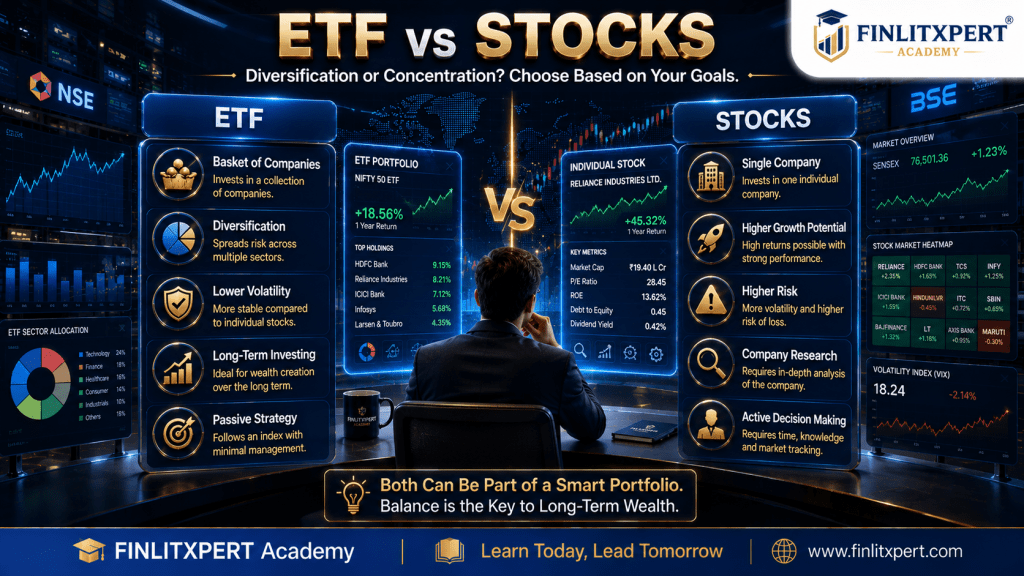
When you buy a stock, you purchase ownership in a single company. The success of your investment depends largely on that company’s financial performance, management decisions, and market conditions. In contrast, when you invest in an ETF, you gain exposure to a diversified portfolio of multiple securities through a single investment.
For beginners, ETFs often provide a simpler way to participate in the financial markets, while experienced investors may use individual stocks to pursue higher growth opportunities. Choosing between ETFs and stocks depends on your financial goals, investment knowledge, time commitment, and risk tolerance.https://www.finlitxpert.com/finlitxpert-course-registration/
Ownership
When you purchase a stock, you become a shareholder in a single company. Your investment’s performance depends on how that specific company performs over time.
An ETF, however, represents ownership in a fund that holds a collection of assets. Depending on the ETF, these assets may include dozens or even hundreds of companies, bonds, commodities, or other investments.
As a result, ETFs provide diversified exposure, while stocks provide concentrated exposure to a single business.
Diversification
Diversification is one of the biggest differences between ETFs and stocks.
Buying one company’s stock means your investment depends entirely on that company’s performance. If the company faces financial difficulties, regulatory issues, or declining profits, your investment may be significantly affected.
By contrast, an ETF spreads your investment across multiple securities. Even if one company performs poorly, the impact on the overall ETF is generally reduced because other holdings may perform better.
For investors seeking to reduce company-specific risk, ETFs provide a convenient and cost-effective diversification strategy.
Risk Level
Individual stocks generally involve higher risk because returns depend on a single company’s performance. Positive news can lead to significant gains, while negative developments may result in substantial losses.
ETFs also experience market fluctuations, but diversification helps reduce company-specific risk. However, ETFs are still exposed to market risk and can decline when the broader market falls.
For many beginner investors, broad-market ETFs may offer a more balanced risk profile than investing in individual stocks alone.
Return Potential
Individual stocks may generate higher returns if a company experiences exceptional growth. At the same time, they can also produce larger losses if the business underperforms.
ETFs generally aim to deliver returns similar to the performance of their underlying benchmark or portfolio. While this may reduce the likelihood of extraordinary gains from a single company, it also helps avoid relying on one investment for success.
Investors should balance their desire for higher returns with their ability to tolerate investment risk.
Research Requirement
Successful stock investing often requires substantial research. Investors may analyse financial statements, earnings reports, industry trends, competitive advantages, management quality, and economic conditions before selecting individual companies.
With ETFs, much of this complexity is reduced because the fund already contains a diversified portfolio managed according to a predefined investment strategy or benchmark.
For investors with limited time or investment experience, ETFs can simplify the investment process.
Volatility
Individual stocks often experience greater price volatility than diversified ETFs. Company-specific announcements such as quarterly earnings, product launches, management changes, or legal issues can cause sharp price movements.
ETFs typically exhibit lower volatility because the performance of multiple holdings offsets the impact of individual companies.
However, sector-specific or thematic ETFs may be more volatile than broad-market index ETFs because they concentrate investments in particular industries or themes.https://www.finlitxpert.com/
Cost
Both ETFs and stocks involve brokerage charges depending on your broker and trading activity.
ETFs also have an expense ratio, which covers fund management and operational costs. Most broad-market ETFs have relatively low expense ratios.
Individual stocks do not have fund management expenses, but building a diversified stock portfolio may require purchasing multiple companies, potentially increasing transaction costs over time.
Suitable Investors
ETFs are generally suitable for investors who want diversification, lower maintenance, passive investing, and long-term wealth creation.
Individual stocks may be appropriate for investors who enjoy researching companies, understand financial markets, and are comfortable accepting higher levels of investment risk in pursuit of potentially higher returns.
Many experienced investors combine ETFs and individual stocks within the same portfolio to achieve both diversification and growth opportunities.https://www.finlitxpert.com/
Comparison Table
| Feature | ETF | Individual Stocks |
|---|---|---|
| Ownership | Portfolio of multiple assets | Single company |
| Diversification | High | Low |
| Risk | Moderate (depends on ETF type) | Higher company-specific risk |
| Return Potential | Tracks portfolio or benchmark | Can be higher or lower depending on the company |
| Research Needed | Lower | Higher |
| Volatility | Usually lower | Usually higher |
| Expense Ratio | Yes (generally low) | No fund expense ratio |
| Best For | Beginners, passive investors, long-term investing | Investors willing to research individual companies |
Which One Should You Choose?
Choose ETFs if you:
- Want instant diversification.
- Prefer lower maintenance investing.
- Are new to the stock market.
- Believe in long-term passive investing.
- Want exposure to multiple companies through a single investment.
Choose Individual Stocks if you:
- Enjoy researching businesses.
- Have experience analysing financial markets.
- Can tolerate higher investment risk.
- Want to build a concentrated portfolio.
- Are seeking the potential for higher returns while accepting the possibility of greater losses.
Many investors choose a balanced approach by using ETFs as the core of their portfolio and selectively adding high-quality individual stocks to pursue additional growth opportunities.
Key Takeaways
- ETFs provide diversification through a single investment, while stocks represent ownership in one company.
- Individual stocks may offer higher return potential but also carry greater company-specific risk.
- ETFs are generally more suitable for beginners and long-term passive investors.
- Experienced investors often combine ETFs and individual stocks to create a diversified investment portfolio aligned with their financial goals and risk tolerance.
How to Invest in ETFs in India
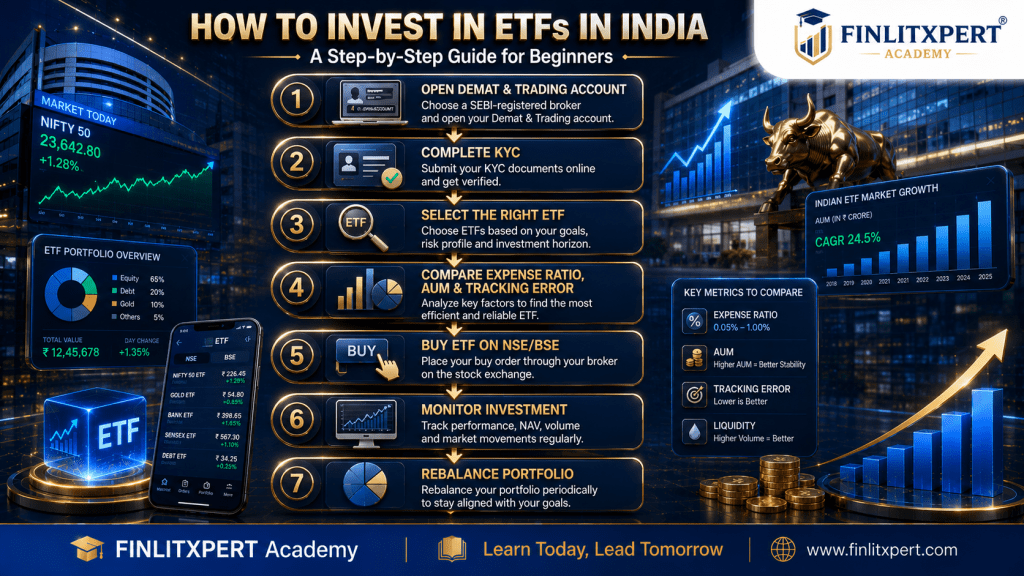
Investing in Exchange Traded Funds (ETFs) in India has become easier than ever. With a demat account, a trading account, and access to a registered stock broker, investors can buy and sell ETFs on the National Stock Exchange (NSE) or the Bombay Stock Exchange (BSE), just like shares of listed companies.
ETFs are suitable for investors seeking diversification, lower investment costs, and long-term wealth creation. However, before making your first investment, it is important to understand the process, evaluate different ETFs carefully, and ensure that your investment aligns with your financial goals and risk tolerance.
The following step-by-step guide will help beginners understand how to start investing in ETFs in India with confidence.
Open a Demat and Trading Account
To invest in ETFs, you need both a demat account and a trading account with a SEBI-registered stock broker.
The demat account securely holds your ETF units in electronic form, while the trading account enables you to place buy and sell orders on the stock exchange.
When selecting a broker, compare factors such as brokerage charges, annual maintenance fees, trading platform quality, research tools, customer support, and overall user experience before opening your account.
Complete KYC Verification
Before you can begin investing, you must complete the Know Your Customer (KYC) process.
Typically, this involves submitting documents such as your PAN card, Aadhaar card, address proof, bank account details, and a recent photograph. Many brokers now offer fully digital account opening, allowing investors to complete KYC online.
Once your account is verified and activated, you can begin investing in ETFs.https://www.finlitxpert.com/finlitxpert-traderx-live-2026/
Choose the Right ETF
Not all ETFs are the same. Before investing, evaluate whether the ETF matches your investment objective.
For example:
- Broad Market ETFs – Suitable for long-term wealth creation.
- Gold ETFs – Useful for portfolio diversification.
- Bond ETFs – Appropriate for relatively conservative investors seeking fixed-income exposure.
- International ETFs – Provide access to overseas markets.
- Sector or Thematic ETFs – Suitable for investors with higher risk tolerance and specific market views.
Always understand what the ETF invests in before making an investment decision.
Check Important ETF Parameters
Before purchasing an ETF, review the following factors:
- Expense Ratio – Lower costs generally improve long-term investment efficiency.
- Assets Under Management (AUM) – A larger AUM may indicate greater investor participation, though it should not be the sole deciding factor.
- Liquidity – Higher trading volume can make it easier to buy and sell ETF units.
- Tracking Error – A lower tracking error generally indicates that the ETF is following its benchmark more closely.
- Fund House Reputation – Consider the experience and credibility of the Asset Management Company managing the ETF.
Place Your Buy Order
After selecting an ETF, log in to your broker’s trading platform and search for the ETF by its trading symbol.
Enter the number of ETF units you wish to purchase and choose the order type:
- Market Order – Executes the trade at the best available market price.
- Limit Order – Executes only at the price specified by you or a better available price, if the market reaches that level.
Review the order details carefully before confirming the transaction.https://www.finlitxpert.com/
Monitor Your Investment
After purchasing ETF units, monitor your investment periodically rather than reacting to every short-term market movement.
Review whether the ETF continues to align with your financial goals, investment horizon, and desired asset allocation.
For long-term investors, regular portfolio reviews and disciplined investing are generally more effective than frequent trading.
Rebalance Your Portfolio
As markets change over time, the allocation of your investments may shift away from your original plan.
Periodic portfolio rebalancing helps restore your desired mix of equities, bonds, gold, and other asset classes.
Rebalancing can help manage portfolio risk and keep your investments aligned with your long-term financial objectives.
Before You Invest: ETF Checklist
✓ Do I understand what this ETF invests in?
✓ Does this ETF match my financial goals?
✓ Is the expense ratio reasonable?
✓ Is the ETF sufficiently liquid?
✓ Is the tracking error acceptable?
✓ Am I investing with a long-term perspective?
✓ Does this investment fit my overall portfolio diversification strategy?
Common Mistakes to Avoid
Many beginners make avoidable mistakes when investing in ETFs.
Common mistakes include:
- Investing without understanding the ETF’s underlying assets.
- Choosing an ETF based only on recent performance.
- Ignoring expense ratios and tracking error.
- Concentrating too much money in a single sector or thematic ETF.
- Frequently buying and selling based on short-term market movements.
- Investing without clear financial goals.
Avoiding these mistakes can help investors build a disciplined and well-diversified investment portfolio.https://www.finlitxpert.com/finlitxpert-course-registration/
Step-by-Step Investment Flow
Open Demat & Trading Account
↓
Complete KYC
↓
Choose the Right ETF
↓
Compare Expense Ratio, AUM & Tracking Error
↓
Place Buy Order
↓
Monitor Portfolio
↓
Rebalance Periodically
↓
Stay Invested for the Long Term
Key Takeaways
- Investing in ETFs in India requires a demat account and a trading account.
- Compare ETFs based on investment objective, expense ratio, liquidity, AUM, and tracking error.
- Invest according to your financial goals and risk tolerance.
- Monitor your portfolio periodically instead of reacting to short-term market movements.
- Long-term discipline and diversification remain key principles for successful ETF investing.
Best ETFs for Beginners
For beginners, choosing the right Exchange Traded Fund (ETF) can make investing simpler and more disciplined. Since ETFs invest in a diversified basket of securities, they help reduce company-specific risk while providing exposure to different segments of the financial markets.
Rather than trying to identify the “best-performing” ETF based on recent returns, beginners should focus on selecting ETFs that align with their financial goals, investment horizon, and risk tolerance. A well-chosen ETF can serve as the foundation of a long-term investment portfolio.
The following factors can help beginners evaluate ETFs before making an investment decision.
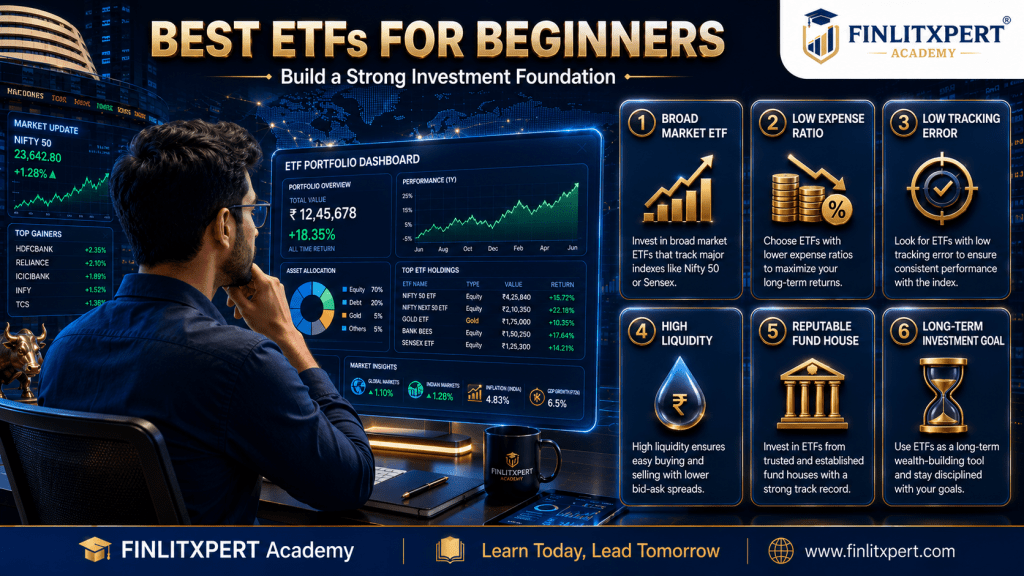
Choose Broad Market Index ETFs
For most beginners, broad market Index ETFs are often a practical starting point. These ETFs track widely followed market indices such as the Nifty 50, Sensex, or Nifty Next 50 and provide exposure to many companies through a single investment.
Broad market ETFs generally offer better diversification than investing in individual stocks and can help investors participate in the long-term growth of the overall market.
If you are new to investing, starting with a diversified Index ETF may be simpler than selecting individual companies.https://www.finlitxpert.com/finlitxpert-traderx-live-2026/
Look for a Low Expense Ratio
The expense ratio represents the annual cost of managing an ETF.
Although the percentage may appear small, lower expenses can have a meaningful impact on long-term investment returns because a greater portion of your money remains invested.
When comparing similar ETFs that track the same benchmark, the expense ratio is one of the factors worth reviewing alongside other characteristics such as liquidity and tracking error.
Check Tracking Error
Tracking error measures how closely an ETF follows the performance of its benchmark index.
An ETF with a lower tracking error generally reflects the benchmark more accurately, making it a preferable choice when comparing funds with similar investment objectives.
Reviewing historical tracking error can help investors understand how efficiently an ETF has tracked its underlying index over time.
Consider Liquidity
Liquidity refers to how easily ETF units can be bought or sold on the stock exchange.
ETFs with higher trading volumes often have narrower bid-ask spreads, making transactions more efficient.
Before investing, consider whether the ETF has sufficient trading activity to support convenient buying and selling.
Select a Reputable Fund House
The Asset Management Company (AMC) plays an important role in managing an ETF.
While beginners should not choose an ETF based solely on the fund house, it can be helpful to consider the AMC’s experience, operational processes, and ability to manage index-tracking products effectively.
Always review the ETF’s investment objective and official documents before investing.https://www.finlitxpert.com/finlitxpert-course-registration/
Match the ETF to Your Financial Goals
Different ETFs serve different investment purposes.
For example:
- Broad Market ETFs – Long-term wealth creation.
- Gold ETFs – Portfolio diversification.
- Bond ETFs – Relatively stable fixed-income exposure.
- International ETFs – Global diversification.
- Sector or Thematic ETFs – Targeted exposure with potentially higher risk.
Choose ETFs that support your financial objectives rather than following market trends or short-term performance.
Popular ETF Categories for Beginners
Instead of focusing on a specific product, beginners can explore the following ETF categories based on their investment objectives:
- Nifty 50 Index ETFs
- Sensex Index ETFs
- Nifty Next 50 ETFs
- Gold ETFs
- Government Bond ETFs
- Broad International Index ETFs
These categories offer diversified exposure and are commonly considered by investors building long-term portfolios. Investors should compare individual ETFs within each category before investing.
Illustrative Beginner Portfolio Example
The following is an illustrative example for educational purposes only and should not be considered personalized investment advice.
Example Portfolio:
- 60% Broad Market Index ETF
- 20% Gold ETF
- 20% Bond ETF
This allocation demonstrates one possible approach to diversification. The appropriate asset allocation varies based on an individual’s financial goals, investment horizon, and risk tolerance.
Common Mistakes When Choosing an ETF
Avoid these common mistakes:
- Selecting an ETF solely because it performed well recently.
- Ignoring expense ratios and tracking error.
- Investing without understanding the underlying assets.
- Concentrating your portfolio in a single sector ETF.
- Frequently buying and selling based on short-term market movements.
- Choosing investments without clear financial goals or a defined investment plan.
A disciplined, long-term approach is generally more effective than chasing short-term market trends.
Checklist Before Buying an ETF
✓ Does the ETF match my investment objective?
✓ What index or assets does it track?
✓ Is the expense ratio competitive?
✓ Is the tracking error relatively low?
✓ Does it have sufficient trading liquidity?
✓ Am I investing for the long term?
✓ Does this ETF improve my portfolio diversification?
Comparison Table
| Selection Factor | Why It Matters |
|---|---|
| Broad Diversification | Helps reduce company-specific risk |
| Expense Ratio | Lower costs may improve long-term returns |
| Tracking Error | Indicates how closely the ETF follows its benchmark |
| Liquidity | Supports efficient buying and selling |
| Fund House | Reflects the ETF’s operational management |
| Investment Objective | Helps align investments with financial goals |
| Asset Allocation | Supports portfolio diversification |
Key Takeaways
- Beginners should focus on diversified, low-cost ETFs rather than chasing recent performance.
- Compare ETFs based on expense ratio, tracking error, liquidity, and investment objective.
- Broad market Index ETFs are often used as core portfolio investments.
- Gold and Bond ETFs can help diversify a long-term investment portfolio.
- Invest according to your financial goals, investment horizon, and risk tolerance rather than short-term market sentiment.
Who Should Invest in ETFs?
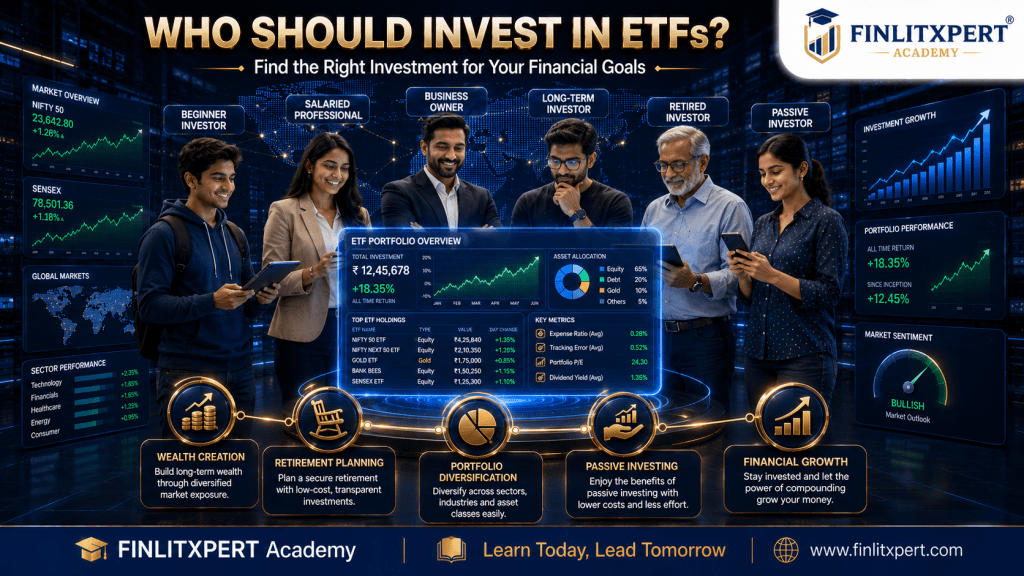
Exchange Traded Funds (ETFs) are designed to suit a wide range of investors because they offer diversification, relatively low costs, transparency, and flexibility. However, no investment product is suitable for everyone. Before investing in ETFs, it is important to evaluate your financial goals, investment horizon, risk tolerance, and overall portfolio strategy.
For many investors, ETFs can serve as the foundation of a long-term investment portfolio. Whether you are just starting your investment journey or looking to diversify an existing portfolio, ETFs may provide an efficient way to access different asset classes through a single investment.https://www.finlitxpert.com/
Let’s look at the types of investors who may find ETFs suitable.
Beginner Investors
ETFs are often considered a practical starting point for beginners because they provide instant diversification through a single investment.
Instead of researching and selecting multiple individual stocks, beginners can gain exposure to an entire market index or asset class with one ETF. This simplifies investing while helping reduce company-specific risk.
Broad-market Index ETFs are commonly used by new investors who want to build long-term wealth through disciplined investing.
Long-Term Investors
Investors with long-term financial goals, such as retirement planning, children’s education, or wealth creation, may find ETFs particularly useful.
A long investment horizon allows investors to benefit from market growth over time while reducing the impact of short-term market volatility.
Regular investing combined with patience and diversification can contribute to achieving long-term financial objectives.
Salaried Professionals
Salaried professionals often seek investment options that are simple to manage alongside their careers.
ETFs can provide diversified market exposure without requiring continuous monitoring or frequent investment decisions. Investors can gradually build their portfolios by investing regularly according to their financial plans.
For professionals with limited time, ETFs can offer an efficient and straightforward investment approach.
Business Owners and Self-Employed Individuals
Business owners and self-employed individuals may use ETFs to diversify their personal investments beyond their businesses.
Since a significant portion of their financial exposure may already be tied to business performance, investing in diversified ETFs can help spread investment risk across broader financial markets.
A diversified portfolio can complement other long-term financial planning strategies.https://www.finlitxpert.com/
Passive Investors
Investors who believe in passive investing often prefer ETFs because many ETFs are designed to track benchmark indices rather than actively select securities.
Passive investing focuses on participating in overall market growth instead of attempting to predict short-term market movements or outperform the market.
This strategy may help investors maintain discipline and avoid emotional investment decisions.
Investors Seeking Portfolio Diversification
ETFs can help investors diversify across different asset classes, sectors, industries, and geographical regions.
For example, an investor may combine:
- Broad Market Equity ETFs
- Gold ETFs
- Bond ETFs
- International ETFs
This diversified approach can help reduce concentration risk and create a more balanced investment portfolio.
Retirement Investors
Many investors include ETFs in retirement portfolios because they offer broad diversification and relatively low investment costs.
Depending on an individual’s financial objectives, retirement portfolios may include a combination of equity ETFs for growth and bond ETFs for relatively stable income.
Asset allocation should always reflect the investor’s risk tolerance, time horizon, and retirement goals.
Investors Who Should Be Cautious
Although ETFs are suitable for many investors, they may not be appropriate in every situation.
Investors should exercise additional caution if they:
- Need access to their invested money in the very short term.
- Are uncomfortable with market fluctuations.
- Do not understand the ETF’s underlying assets or investment strategy.
- Invest solely based on recent performance or social media trends.
Before investing, ensure that the ETF aligns with your financial objectives and level of investment knowledge.
Is an ETF Right for You?
Consider the following questions before investing:
✓ Am I investing for the long term?
✓ Do I want a diversified investment?
✓ Am I comfortable with market-linked investments?
✓ Do I understand the ETF’s investment objective?
✓ Does this ETF fit my financial goals and risk tolerance?
✓ Am I willing to stay invested during periods of market volatility?
If your answers are mostly “Yes,” an ETF may be worth considering as part of a diversified investment portfolio. However, investment decisions should always be based on your personal financial circumstances and objectives.
Investor Suitability Table
| Investor Type | ETF Suitability |
|---|---|
| Beginners | ★★★★★ Excellent |
| Long-Term Investors | ★★★★★ Excellent |
| Salaried Professionals | ★★★★★ Excellent |
| Business Owners | ★★★★☆ Very Good |
| Passive Investors | ★★★★★ Excellent |
| Retirement Investors | ★★★★☆ Very Good |
| Conservative Investors | ★★★★☆ Depends on ETF Type |
| Short-Term Traders | ★★★☆☆ Depends on Strategy |
Key Takeaways
- ETFs can be suitable for beginners, long-term investors, salaried professionals, business owners, and passive investors.
- Broad-market ETFs are commonly used as core portfolio investments due to their diversification and relatively low costs.
- The suitability of an ETF depends on your financial goals, investment horizon, and risk tolerance.
- Before investing, understand the ETF’s strategy, underlying assets, and potential risks.
- A diversified portfolio and disciplined long-term approach remain important principles for successful investing.
Common Mistakes Beginners Make When Investing in ETFs
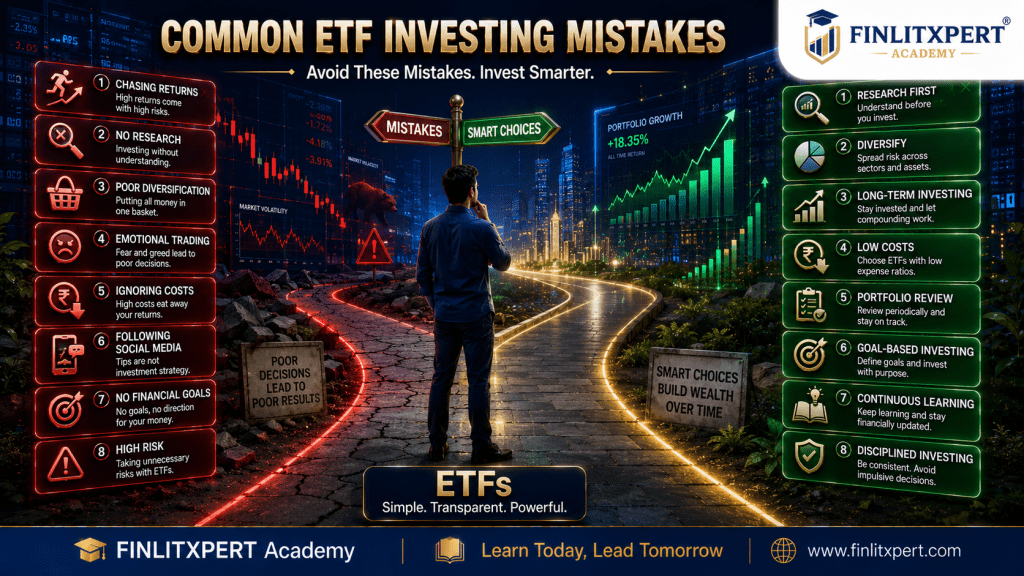
Exchange Traded Funds (ETFs) are often considered beginner-friendly investment products, but that does not mean investors cannot make costly mistakes. Many new investors focus only on recent performance or popular recommendations without understanding how an ETF works or whether it matches their financial goals.
Successful investing is not about finding the “perfect” ETF—it is about following a disciplined investment process, staying diversified, and avoiding common mistakes that can negatively impact long-term returns.
By understanding these mistakes in advance, beginners can make better investment decisions and build a stronger foundation for long-term wealth creation.
Investing Without Understanding the ETF
One of the biggest mistakes beginners make is investing in an ETF without understanding what it actually owns.
Some ETFs track broad market indices, while others invest in specific sectors, commodities, international markets, or thematic industries. Buying an ETF simply because it is popular can expose you to risks you did not intend to take.
Before investing, always review the ETF’s investment objective, benchmark, underlying assets, and risk profile.
Chasing Past Performance
Many investors buy an ETF after seeing strong recent returns, assuming that the same performance will continue.
However, past performance does not guarantee future results. Market conditions change, and investments that performed well in one period may underperform in another.
Instead of focusing only on historical returns, evaluate whether the ETF fits your long-term investment strategy.https://www.finlitxpert.com/finlitxpert-course-registration/
Ignoring Expense Ratio
Even small differences in expense ratios can affect long-term returns.
Although ETFs generally have lower costs than many actively managed funds, comparing expense ratios remains important when evaluating similar ETFs.
Lower investment costs allow more of your money to stay invested over time.
Ignoring Tracking Error
A good ETF should closely follow its benchmark index.
Some investors compare only returns and overlook tracking error, which measures how accurately an ETF replicates its benchmark.
Reviewing tracking error alongside the expense ratio provides a more complete picture of an ETF’s efficiency.
Poor Diversification
Although ETFs provide diversification, beginners sometimes invest only in a single sector ETF or thematic ETF.
For example, investing your entire portfolio in a technology ETF or banking ETF increases concentration risk.
A diversified portfolio may include different asset classes and ETF categories rather than relying on a single investment theme.https://www.finlitxpert.com/finlitxpert-traderx-live-2026/
Frequent Buying and Selling
Some beginners treat ETFs like short-term trading instruments and react to every market movement.
Frequent trading can increase transaction costs and may lead to emotional decision-making.
Investors with long-term financial goals often benefit from staying invested and reviewing their portfolios periodically instead of reacting to daily price fluctuations.
Investing Without Financial Goals
Investing without a clear objective often leads to inconsistent decisions.
Before purchasing an ETF, identify why you are investing.
Common financial goals include:
- Long-term wealth creation
- Retirement planning
- Children’s education
- Portfolio diversification
Having a defined objective makes it easier to select investments that align with your overall financial plan.
Ignoring Risk Tolerance
Not every ETF carries the same level of risk.
Broad-market Index ETFs, Gold ETFs, Bond ETFs, and Sector ETFs all have different risk characteristics.
Choose ETFs that match your ability to tolerate market fluctuations and your investment time horizon.
Not Reviewing the Portfolio
Investing is not a one-time activity.
Even long-term investors should periodically review their portfolios to ensure that their investments remain aligned with their financial goals and desired asset allocation.
Periodic reviews can also help identify whether portfolio rebalancing is needed.
Following Social Media Without Research
Social media can introduce investors to new ideas, but it should not replace independent research.
Avoid making investment decisions based solely on viral posts, influencer opinions, or online trends.
Always verify information using official fund documents, trusted financial education resources, and your own research before investing.
Beginner ETF Success Checklist
✓ Understand the ETF’s investment objective.
✓ Know which index or assets it tracks.
✓ Compare expense ratio and tracking error.
✓ Review trading liquidity.
✓ Diversify across suitable asset classes.
✓ Invest according to your financial goals.
✓ Invest with a long-term perspective.
✓ Review and rebalance your portfolio periodically.
✓ Avoid emotional investing.
✓ Continue learning about investing and financial markets.
Expert Best Practices
Successful ETF investors usually follow a disciplined investment process rather than trying to predict short-term market movements.
Some best practices include:
- Start with diversified Index ETFs.
- Invest regularly according to your financial plan.
- Maintain realistic return expectations.
- Keep investment costs low.
- Diversify across appropriate asset classes.
- Stay patient during market volatility.
- Continue improving your financial knowledge over time.
Summary Table
| Common Mistake | Better Approach |
|---|---|
| Buying without research | Understand the ETF before investing |
| Chasing recent returns | Focus on long-term goals |
| Ignoring costs | Compare expense ratios |
| Ignoring tracking error | Choose efficient ETFs |
| Poor diversification | Build a balanced portfolio |
| Frequent trading | Stay invested for the long term |
| No financial goals | Define clear investment objectives |
| Ignoring risk tolerance | Match investments to your profile |
| No portfolio review | Review and rebalance periodically |
| Following hype | Make informed, research-based decisions |
Key Takeaways
- Most ETF investing mistakes are avoidable through education and disciplined investing.
- Understanding an ETF before investing is just as important as choosing the ETF itself.
- Long-term investing, diversification, and regular portfolio reviews are key principles for successful ETF investing.
- Avoid emotional decisions, market hype, and short-term speculation.
- Consistency and patience are often more valuable than trying to time the market.
Frequently Asked Questions (FAQs)
What is an ETF?
An Exchange Traded Fund (ETF) is an investment fund that holds a diversified portfolio of assets such as stocks, bonds, gold, or other securities. ETF units are traded on stock exchanges like individual shares, allowing investors to buy and sell them during market hours.2. How is an ETF different from a Mutual Fund?
The primary difference is how they are traded. ETFs trade on stock exchanges throughout the day at market prices, while Mutual Funds are bought and redeemed at the Net Asset Value (NAV) calculated after the market closes. ETFs are generally passively managed with lower expense ratios, whereas many Mutual Funds are actively managed.3. Is ETF investing safe?
ETFs can help reduce company-specific risk through diversification, but they are still subject to market risk. The level of risk depends on the type of ETF you choose and the assets it holds. Investors should select ETFs that align with their financial goals and risk tolerance.4. Do I need a Demat Account to invest in ETFs?
Yes. In India, investors generally need both a demat account and a trading account with a SEBI-registered stock broker to buy and sell ETFs on the stock exchange.5. Can beginners invest in ETFs?
Yes. ETFs are often considered suitable for beginners because they provide diversification, relatively low costs, transparency, and ease of investing. Broad-market Index ETFs are commonly used as a starting point by new investors.6. Which ETF is best for beginners?
There is no single ETF that is best for everyone. Beginners should compare ETFs based on their investment objective, diversification, expense ratio, tracking error, liquidity, and overall suitability for their financial goals rather than selecting an ETF solely based on recent performance.7. Can I lose money in an ETF?
Yes. Since ETFs are market-linked investments, their value can rise or fall depending on the performance of their underlying assets. Diversification helps reduce certain risks, but it does not eliminate the possibility of investment losses.8. What is the minimum amount required to invest in an ETF?
The minimum investment depends on the market price of one ETF unit and any applicable brokerage charges. Investors can usually begin by purchasing a single ETF unit through their trading account.9. Are ETFs better than stocks?
Neither investment is universally better. ETFs provide diversification through a single investment, while individual stocks offer ownership in one company. The right choice depends on your investment goals, knowledge, and risk tolerance.10. Are ETFs better than Mutual Funds?
ETFs and Mutual Funds serve different purposes. ETFs generally offer lower costs and intraday trading flexibility, while Mutual Funds may provide active management and convenient SIP investing. The better option depends on your individual investment needs and preferences.11. Can I invest in Gold through ETFs?
Yes. Gold ETFs allow investors to gain exposure to gold without purchasing or storing physical gold. They are commonly used for portfolio diversification and as part of a long-term investment strategy.12. What is an Expense Ratio?
The expense ratio is the annual fee charged for managing an ETF. It is expressed as a percentage of the fund's assets. Lower expense ratios generally leave more of your investment working toward your long-term financial goals.13. What is Tracking Error?
Tracking error measures how closely an ETF follows the performance of its benchmark index. A lower tracking error generally indicates that the ETF is replicating its benchmark more accurately.14. Can I invest in International ETFs?
Yes. International ETFs provide exposure to overseas markets and global companies. However, investors should also understand the additional risks associated with international investing, including currency fluctuations and geopolitical factors.15. Are ETFs suitable for long-term investing?
Yes. Many investors use ETFs as part of a long-term investment strategy because they offer diversification, relatively low costs, and broad market exposure. The suitability of an ETF depends on the investor's financial goals, investment horizon, and risk tolerance.16. Do ETFs pay dividends?
Some ETFs distribute dividends received from the underlying securities, while others may reinvest those earnings, depending on the fund's structure and distribution policy. Investors should review the ETF's official documents to understand how income is handled.17. Can I sell an ETF anytime?
Yes. ETFs can generally be bought or sold during normal stock exchange trading hours, subject to market liquidity and trading conditions.18. Should I invest all my money in one ETF?
Investing all your money in a single ETF may increase concentration risk, especially if the ETF focuses on one sector or theme. A diversified portfolio that reflects your financial goals and risk tolerance is generally a more balanced approach.Conclusion
Exchange Traded Funds (ETFs) have transformed the way people invest by making diversified investing more accessible, transparent, and cost-effective. Whether you are a beginner starting your investment journey or an experienced investor seeking efficient portfolio diversification, ETFs can play an important role in a well-planned investment strategy.
However, successful investing is not about finding a “perfect” ETF or trying to predict short-term market movements. It begins with understanding your financial goals, assessing your risk tolerance, choosing investments that align with your objectives, and maintaining a disciplined long-term approach.
Before investing in any ETF, take the time to understand what it tracks, compare factors such as expense ratio, tracking error, liquidity, and portfolio composition, and review the official scheme documents. Avoid making decisions based solely on market trends, social media discussions, or recent performance.
Remember that every investment carries risk, and past performance does not guarantee future results. Building wealth is usually the result of consistent investing, diversification, patience, and continuous learning.
At FINLITXPERT Academy, our mission is to simplify financial education and empower investors with practical, unbiased, and easy-to-understand knowledge. By improving your financial literacy today, you can make more informed investment decisions for tomorrow.
🎓 Ready to Build Your Investment Knowledge?
Explore more beginner-friendly stock market and personal finance guides from FINLITXPERT Academy.
Whether you’re learning about the stock market, mutual funds, ETFs, SIPs, technical analysis, or fundamental analysis, our educational resources are designed to help you make informed financial decisions with confidence.
🚀Learn Today. Lead Tomorrow.