
How to Invest in Mutual Funds: Step-by-Step Guide for Beginners (2026)

Introduction: How to Start Investing in Mutual Funds
Investing is one of the most effective ways to work towards long-term financial goals, but choosing the right investment option can often feel confusing for beginners. Mutual funds offer a convenient way to invest in a diversified portfolio of assets such as stocks, bonds, or a combination of both, depending on the type of fund you choose.
If you are wondering how to invest in mutual funds, the process is easier to understand when broken down into simple steps. Before investing, it is important to define your financial goals, understand your risk tolerance, complete KYC requirements, choose a suitable mutual fund category, and decide whether you want to invest through a Systematic Investment Plan (SIP) or a lump-sum investment.
In this step-by-step guide, you will learn how mutual fund investing works in India, how to start your first investment, what factors to consider while selecting a mutual fund, and what common mistakes beginners should avoid. The goal is to help you make informed investment decisions rather than choosing a fund based only on past returns.Learning how to invest in mutual funds can help beginners build a disciplined and goal-oriented approach to long-term investing.https://www.finlitxpert.com/

What Is a Mutual Fund?
A mutual fund is an investment vehicle that pools money from many investors and invests it in a diversified portfolio of assets such as stocks, bonds, money market instruments, or a combination of different securities. The pooled money is professionally managed according to the investment objective of the mutual fund scheme.
When you invest in a mutual fund, you receive units of the scheme based on its applicable Net Asset Value (NAV). Instead of selecting and managing individual securities yourself, the fund’s investment portfolio is managed by professional fund managers within a defined investment strategy.
Different types of mutual funds are designed for different financial goals, investment horizons, and levels of risk. For example, equity funds primarily invest in shares, debt funds mainly invest in fixed-income securities, while hybrid funds combine equity and debt investments. Understanding how mutual funds work is an important first step before choosing a scheme that aligns with your financial goals and risk tolerance.AMFI – Association of Mutual Funds in India.

Why Should You Invest in Mutual Funds?
Mutual funds can be a useful investment option for investors who want to work towards their financial goals without having to select and manage individual securities on their own. One of their key advantages is professional fund management, where investment decisions are made according to the scheme’s stated investment objective and strategy.
Mutual funds also provide diversification by spreading investments across multiple securities or asset classes, depending on the type of scheme. Diversification can help reduce the impact of poor performance from a single investment, although it does not eliminate investment risk.
Another advantage is accessibility and flexibility. Investors can choose from different categories of mutual funds according to their financial goals, investment horizon, and risk tolerance. Many schemes also allow investors to invest systematically through a Systematic Investment Plan (SIP), making it possible to invest a fixed amount at regular intervals.
However, mutual funds are market-linked investments, and returns are not guaranteed. Before investing, it is important to understand the scheme’s objectives, risks, costs, and suitability rather than selecting a fund only because of its past performance.https://www.finlitxpert.com/finlitxpert-traderx-live-2026/

How to Invest in Mutual Funds: Step-by-Step Process
Step 1: Define Your Financial Goals
Before investing in mutual funds, the first step is to clearly define your financial goals. Your investment strategy should be based on what you want to achieve, how much money you may need, and how much time you have to reach that goal.
Financial goals can vary from person to person. Short-term goals may include building an emergency fund or saving for a planned purchase, while medium- and long-term goals may include buying a home, funding a child’s education, planning for retirement, or building long-term wealth.
Once you identify your goal and investment horizon, it becomes easier to evaluate which category of mutual fund may be suitable for you. Different mutual fund categories carry different levels of risk, so your investment choice should align with both your financial objective and the time available to achieve it.
Setting clear and realistic goals also helps you estimate how much you may need to invest regularly and allows you to track your progress over time. Instead of investing without a plan, goal-based investing gives your mutual fund journey a clear purpose and direction.https://www.finlitxpert.com/

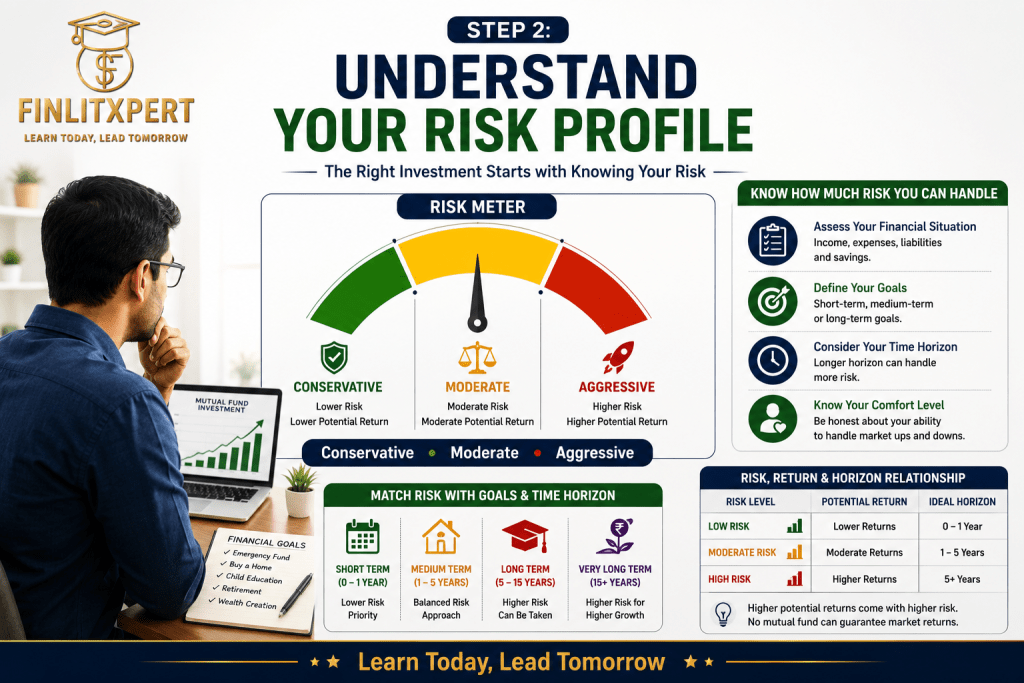
Step 2: Understand Your Risk Profile
Before choosing a mutual fund, it is important to understand your risk profile. Your risk profile reflects how much investment risk you are financially able and emotionally willing to take while working towards your financial goals.
Investors are generally described as conservative, moderate, or aggressive based on factors such as their financial situation, investment horizon, goals, and ability to handle fluctuations in investment value. A conservative investor may prefer relatively lower-risk investments, while an aggressive investor may be willing to accept greater market volatility in pursuit of potentially higher long-term returns.
Your investment horizon also plays an important role in assessing risk. Money required for a near-term goal generally should not be exposed to the same level of market risk as money invested for a long-term goal. It is therefore important to match the risk level of a mutual fund scheme with your goals, time horizon, and personal risk tolerance.
Remember that higher potential returns generally involve higher risk, and no mutual fund can guarantee market-linked returns. Understanding your risk profile before investing can help you choose more suitable investments and avoid making emotional decisions during periods of market volatility.
Step 3: Complete Your KYC
Before you can invest in mutual funds in India, you generally need to complete the Know Your Customer (KYC) process. KYC is an identity-verification requirement designed to verify an investor’s identity and help financial institutions comply with applicable regulatory requirements.
To complete KYC, investors typically need details and documents such as a PAN, proof of identity and address, a registered mobile number and email address, along with other information required during the verification process. Depending on the applicable process, identity verification may be completed digitally through an authorised platform or through an offline KYC process.
You should also have an active bank account linked to your investment because it is generally used for making investments and receiving redemption proceeds or other applicable payments. Additional verification requirements may apply depending on your investor status and the investment platform or intermediary you use.
Once your KYC status is valid for mutual fund investing under the applicable requirements, you can proceed with selecting a suitable mutual fund scheme and making an investment. Always complete KYC through an authorised mutual fund, intermediary, or recognised KYC channel, and never share sensitive banking credentials such as your OTP, PIN, or password with anyone.

Step 4: Choose the Right Type of Mutual Fund
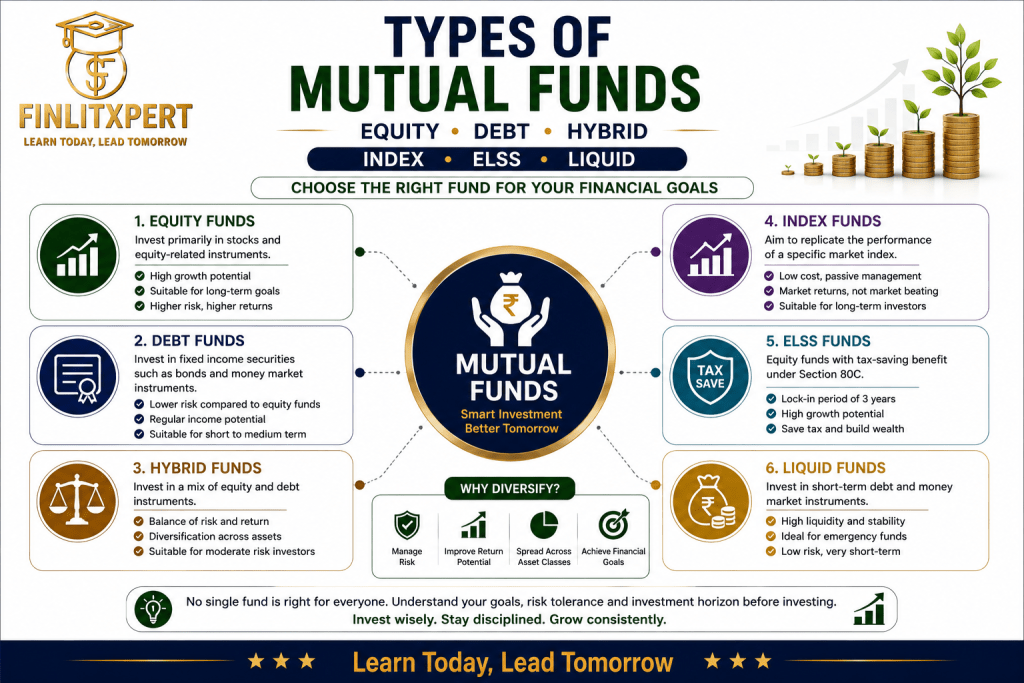
Once you have defined your financial goals, understood your risk profile, and completed the KYC process, the next step is to choose a suitable type of mutual fund. Mutual funds are available in different categories, and each category has its own investment objective, asset allocation, risk level, and suitability for different investment horizons.
Equity mutual funds primarily invest in stocks and generally carry higher market risk, making them more relevant to investors who can tolerate market fluctuations and have an appropriate investment horizon. Debt mutual funds mainly invest in fixed-income instruments and have different types of risks, including interest-rate and credit risk. Hybrid funds invest across more than one asset class, commonly combining equity and debt in varying proportions.
Other categories include index funds, which aim to track a specified market index; liquid funds, which invest in short-term money-market and debt instruments; and Equity Linked Savings Schemes (ELSS), which are equity-oriented tax-saving mutual funds subject to applicable tax rules and a statutory lock-in period.
There is no single mutual fund category that is suitable for every investor. Before selecting a scheme, consider your financial goal, investment horizon, risk tolerance, liquidity needs, and the scheme’s investment objective. Always read the Scheme Information Document and Riskometer carefully before investing.https://www.finlitxpert.com/finlitxpert-course-registration/

Step 5: Choose Between Direct and Regular Plans
After selecting a suitable mutual fund category, the next step is to decide whether you want to invest through a Direct Plan or a Regular Plan. Both plans invest in the same mutual fund scheme and follow the same investment objective, portfolio, and fund manager. However, the way you invest and the costs involved can differ.
A Direct Plan allows investors to invest directly with the Asset Management Company (AMC) without involving a distributor or intermediary. Since there is no distributor commission, Direct Plans generally have a lower expense ratio, which can result in slightly higher net returns over the long term if all other factors remain the same.
A Regular Plan is purchased through a mutual fund distributor, financial adviser, or investment platform that offers advisory or distribution services. The expense ratio of a Regular Plan generally includes distribution-related costs. Some investors may choose this option if they value professional guidance, investment support, or ongoing assistance.
There is no universally better option. The right choice depends on your knowledge, confidence, investment experience, and whether you require professional advice. Before investing, understand the features, costs, and services associated with each option and select the one that best suits your financial needs.https://www.finlitxpert.com/

Step 6: Choose Between Growth and IDCW Options
After selecting a Direct or Regular Plan, the next decision is choosing between the Growth Option and the IDCW (Income Distribution cum Capital Withdrawal) Option. These options determine how the returns generated by a mutual fund are treated during your investment period.
Under the Growth Option, any gains generated by the mutual fund remain invested in the scheme. This allows the investment to benefit from the power of compounding over time because returns continue to stay invested instead of being distributed. Many long-term investors choose this option when their primary objective is wealth creation.
Under the IDCW Option, the mutual fund may distribute money to investors from time to time, subject to the availability of distributable surplus and the fund’s IDCW policy. Such distributions are not guaranteed and should not be considered fixed or regular income.
The choice between Growth and IDCW depends on your financial objectives rather than which option is universally better. Investors seeking long-term capital appreciation may prefer the Growth Option, while some investors who require periodic distributions may evaluate the IDCW Option after understanding its features, taxation, and implications. Always read the Scheme Information Document before making your decision.https://www.finlitxpert.com/

Step 7: Decide Between SIP and Lump Sum
Once you have selected a mutual fund scheme, the next step is deciding how you want to invest—through a Systematic Investment Plan (SIP) or a Lump Sum investment. Both methods invest in the same mutual fund, but they differ in how and when your money is invested.
A Systematic Investment Plan (SIP) allows you to invest a fixed amount at regular intervals, such as monthly or quarterly. SIPs encourage disciplined investing and spread your investments over time, which can reduce the impact of investing all your money at a single market level. They are commonly chosen by investors who earn a regular income and want to build long-term wealth gradually.
A Lump Sum investment involves investing a larger amount of money in a single transaction. This approach may be considered by investors who already have a substantial amount available for investment and have evaluated whether it aligns with their financial goals, investment horizon, and risk tolerance.
Neither SIP nor Lump Sum is universally better. The right choice depends on factors such as your cash flow, financial goals, investment horizon, and personal circumstances. Some investors may even use a combination of both methods as part of their overall investment strategy. Before investing, ensure that your chosen approach aligns with your financial plan and risk profile.https://www.finlitxpert.com/finlitxpert-traderx-live-2026/

Step 8: Select a Suitable Mutual Fund Scheme
After deciding how you want to invest, the next step is selecting a suitable mutual fund scheme. Since multiple schemes may exist within the same category, choosing one should involve evaluating several factors rather than relying only on past returns.
Begin by reviewing the scheme’s investment objective to ensure it aligns with your financial goals. Also consider the scheme’s risk level, investment strategy, portfolio composition, benchmark, and expense ratio. Understanding these factors can help you determine whether the scheme is appropriate for your investment horizon and risk tolerance.
You may also review the fund’s long-term performance across different market cycles instead of focusing only on recent returns. While historical performance can provide useful context, it does not guarantee future results. The experience of the fund management team and consistency in following the stated investment objective may also be relevant when evaluating a scheme.
Before making your investment, carefully read the Scheme Information Document (SID), Key Information Memorandum (KIM), and Riskometer. Choosing a mutual fund based on your financial goals, risk profile, and investment horizon is generally a more informed approach than selecting a scheme solely because it has recently delivered high returns.https://www.finlitxpert.com/finlitxpert-course-registration/

Step 9: Make Your First Investment
After selecting a suitable mutual fund scheme, you are ready to make your first investment. Whether you choose a Systematic Investment Plan (SIP) or a Lump Sum investment, the process is generally straightforward once your KYC has been completed and your bank account is linked.
Begin by logging into your preferred investment platform or the authorised website or application of the mutual fund provider. Select your chosen scheme, decide whether you want to invest through a Direct Plan or Regular Plan, choose the Growth or IDCW option if applicable, and enter your investment amount. Carefully review all details before confirming the transaction.
If you are starting a SIP, you will usually need to register a bank mandate or provide payment authorisation for automatic periodic investments. For a Lump Sum investment, you can complete the payment through the available banking options provided by the investment platform.
After the transaction is successfully processed, you will receive a confirmation and the mutual fund units will generally be allotted according to the applicable Net Asset Value (NAV), subject to the scheme’s cut-off time and regulatory guidelines. Keep your investment confirmation and account statements for future reference and regularly monitor your portfolio as part of your long-term financial plan.https://www.finlitxpert.com/

Step 10: Track and Review Your Investment
Making your first investment is only the beginning of your mutual fund journey. To stay aligned with your financial goals, it is important to regularly track and review your portfolio. Monitoring your investments helps you understand whether your portfolio continues to match your risk profile, investment horizon, and long-term objectives.
Instead of checking your portfolio every day, consider reviewing it periodically, such as every six or twelve months, or whenever there is a significant change in your financial goals or personal circumstances. During each review, evaluate whether your asset allocation remains appropriate, whether your investments are performing in line with their objectives, and whether any portfolio rebalancing is necessary.
Avoid making investment decisions based solely on short-term market movements or temporary fluctuations. Mutual fund investments are generally intended to support long-term financial goals, and reacting emotionally to market volatility can affect investment discipline.
A disciplined investment approach, regular portfolio reviews, continued SIP investments where appropriate, and periodic goal assessment can help investors remain focused on their long-term financial plan. If you are uncertain about major investment decisions, consider seeking guidance from a qualified financial professional.https://www.finlitxpert.com/finlitxpert-traderx-live-2026/

Types of Mutual Funds You Should Know
Mutual funds are available in different categories, and each category is designed to meet specific investment objectives, risk levels, and time horizons. Understanding these categories is important because no single mutual fund is suitable for every investor.
Some mutual funds focus primarily on long-term capital appreciation through equity investments, while others aim to provide relatively stable returns by investing mainly in debt securities. Certain funds combine multiple asset classes, and others are designed to track market indices or help investors meet specific objectives such as tax saving or short-term cash management.
Before selecting a mutual fund, investors should evaluate their financial goals, investment horizon, liquidity needs, and risk tolerance rather than choosing a fund based only on recent performance. A better understanding of different mutual fund categories can help investors make more informed investment decisions that align with their long-term financial plans.https://www.finlitxpert.com/finlitxpert-course-registration/
Equity Mutual Funds
Equity Mutual Funds primarily invest in shares of listed companies with the objective of generating long-term capital appreciation. Since these funds are linked to the stock market, their value can fluctuate based on market conditions. As a result, they generally involve a higher level of market risk compared to many other categories of mutual funds.
These funds are often considered by investors who have a long-term investment horizon and are comfortable with short-term market volatility. Equity Mutual Funds are available in different categories, including Large Cap Funds, Mid Cap Funds, Small Cap Funds, Multi Cap Funds, Flexi Cap Funds, Sectoral Funds, and Thematic Funds. Each category follows a different investment strategy and risk profile.
Historically, equity investments have had the potential to generate attractive long-term returns, but past performance should never be considered a guarantee of future results. Investors should evaluate their financial goals, risk tolerance, investment horizon, and the scheme’s investment objective before selecting an equity mutual fund.
For investors aiming to build long-term wealth through market participation, Equity Mutual Funds may form an important part of a diversified investment portfolio when selected appropriately and reviewed periodically.

Debt Mutual Funds
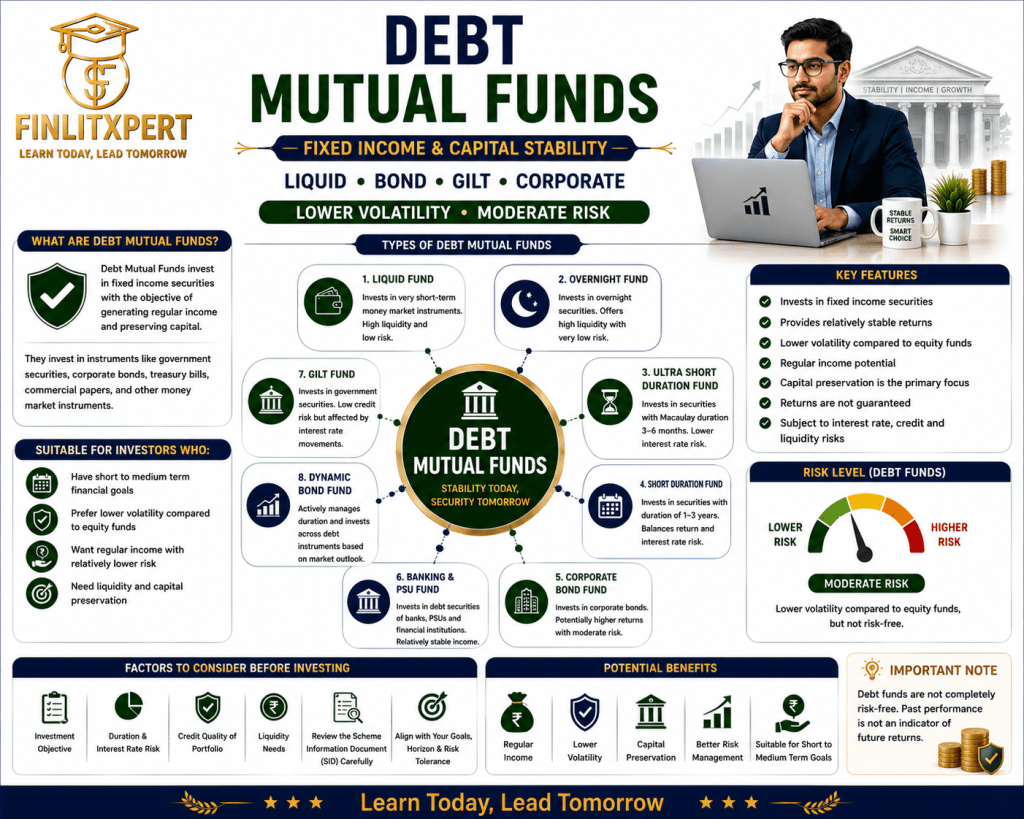
Debt Mutual Funds primarily invest in fixed-income securities such as government securities, treasury bills, corporate bonds, commercial papers, certificates of deposit, and other money market instruments. Their primary objective is generally to provide relatively stable returns while preserving capital, although returns and capital are not guaranteed.
Compared with Equity Mutual Funds, Debt Mutual Funds usually experience lower market volatility. However, they are still exposed to risks such as interest rate risk, credit risk, reinvestment risk, and liquidity risk. The level of these risks depends on the type of debt securities held by the scheme and prevailing market conditions.
Debt Mutual Funds are often considered by investors who have short- to medium-term financial goals or who prefer relatively lower market volatility. Different categories include Liquid Funds, Overnight Funds, Ultra Short Duration Funds, Short Duration Funds, Corporate Bond Funds, Banking & PSU Funds, Gilt Funds, and Dynamic Bond Funds, each designed for different investment objectives and time horizons.
Before investing in a Debt Mutual Fund, investors should carefully review the scheme’s investment objective, portfolio quality, average maturity, duration, risk profile, and the Scheme Information Document (SID). Choosing the appropriate debt fund should depend on your financial goals, investment horizon, liquidity requirements, and overall risk tolerance rather than expected returns alone.
Hybrid Mutual Funds
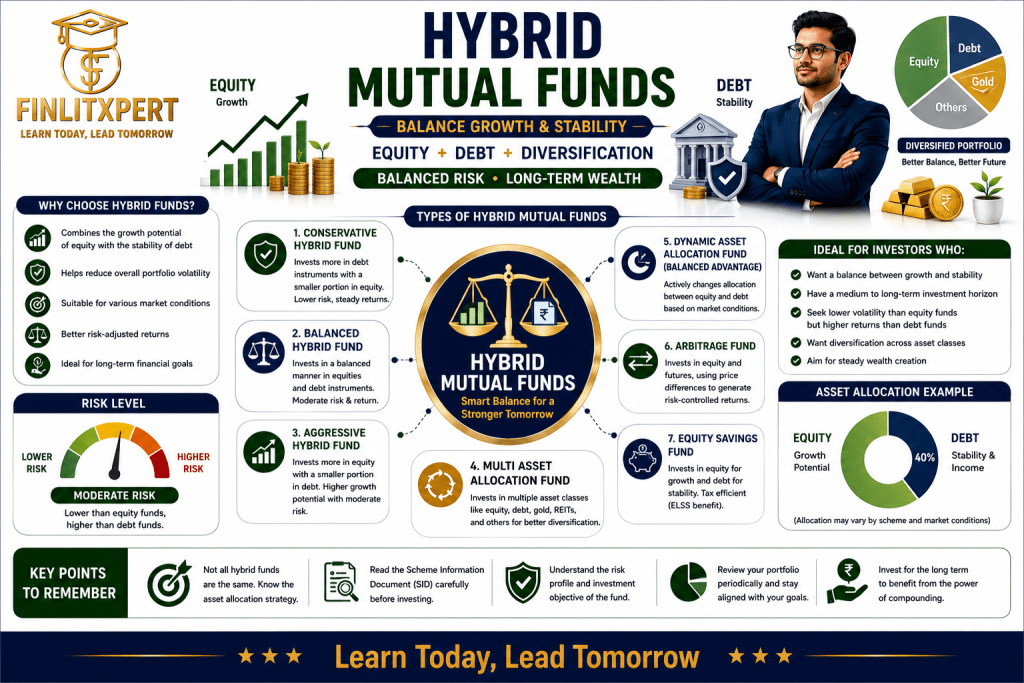
Hybrid Mutual Funds invest in a combination of two or more asset classes, most commonly equity and debt, with the objective of balancing growth potential and risk management. By diversifying investments across different asset classes, these funds aim to reduce the impact of market volatility while providing opportunities for long-term wealth creation.
Depending on their investment strategy, Hybrid Mutual Funds may allocate different proportions to equity, debt, and, in some cases, other asset classes such as gold or REITs. The asset allocation may remain fixed or may change over time based on the scheme’s investment mandate.
Hybrid Mutual Funds are available in several categories, including Conservative Hybrid Funds, Balanced Hybrid Funds, Aggressive Hybrid Funds, Multi Asset Allocation Funds, Dynamic Asset Allocation (Balanced Advantage) Funds, Arbitrage Funds, and Equity Savings Funds. Each category follows a distinct investment approach and is designed for different investor needs.
These funds may be suitable for investors seeking a balance between capital appreciation and relatively lower volatility than a pure equity portfolio. However, the level of risk and return varies depending on the allocation to different asset classes. Investors should always review the Scheme Information Document (SID), investment objective, asset allocation strategy, and Riskometer before investing.https://www.finlitxpert.com/
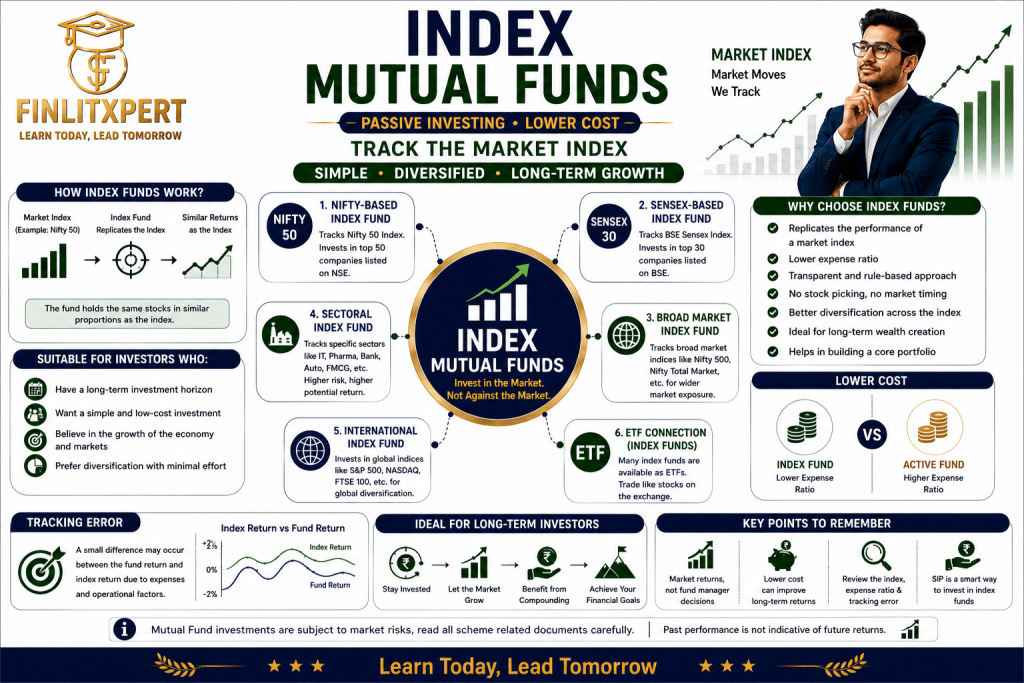
Index Mutual Funds
Index Mutual Funds are passive mutual funds that aim to replicate the performance of a specific market index rather than trying to outperform it. These funds invest in the same securities and generally in similar proportions as the underlying benchmark index, making them a simple and transparent investment option.
Since Index Mutual Funds follow a passive investment strategy, they generally have lower portfolio turnover and often lower expense ratios than actively managed mutual funds. However, their returns are intended to closely track the benchmark index and may differ slightly because of tracking error, fund expenses, and operational factors.
Index Mutual Funds are available for several market indices, such as large-cap, broad-market, sectoral, and thematic indices. Investors often consider these funds for long-term wealth creation, portfolio diversification, and disciplined investing without relying on active stock selection.
Although Index Mutual Funds seek to mirror the performance of a market index, they remain subject to market risk. If the benchmark index declines, the value of the investment may also decline. Investors should evaluate their financial goals, investment horizon, and risk tolerance before selecting an Index Mutual Fund and should carefully review the Scheme Information Document (SID) and Riskometer before investing.https://www.finlitxpert.com/finlitxpert-traderx-live-2026/
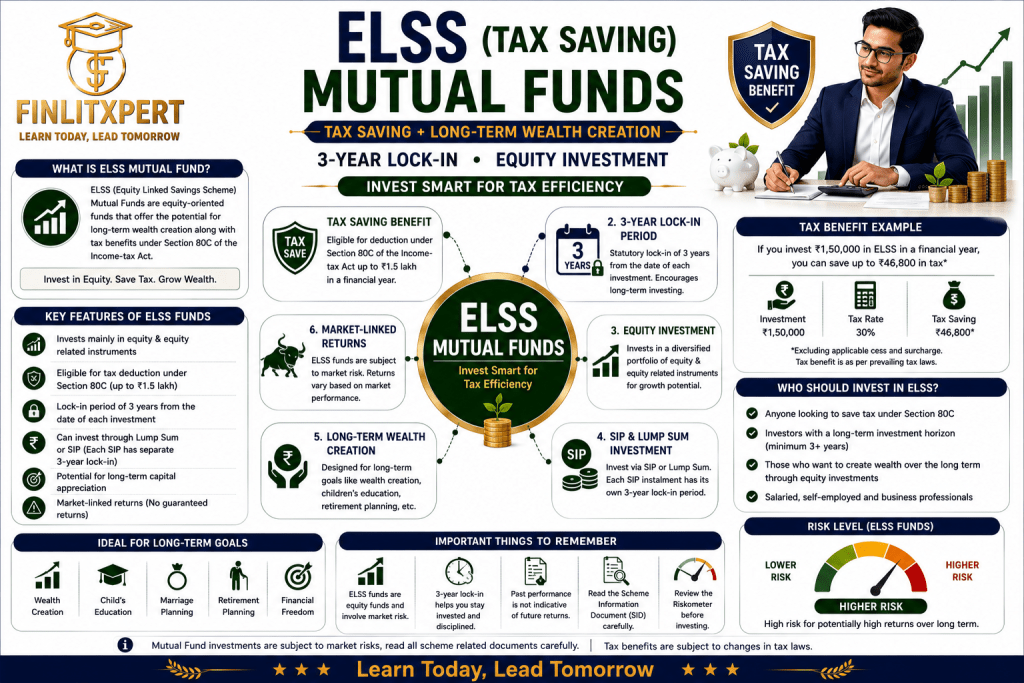
ELSS (Equity Linked Savings Scheme) Mutual Funds
Equity Linked Savings Schemes (ELSS) are equity-oriented mutual funds that combine long-term wealth creation potential with tax benefits under the applicable provisions of the Income-tax Act. These funds invest predominantly in equity and equity-related instruments and are designed for investors who wish to participate in the stock market while also considering eligible tax-saving opportunities.
One of the key features of ELSS Mutual Funds is the statutory lock-in period of three years from the date of each investment. During this period, investors generally cannot redeem their units. Although the lock-in encourages long-term investing, ELSS funds remain subject to market risk because their performance depends on the underlying equity investments.
ELSS investments can generally be made through either a Lump Sum investment or a Systematic Investment Plan (SIP). Each SIP instalment has its own separate three-year lock-in period. Investors should understand this feature before choosing their preferred investment method.
While ELSS funds may offer long-term growth potential and eligible tax benefits under applicable law, they do not guarantee returns or tax outcomes. Before investing, investors should review the Scheme Information Document (SID), Riskometer, applicable tax rules, investment objective, and their own financial goals, investment horizon, and risk tolerance.
Liquid Mutual Funds
Liquid Mutual Funds are a category of debt mutual funds that primarily invest in short-term money market instruments with very short maturities, generally up to 91 days, in accordance with applicable regulatory requirements. Their primary objective is to provide high liquidity while aiming to preserve capital and generate returns from short-term fixed-income investments.
These funds typically invest in instruments such as Treasury Bills (T-Bills), Commercial Papers (CPs), Certificates of Deposit (CDs), and other high-quality money market securities. Because of their short maturity profile, Liquid Mutual Funds generally experience lower interest-rate sensitivity than many other debt fund categories, although they are not completely risk-free.
Liquid Mutual Funds are often considered by investors who wish to park surplus funds for a short period while maintaining easy access to their money. They may also be used as part of an emergency fund strategy or for temporarily holding funds before deploying them into longer-term investments. However, investors should remember that returns are market-linked and are neither fixed nor guaranteed.
Before investing, investors should evaluate the scheme’s investment objective, portfolio quality, liquidity, expense ratio, and risk profile. Reading the Scheme Information Document (SID), Key Information Memorandum (KIM), and Riskometer can help investors understand whether a Liquid Mutual Fund is appropriate for their short-term financial needs.https://www.finlitxpert.com/finlitxpert-course-registration/

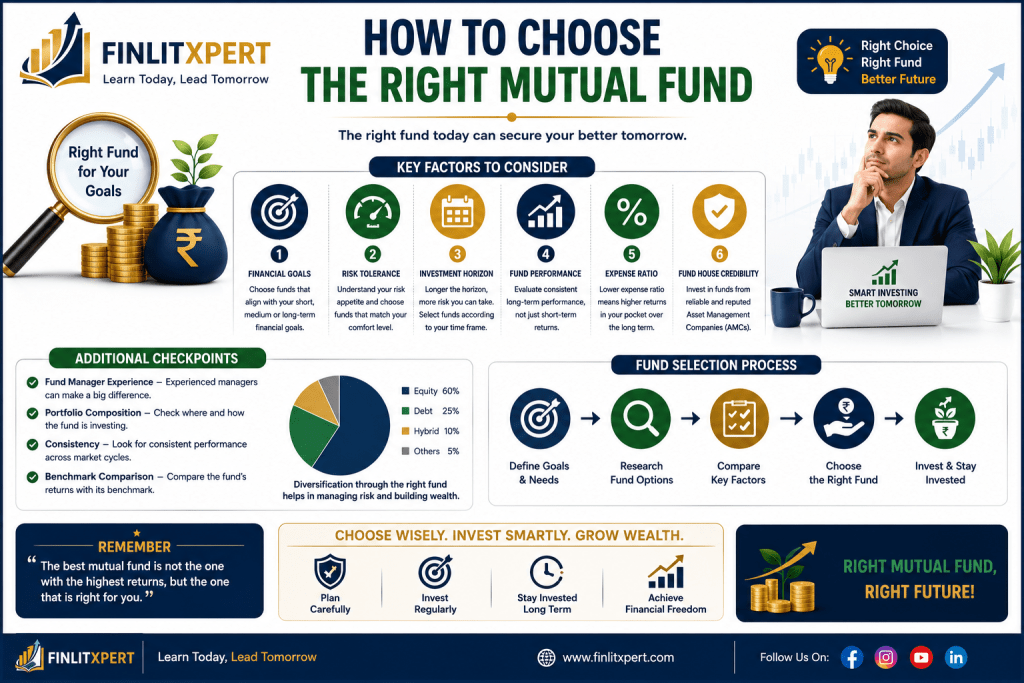
How to Choose the Right Mutual Fund
Choosing the right mutual fund is an important step toward achieving your financial goals. With thousands of mutual fund schemes available in India, investors should avoid selecting a fund simply because it has recently delivered the highest returns. The right mutual fund should match your financial objectives, risk tolerance, investment horizon, and overall investment strategy.
Start by clearly identifying your financial goal. Your choice of mutual fund may differ depending on whether you are investing for short-term needs, buying a home, funding your child’s education, planning for retirement, or creating long-term wealth. Once the goal and investment horizon are clear, assess how much investment risk you are comfortable taking. Equity-oriented funds generally involve higher market risk and may be more appropriate for suitable long-term goals, while debt-oriented or certain hybrid funds may serve different risk and investment requirements.
Investors should also evaluate important factors such as the scheme’s investment objective, asset allocation, Riskometer, expense ratio, benchmark, portfolio composition, fund manager’s track record, and consistency of performance across different market cycles. Past performance can provide useful historical information, but it should never be treated as a guarantee of future returns. Comparing a fund only on the basis of one-year or recent returns can therefore lead to poor investment decisions.
Another important decision is whether to choose a Direct Plan or a Regular Plan. Direct Plans generally have lower expense ratios because no distributor commission is involved, while Regular Plans are purchased through intermediaries and may include distribution costs. Investors should understand the differences, costs, and level of guidance they require before selecting the appropriate option.
Before investing, carefully read the Scheme Information Document (SID), Key Information Memorandum (KIM), Riskometer, and other official scheme disclosures. Instead of searching for a universally “best” mutual fund, focus on selecting a suitable fund that aligns with your individual goals, risk profile, time horizon, and financial plan. A well-researched fund selection combined with disciplined investing and periodic portfolio reviews can help you work toward your long-term financial objectives.If you are wondering how to invest in mutual funds, start by completing KYC, choosing a suitable fund and selecting an investment method that matches your financial goals.SEBI – Securities and Exchange Board of India
Direct Plan vs Regular Plan: What Is the Difference?
Direct Plan vs Regular Plan: What Is the Difference?
Direct and Regular Plans are two ways of investing in the same mutual fund scheme, but the main difference lies in how you invest and the expenses you pay. Both plans generally have the same investment objective, portfolio, fund manager, and underlying securities. However, their expense ratios and Net Asset Values (NAVs) differ because of distribution-related costs.
In a Direct Plan, investors invest directly with the mutual fund without going through a mutual fund distributor. Since distributor commissions are not included, Direct Plans generally have a lower expense ratio than Regular Plans of the same scheme. The lower ongoing cost can potentially result in a higher investment value over the long term, assuming all other factors remain the same. Direct Plans may be suitable for investors who can independently research, select, monitor, and manage their mutual fund investments.
In a Regular Plan, investors invest through a mutual fund distributor or intermediary. The expense ratio is generally higher because distribution commissions and related expenses are included in the scheme’s costs. In return, investors may receive assistance with understanding products, completing transactions, maintaining investment records, and other services provided by the distributor. However, the nature and extent of such services can vary.
For example, if the Direct and Regular Plans of the same mutual fund scheme hold an identical portfolio, their investment performance before expenses is essentially based on the same underlying assets. However, because the Regular Plan generally has a higher expense ratio, the difference in costs can affect the NAV and long-term returns available to investors.
Choosing between a Direct Plan and a Regular Plan depends on your investment knowledge, ability to evaluate mutual funds, need for assistance, and comfort with managing investments independently. Investors who are confident about selecting and monitoring funds themselves may consider Direct Plans, while those who prefer distributor assistance may consider Regular Plans.
Before investing, compare the expense ratio, investment objective, risk level, portfolio, and other scheme details rather than choosing a plan solely on the basis of past returns. Always read the Scheme Information Document (SID), Key Information Memorandum (KIM), and Riskometer before making an investment decision.https://www.finlitxpert.com/finlitxpert-traderx-live-2026/

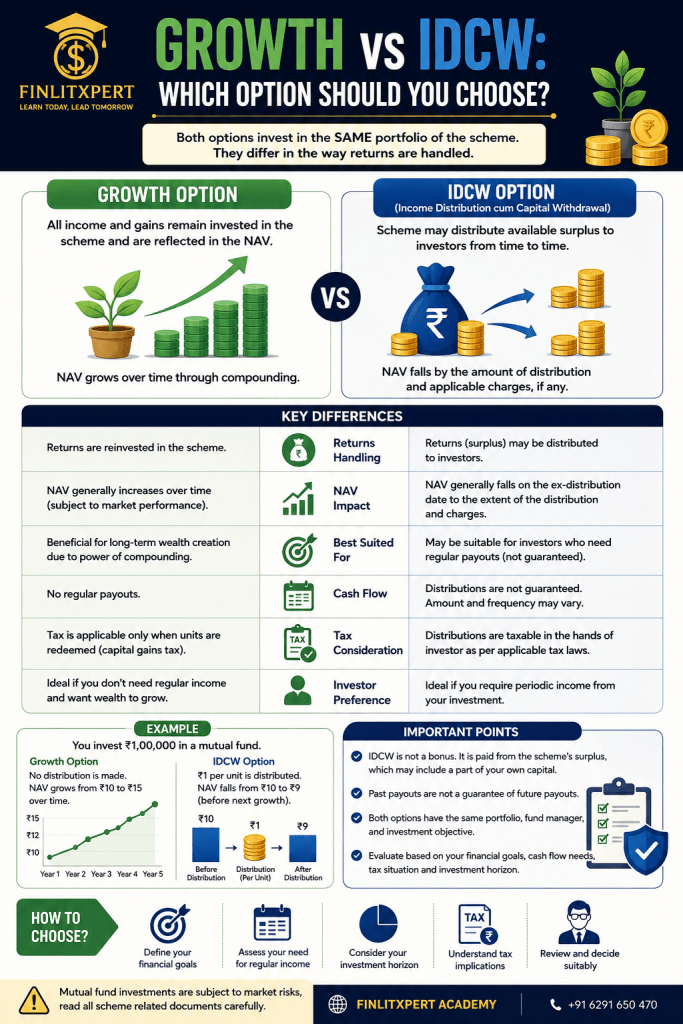
Growth vs IDCW: Which Option Should You Choose?
Growth vs IDCW: Which Option Should You Choose?
When investing in a mutual fund, investors may come across different options such as Growth and IDCW (Income Distribution cum Capital Withdrawal). Both options invest in the same underlying portfolio of the scheme, but they differ mainly in how the returns or distributable surplus are handled. Choosing between Growth and IDCW should depend on your financial goals, cash-flow requirements, investment horizon, and applicable tax considerations.
Under the Growth option, the scheme does not make periodic distributions to investors in the normal course. Instead, any income or gains generated by the portfolio remain invested in the scheme and are reflected in its Net Asset Value (NAV). This allows the invested value to potentially benefit from compounding over time. As a result, the Growth option is generally considered more suitable for investors whose objective is long-term wealth creation and who do not require periodic cash flow from their investment.
Under the IDCW option, the mutual fund may distribute a portion of the scheme’s distributable surplus to investors from time to time, subject to the availability of such surplus and the decision of the fund house. IDCW was previously commonly referred to as the “Dividend” option. However, IDCW should not be confused with guaranteed interest or additional returns. The amount and frequency of distributions are not guaranteed.
An important point to understand is that when IDCW is paid, the NAV of the scheme generally falls to the extent of the distribution and applicable statutory levies, if any. Therefore, an IDCW payout is not “free money” over and above your investment returns. Depending on the circumstances, the distribution may also include a portion of the investor’s capital, which is why the term Income Distribution cum Capital Withdrawal is used.
For example, an investor focused on building a retirement corpus or accumulating wealth over a long period may prefer the Growth option because the investment remains within the scheme and can potentially compound over time. On the other hand, an investor who specifically requires distributions from the investment may consider an IDCW option after understanding that payouts are neither fixed nor guaranteed.
Taxation is another important factor when comparing Growth and IDCW options. The tax treatment of capital gains and IDCW distributions may differ and can change based on prevailing tax laws, the type of mutual fund, and the investor’s individual tax situation. Investors should therefore check the latest applicable tax rules or consult a qualified tax professional before making a decision.
Ultimately, there is no single option that is best for every investor. If your primary objective is long-term capital appreciation and you do not need periodic distributions, the Growth option may be more aligned with your goal. If you have a specific need for potential distributions and understand their impact on NAV, taxation, and invested capital, you may evaluate the IDCW option.
Before investing, carefully review the Scheme Information Document (SID), Key Information Memorandum (KIM), tax implications, Riskometer, and your own financial requirements. The right choice between Growth and IDCW should always be based on your individual financial goals rather than simply choosing an option based on past payouts or returns.https://www.finlitxpert.com/finlitxpert-course-registration/
SIP vs Lump Sum: Which Investment Method Is Better?
SIP vs Lump Sum: Which Investment Method Is Better?
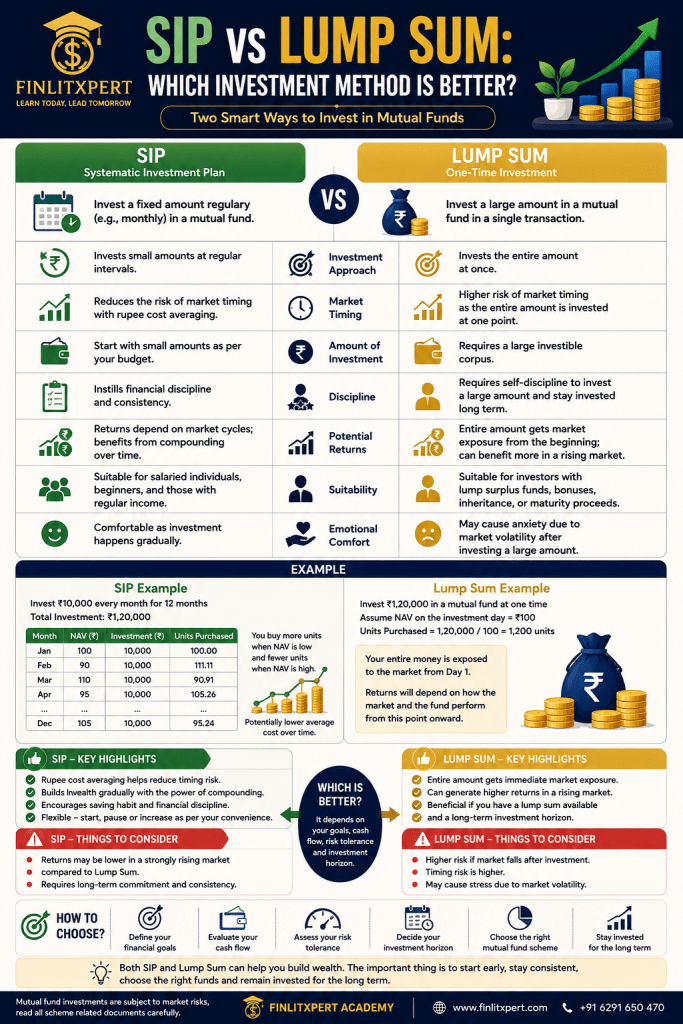
When investing in mutual funds, one of the most common decisions investors face is whether to invest through a Systematic Investment Plan (SIP) or make a Lump Sum investment. Both methods ultimately invest your money in a mutual fund scheme, but they differ in how and when the money is invested. The better option depends on your financial situation, availability of funds, investment goals, risk tolerance, cash flow, and investment horizon.
A Systematic Investment Plan (SIP) allows you to invest a fixed amount in a mutual fund at regular intervals, such as monthly, quarterly, or at another frequency offered by the scheme. Instead of investing a large amount at once, SIP helps spread investments over time. This approach can be particularly useful for salaried individuals or investors who receive a regular income and want to build wealth gradually through disciplined investing.
One of the important features associated with SIP investing is rupee cost averaging. Because a fixed amount is invested periodically, you generally purchase more mutual fund units when the NAV is lower and fewer units when the NAV is higher. This can reduce the need to predict the best time to enter the market. However, rupee cost averaging does not guarantee profits or protect investors from losses during declining markets.
SIPs can also encourage financial discipline and make investing accessible because investors can start with relatively small amounts, depending on the minimum investment requirement of the chosen scheme. Regular investing over a long period may also allow investors to benefit from the potential power of compounding, particularly when gains remain invested.
A Lump Sum investment, on the other hand, involves investing a larger amount of money in a mutual fund in a single transaction. This method may be suitable for investors who already have a significant amount available, such as from accumulated savings, a bonus, maturity proceeds, or another source, and want to invest it according to their financial plan.
One potential advantage of Lump Sum investing is that the entire amount gets market exposure from the beginning. If the market performs well after the investment is made, the full investment can participate in that growth. However, investing a large amount at one time can also expose the investor to greater timing risk, particularly if the investment is made just before a significant market decline.
For example, suppose Investor A invests ₹10,000 every month through SIP, while Investor B invests ₹1,20,000 as a Lump Sum at the beginning of the year. Investor A’s money enters the market gradually at different NAV levels, whereas Investor B’s entire amount is invested immediately. Their eventual outcomes will depend on market movements, the performance of the selected mutual fund scheme, investment duration, and other factors. Neither method can guarantee higher returns in every market condition.
So, which is better—SIP or Lump Sum? SIP may be more suitable for investors who have regular monthly income, want to invest gradually, prefer disciplined investing, or are uncomfortable investing a large amount at once. Lump Sum may be considered by investors who already have substantial investible funds, have an appropriate long-term horizon, understand the associated market risk, and are comfortable with immediate market exposure.
Investors who have a large amount available but do not want to invest it in an equity-oriented scheme all at once may also explore strategies such as a Systematic Transfer Plan (STP), where available under applicable scheme rules. This can allow money to be transferred gradually from one mutual fund scheme to another. However, investors should understand taxation, exit loads, risks, and other implications before using such a strategy.
Ultimately, there is no universally better choice between SIP and Lump Sum. The appropriate investment method depends on your financial goals, available capital, income pattern, risk tolerance, investment horizon, and market exposure preferences. More importantly, investors should focus on choosing a suitable mutual fund scheme, maintaining an appropriate asset allocation, investing consistently, and staying aligned with their long-term financial plan.
Before investing, carefully review the Scheme Information Document (SID), Key Information Memorandum (KIM), expense ratio, exit load, Riskometer, and other relevant scheme details. Mutual fund investments are subject to market risks, and neither SIP nor Lump Sum guarantees returns or protection from losses.https://www.finlitxpert.com/finlitxpert-course-registration/
How to Invest in Mutual Funds
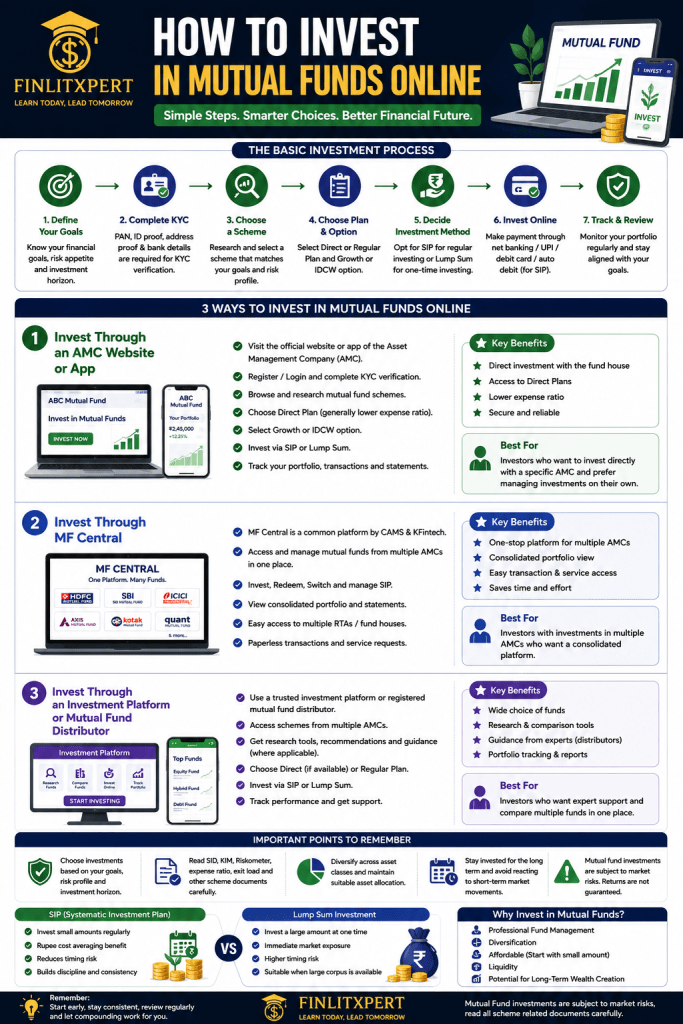
Investing in mutual funds online has made the investment process more convenient and accessible. Investors can research mutual fund schemes, complete the required KYC process, make investments, set up a Systematic Investment Plan (SIP), and track their portfolios digitally. Depending on their preference, investors may invest through the official website or app of an Asset Management Company (AMC), an authorized mutual fund platform, or other permitted intermediaries.
Before investing, the first step is to define your financial goals and understand your risk profile. Consider why you are investing—such as retirement planning, children’s education, buying a home, creating an emergency fund, or long-term wealth creation—and determine your expected investment horizon. This helps you identify a mutual fund category that is more closely aligned with your objectives and ability to tolerate investment risk.
Next, complete the applicable Know Your Customer (KYC) requirements. KYC is generally required before investing in mutual funds in India. Depending on the applicable process, investors may need to provide details and documents such as PAN, officially valid identity or address proof, bank account information, and other required verification. Investors should ensure that their KYC status and personal details meet the current regulatory requirements before proceeding.
Once the required verification is complete, choose a suitable mutual fund scheme. Do not select a fund solely because it has recently generated high returns. Compare factors such as the scheme’s investment objective, fund category, asset allocation, Riskometer, expense ratio, portfolio, benchmark, fund management approach, and performance consistency across different market conditions. Past performance does not guarantee future returns.
You will also need to choose between a Direct Plan and a Regular Plan. A Direct Plan is purchased without a mutual fund distributor and generally has a lower expense ratio, while a Regular Plan is purchased through a distributor or intermediary and includes distribution-related costs. Both options may belong to the same underlying scheme, but their expense ratios and NAVs differ. Choose based on your ability to manage investments independently and your need for distributor assistance.
After selecting the scheme and plan, choose the appropriate option, such as Growth or IDCW (Income Distribution cum Capital Withdrawal), where available. Investors focused on long-term accumulation may evaluate the Growth option, where gains remain invested and are reflected in the NAV. IDCW may make distributions subject to the availability of distributable surplus and applicable rules, but such distributions are not guaranteed.
The next step is to decide whether you want to invest through SIP or Lump Sum. With SIP, you invest a chosen amount at regular intervals, which can encourage disciplined investing and provide the benefit of rupee cost averaging. A Lump Sum investment involves investing a larger amount at one time and provides immediate market exposure. The appropriate method depends on your available funds, regular cash flow, risk tolerance, and investment strategy.
To complete the online investment, enter the required investment details, verify your registered bank account and complete the payment using an available authorized payment method. For SIP investments, you may also need to register an electronic mandate or another approved recurring payment instruction so that future installments can be processed according to the selected SIP schedule.
After the transaction is successfully processed and units are allotted according to applicable rules, keep the transaction confirmation and account statement for your records. You can generally monitor your investments through the relevant AMC or investment platform and review details such as invested amount, current value, NAV, transactions, and portfolio allocation.
Online investing makes mutual funds easier to access, but convenience should not replace proper research. Avoid making frequent investment decisions based only on short-term market movements. Review your portfolio periodically to ensure that your investments remain aligned with your financial goals, risk profile, asset allocation, and investment horizon.
Before investing online, use official or authorized investment channels, verify important scheme information, and carefully read the Scheme Information Document (SID), Key Information Memorandum (KIM), Riskometer, expense ratio, exit load, and other relevant disclosures. Never share sensitive information such as passwords, OTPs, or banking credentials with unauthorized persons.
Mutual fund investments are subject to market risks, and returns are not guaranteed. A disciplined, goal-based approach combined with appropriate fund selection and periodic review can help investors use online mutual fund investing effectively as part of a long-term financial plan.https://www.finlitxpert.com/
Invest Through an AMC Website or App
One of the most direct ways to invest in mutual funds online is through the official website or mobile application of an Asset Management Company (AMC). An AMC manages mutual fund schemes and provides investors with a digital platform where they can complete eligible transactions such as purchasing units, starting or managing a Systematic Investment Plan (SIP), making additional investments, switching or redeeming units, and tracking their investments, subject to the features and rules of the respective fund house.
To begin, visit the official website or download the official app of the AMC whose mutual fund scheme you want to invest in. Always verify that you are using the genuine website or application to reduce the risk of fraud or phishing. New investors generally need to register using the required personal details and complete or validate the applicable KYC requirements before making an investment.
After registration and verification, you can browse the mutual fund schemes offered by that particular AMC. Before selecting a scheme, evaluate its investment objective, fund category, asset allocation, Riskometer, expense ratio, benchmark, portfolio, exit load, investment horizon, and other relevant details. A fund should be selected according to your financial goals and risk profile rather than solely on the basis of recent returns.
When investing through an AMC directly, you can generally choose the Direct Plan of an eligible scheme, where available. Direct Plans do not involve distributor commissions and therefore generally have a lower expense ratio than Regular Plans of the same scheme. However, investors choosing a Direct Plan are responsible for researching, selecting, monitoring, and managing their investments independently.
You will then need to choose the appropriate investment option, such as Growth or IDCW, where available, and decide whether to invest through SIP or Lump Sum. For a SIP, select the investment amount, frequency, and applicable installment date, and complete the required mandate or recurring payment authorization. For a Lump Sum investment, enter the amount you want to invest and complete the transaction using one of the payment methods supported by the AMC.
Once the transaction is successfully processed, mutual fund units are allotted according to applicable NAV and realization-of-funds rules. You can generally view your transaction history, account statement, current portfolio value, SIP details, and other investment information through the AMC’s online account or app.
A key limitation of investing through an individual AMC website or app is that it primarily provides access to schemes managed by that particular fund house. If you invest across multiple AMCs, you may need to use different platforms or consolidated account services to view and manage your complete mutual fund portfolio.
Investing through an AMC’s official digital platform can be a convenient option for investors who prefer dealing directly with the fund house and are comfortable making their own investment decisions. Before investing, carefully read the Scheme Information Document (SID), Key Information Memorandum (KIM), Riskometer, expense ratio, exit load, and other relevant scheme documents.
Mutual fund investments are subject to market risks, and returns are not guaranteed. Investors should choose schemes based on their financial goals, risk tolerance, investment horizon, and overall financial plan.https://www.finlitxpert.com/finlitxpert-course-registration/
Invest Through MF Central
MF Central is an online mutual fund service platform that allows investors to access and manage mutual fund investments across multiple participating Asset Management Companies (AMCs) through a unified interface. It is an initiative of KFin Technologies and Computer Age Management Services (CAMS), two major Registrar and Transfer Agents (RTAs) serving the mutual fund industry in India.
Instead of visiting the websites or apps of different AMCs separately, investors can use MF Central to view and manage eligible mutual fund folios from multiple fund houses in one place. This can be particularly convenient for investors who hold investments across several AMCs and want a more consolidated way to access their mutual fund portfolio.
To use MF Central, investors generally need to register or log in using the required details linked to their mutual fund holdings. Depending on the services available and applicable verification requirements, investors can access their portfolio information and perform various eligible transactions through the platform.
MF Central provides access to a range of mutual fund services. Investors may be able to make purchases, additional investments, redemptions, switches and manage certain SIP-related transactions, subject to scheme eligibility and applicable rules. The platform also supports various non-financial service requests, helping investors manage mutual fund folios through a common digital interface.
One of the major advantages of MF Central is consolidated portfolio access. If you have mutual fund investments serviced by different RTAs or across multiple participating AMCs, the platform can make it easier to view and manage eligible holdings without logging in separately to every fund house.
Before making a new investment through MF Central, investors should independently evaluate the mutual fund scheme they intend to select. Consider factors such as the scheme’s investment objective, fund category, asset allocation, Riskometer, expense ratio, exit load, investment horizon and suitability for your financial goals. Do not choose a mutual fund solely on the basis of recent or past returns.
Investors should also carefully select the appropriate plan and option while making a transaction. Understand the differences between Direct and Regular Plans, as well as Growth and IDCW options, before confirming an investment. The availability of specific plans, options and transaction features may depend on the scheme and platform functionality.
After completing a transaction, review the transaction confirmation and verify the details of your investment. Your mutual fund units will be allotted according to applicable NAV, cut-off timing and realization-of-funds rules.
MF Central can be a convenient option for investors who want a centralized digital platform for accessing and managing mutual fund investments across multiple participating fund houses. However, the convenience of a platform should not replace proper fund research and suitability assessment.
Always access MF Central through its official website or authorized channels and never share passwords, OTPs or sensitive financial information with unauthorized persons. Before investing, carefully read the Scheme Information Document (SID), Key Information Memorandum (KIM), Riskometer and other relevant scheme documents.
Mutual fund investments are subject to market risks, and returns are not guaranteed. Select investments according to your financial goals, risk tolerance, investment horizon and overall financial plan.https://www.finlitxpert.com/finlitxpert-traderx-live-2026/
Invest Through an Investment Platform or Mutual Fund Distributor
Another convenient way to invest in mutual funds is through an online investment platform or a mutual fund distributor. These channels can help investors access mutual fund schemes from multiple Asset Management Companies (AMCs) through a single platform, making it easier to compare, invest in, track, and manage investments without visiting each fund house separately.
Online investment platforms may offer features such as digital onboarding, KYC assistance, mutual fund research tools, portfolio tracking, SIP management, transaction history, goal-based investing tools, and consolidated portfolio views. The exact services, charges, and types of mutual fund plans available can vary from one platform to another, so investors should understand how a platform operates before investing.
A mutual fund distributor, on the other hand, can assist investors in understanding mutual fund products, completing transactions, maintaining investment records, and selecting investments based on the services offered by the distributor. Investors should verify that the distributor has a valid AMFI Registration Number (ARN), where applicable, and understand the nature of the services being provided.
An important factor to check is whether you are investing in a Direct Plan or a Regular Plan. Some online platforms facilitate Direct Plans, while distributors generally facilitate Regular Plans. Direct Plans do not include distributor commissions in their expense ratio and therefore generally have lower expenses than Regular Plans of the same scheme. Regular Plans include distribution-related expenses, which can result in a higher expense ratio.
Before using any investment platform, check whether it is an authorized and legitimate channel for mutual fund transactions. Review its terms and conditions, applicable fees or charges, privacy and security practices, customer support, transaction process, and the type of mutual fund plans it offers. Investors should never share passwords, OTPs, PINs, or other sensitive financial credentials with unauthorized persons.
The convenience of comparing many mutual funds on one platform can be useful, but investors should avoid selecting schemes solely because they appear at the top of a recommendation list, have high ratings, or have generated strong recent returns. Ratings and historical performance may change and do not guarantee future results.
Before selecting a mutual fund, evaluate its investment objective, fund category, asset allocation, Riskometer, expense ratio, exit load, benchmark, portfolio, investment horizon, and consistency with your financial goals and risk profile. Also understand whether you are choosing the Growth or IDCW option and whether SIP or Lump Sum investing is more appropriate for your financial situation.
After selecting a suitable scheme, you can complete the investment using the payment methods supported by the platform. For SIP investments, you may need to set up an approved electronic mandate or recurring payment instruction. Mutual fund units are allotted according to applicable NAV, cut-off timing, and realization-of-funds rules.
Investment platforms and mutual fund distributors can make mutual fund investing more accessible and convenient, especially for investors who want to manage investments across multiple fund houses from one place. However, investors should clearly understand the costs, plan type, services provided, and any potential conflicts associated with the distribution model before making an investment decision.
Always read the Scheme Information Document (SID), Key Information Memorandum (KIM), Riskometer, expense ratio, exit load, and other relevant disclosures before investing. Mutual fund investments are subject to market risks, and returns are not guaranteed. Choose investments according to your financial goals, risk tolerance, investment horizon, and overall financial plan.
How Much Money Do You Need to Start Investing in Mutual Funds?
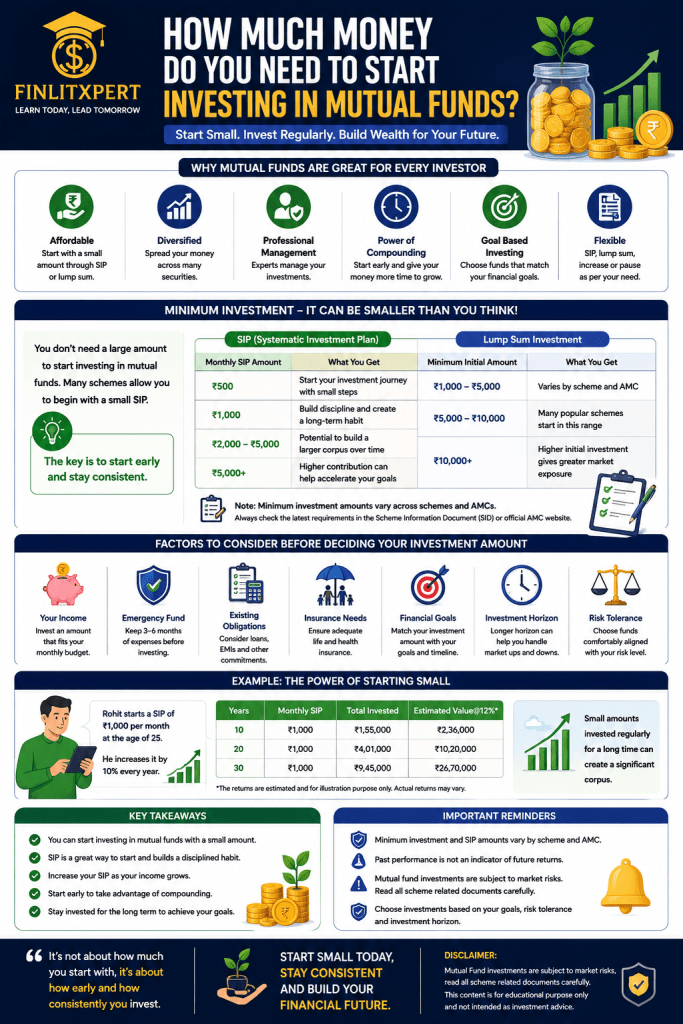
One of the biggest misconceptions about mutual fund investing is that you need a large amount of money to get started. In reality, mutual funds can be accessible to investors with different income levels and budgets. Depending on the mutual fund scheme and Asset Management Company (AMC), you may be able to begin investing with a relatively small amount through a Systematic Investment Plan (SIP) or a lump sum investment.
The minimum investment amount is not the same for every mutual fund scheme. Each scheme specifies its own minimum initial investment and minimum additional investment requirements in its official scheme documents. Some mutual fund schemes allow SIP investments starting with relatively small amounts, while others may require a higher minimum contribution. Therefore, investors should always check the latest minimum investment requirement of the specific scheme before investing.
For example, if a mutual fund allows a monthly SIP starting from ₹500, an investor can begin by investing ₹500 at regular monthly intervals instead of waiting to accumulate a large amount of money. Some schemes or special investment facilities may permit even smaller amounts, subject to the rules and minimum installment requirements applicable at that time.
Starting with a small SIP can be particularly useful for beginners and individuals with a regular monthly income. It allows investors to develop a disciplined investment habit and gradually increase their investments as their income and financial capacity grow. The amount invested can often be increased over time through a higher SIP amount or a step-up strategy, depending on the facilities available.
For lump sum investments, the minimum initial amount may differ from the minimum SIP amount. Depending on the scheme, investors may need to invest a specified minimum amount when making their first lump sum purchase. Subsequent or additional investments may also have separate minimum requirements. These amounts vary across schemes and can change, so investors should verify the current requirements in the relevant Scheme Information Document (SID) or other official scheme information.
More important than finding the absolute minimum amount is deciding how much you can invest comfortably and consistently. Your investment amount should be based on your income, regular expenses, existing financial obligations, emergency fund, insurance needs, financial goals, and investment horizon. Avoid investing money that you may need for essential short-term expenses simply to maintain a higher SIP.
For example, suppose you want to build a long-term investment habit but can currently afford only ₹1,000 per month. Starting with ₹1,000 and investing consistently may be more practical than waiting several years until you can invest a much larger amount. As your income increases, you can review your financial plan and consider gradually increasing your investment contribution.
Starting early can also provide a longer investment horizon, allowing potential returns more time to compound. However, compounding does not guarantee a particular return, and mutual fund performance depends on the underlying investments and market conditions. The appropriate mutual fund category should therefore be selected according to your financial goals and risk profile rather than simply choosing a fund because it has a low minimum investment requirement.
Before starting, define your financial goals, assess your risk tolerance, maintain an appropriate emergency fund, and determine an investment amount that fits comfortably within your budget. Then select a suitable mutual fund scheme and decide whether SIP or lump sum investing is appropriate for your situation.
You do not necessarily need a large amount of money to begin investing in mutual funds. What matters more is starting with an affordable amount, investing consistently, increasing your contribution when financially appropriate, and remaining focused on your long-term financial goals.
Always check the latest minimum investment and SIP requirements in the relevant scheme documents before investing. Mutual fund investments are subject to market risks, and returns are not guaranteed. Read all scheme-related documents carefully and choose investments according to your financial goals, risk tolerance, and investment horizon.
What Are the Costs of Investing in Mutual Funds?
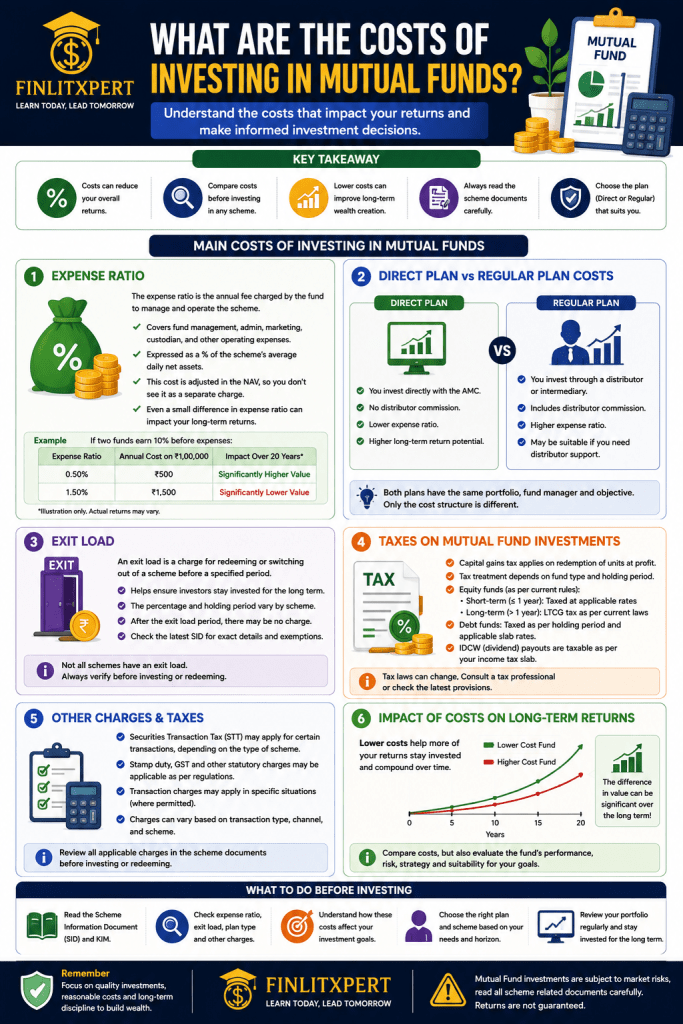
Mutual funds make professional investment management accessible to a wide range of investors, but investing in them is not completely free of costs. Different expenses and charges can affect the returns you ultimately receive. Understanding these costs is important because even seemingly small differences in expenses can have a meaningful impact on your investment value over the long term.
The main costs associated with mutual fund investing may include the expense ratio, exit load, applicable taxes, transaction-related charges in certain situations, and costs associated with choosing a Regular Plan instead of a Direct Plan. Not every charge applies to every investor or every scheme, so it is important to review the latest scheme documents before investing.
Expense Ratio
The expense ratio is one of the most important costs to understand when investing in mutual funds. It represents the recurring expenses charged to the scheme for managing and operating the fund, subject to applicable regulations. These expenses may include investment management and advisory fees, administrative expenses, registrar and transfer agent expenses, custodian-related costs, and other permitted operating expenses.
The expense ratio is expressed as a percentage of the scheme’s average daily net assets and is adjusted in the scheme’s Net Asset Value (NAV). Investors generally do not receive a separate bill for this expense because it is accounted for within the scheme itself.
For example, if two comparable investments generate similar returns before expenses but one has a higher expense ratio, the higher-cost investment may deliver a lower return to investors after expenses, assuming other factors remain the same. Over a long investment horizon, differences in recurring costs can become significant due to their effect on compounding.
Direct Plan vs Regular Plan Costs
Direct and Regular Plans of the same mutual fund scheme generally invest in the same underlying portfolio and have the same investment objective and fund manager. However, their expense ratios differ.
A Direct Plan is purchased without a mutual fund distributor and generally has a lower expense ratio because distributor commissions are not included. A Regular Plan is purchased through a distributor or intermediary and generally has a higher expense ratio because distribution-related expenses are included.
As a result, Direct and Regular Plans have separate NAVs, and their long-term returns can differ because of the difference in expenses. However, investors should not choose a plan based only on cost. Those who need distributor assistance may evaluate a Regular Plan, while investors who can independently research, select, monitor, and manage their investments may consider a Direct Plan.https://www.finlitxpert.com/finlitxpert-traderx-live-2026/
Exit Load
An exit load is a charge that may apply when investors redeem or switch their mutual fund units before a specified period. Its purpose and structure vary depending on the mutual fund scheme.
For example, a scheme may specify an exit load for redemptions made within a particular period from the date of allotment and no exit load after that period. The actual percentage, holding period, exemptions, and conditions vary from scheme to scheme.
Not all mutual funds have the same exit load structure, and some may have no exit load under specified conditions. Investors should therefore check the latest Scheme Information Document (SID) and other official scheme disclosures before investing or redeeming units.
Taxes on Mutual Fund Investments
Taxes can also affect the effective returns from mutual fund investments. The applicable taxation depends on factors such as the type of mutual fund, holding period, nature of the transaction, prevailing tax laws, and the investor’s individual tax circumstances.
Capital gains may arise when mutual fund units are redeemed or transferred at a profit. The applicable tax treatment can differ depending on whether the scheme qualifies for a particular tax category under current law and how long the units have been held.
IDCW (Income Distribution cum Capital Withdrawal) distributions may also have tax implications for investors under prevailing tax rules. Tax laws can change, so investors should verify the latest provisions or consult a qualified tax professional rather than relying on outdated tax rates.
Securities Transaction Tax and Other Applicable Charges
Certain mutual fund transactions may attract Securities Transaction Tax (STT) or other statutory charges where applicable. The treatment can vary depending on the type of scheme and transaction.
Investors may also encounter other permitted transaction-related charges or statutory levies in specific circumstances. The exact applicability can depend on current regulations, the investment channel, transaction type, and scheme.
Therefore, investors should review the transaction details and official disclosures to understand all applicable charges before completing an investment or redemption.https://www.finlitxpert.com/finlitxpert-course-registration/
Impact of Costs on Long-Term Returns
Investment costs may appear small when expressed as percentages, but their effect can accumulate over long periods. A higher recurring expense reduces the portion of investment returns that remains invested and available for future compounding.
For this reason, investors should compare expense ratios and other costs when evaluating similar mutual fund schemes. However, choosing the cheapest fund is not automatically the best strategy. Cost should be considered together with the scheme’s investment objective, portfolio strategy, risk level, tracking error where relevant, consistency, and suitability for your financial goals.
Before investing in any mutual fund, carefully review the expense ratio, exit load, plan type, tax implications, and any other applicable charges. You can find important cost-related information in documents such as the Scheme Information Document (SID), Key Information Memorandum (KIM), and other official disclosures provided by the mutual fund.
Understanding the costs of mutual fund investing helps you make more informed decisions and compare investment options more effectively. Focus not only on potential returns but also on the expenses, risks, taxation, and suitability of the scheme within your overall financial plan.
Mutual fund investments are subject to market risks, and returns are not guaranteed. Read all scheme-related documents carefully before investing.
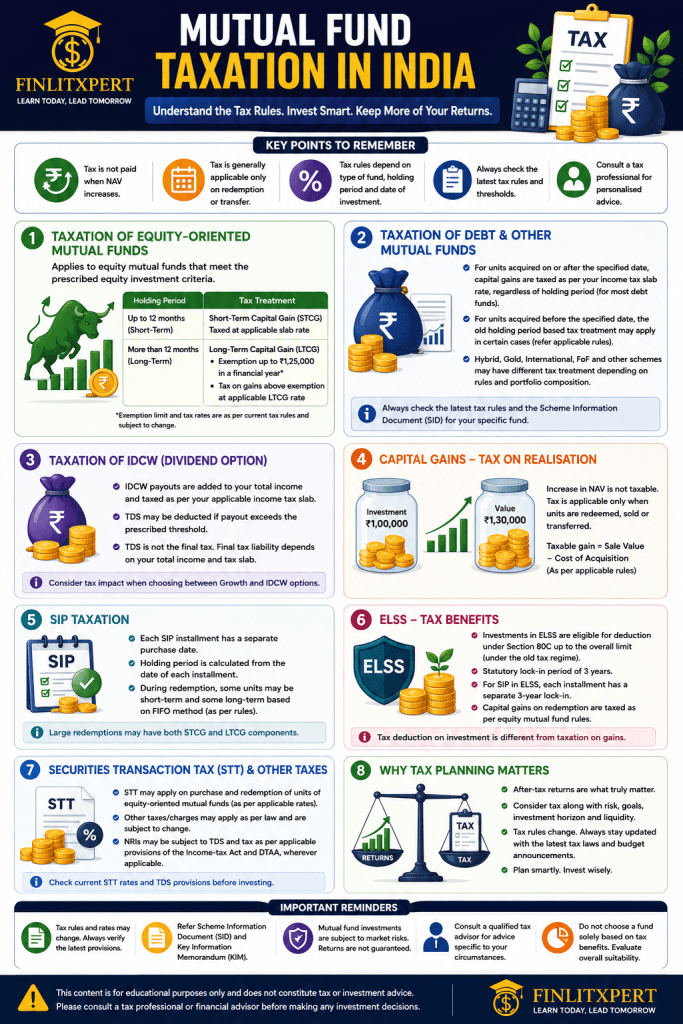
Mutual Fund Taxation in India
Understanding mutual fund taxation in India is an important part of investment planning because taxes can affect the actual returns you receive from your investments. The tax treatment of mutual funds depends on several factors, including the type of mutual fund, the composition of its portfolio, the holding period, the nature of the income or gain, and the tax rules applicable at the time of the transaction.
When you invest in a mutual fund, you generally do not pay tax simply because the value of your investment or NAV increases. Tax liability typically arises when a taxable event occurs, such as redeeming or transferring units at a profit or receiving an IDCW (Income Distribution cum Capital Withdrawal) payout. The exact tax treatment depends on the applicable provisions of the Income-tax Act and subsequent amendments.
Taxation of Equity-Oriented Mutual Funds
For tax purposes, equity-oriented mutual funds that satisfy the applicable equity investment requirements are generally subject to equity capital gains taxation.
If eligible equity-oriented mutual fund units are sold or redeemed within the specified short-term holding period, the resulting profit is treated as Short-Term Capital Gain (STCG) and taxed at the rate prescribed under prevailing tax law.
If the units are held beyond the specified period, the profit is generally classified as Long-Term Capital Gain (LTCG). Eligible long-term capital gains may receive an annual exemption up to the threshold specified under current tax rules, while gains exceeding that threshold are taxed at the applicable LTCG rate.
Investors should check the latest holding-period requirements, exemption limits, and tax rates because these provisions may be revised through Finance Acts or other tax amendments.https://www.finlitxpert.com/finlitxpert-course-registration/
Taxation of Debt and Other Mutual Funds
The taxation of debt-oriented and certain other mutual funds can differ significantly from equity-oriented schemes. Changes introduced in recent years have also made the date of acquisition and the composition of the fund’s portfolio important when determining the applicable tax treatment.
For certain specified mutual funds acquired on or after the relevant statutory date, capital gains may be taxed according to the investor’s applicable income-tax provisions irrespective of the traditional long-term holding benefit that applied under earlier rules.
However, not every non-equity mutual fund is necessarily taxed in exactly the same way. Hybrid funds, international funds, gold funds, fund of funds, and other categories may receive different tax treatment depending on their underlying asset allocation, acquisition date, and the tax law applicable at the time of redemption.
Therefore, investors should avoid assuming that all non-equity funds follow one common tax rule.
Taxation of IDCW
IDCW stands for Income Distribution cum Capital Withdrawal and was previously commonly referred to as the dividend option.
IDCW distributions received from mutual funds are generally taxable in the hands of the investor according to applicable income-tax provisions. Depending on the investor’s total taxable income and prevailing rules, the effective tax impact can vary.
Tax Deducted at Source (TDS) may also apply to certain mutual fund distributions when prescribed conditions and thresholds are met. TDS, however, is not necessarily the investor’s final tax liability. The actual liability is determined when total taxable income and applicable tax provisions are considered.
Investors choosing between Growth and IDCW options should therefore evaluate not only their cash-flow requirements but also the potential tax implications.
Capital Gains Are Generally Taxed on Realisation
An increase in the NAV of your mutual fund does not ordinarily create a capital gains tax liability merely because the investment value has increased.
For example, if you invest ₹1,00,000 and the market value later rises to ₹1,30,000, the ₹30,000 increase is generally an unrealised gain while you continue to hold the units. Capital gains taxation generally becomes relevant when units are redeemed, sold, or otherwise transferred in a manner that constitutes a taxable event.
The taxable gain is calculated according to applicable tax rules after considering factors such as the cost of acquisition, redemption value, eligible adjustments, and other statutory provisions.https://www.finlitxpert.com/
SIP Taxation
A Systematic Investment Plan (SIP) is an investment method rather than a separate type of mutual fund. Therefore, SIP investments do not have a completely separate tax system.
Each SIP installment is generally treated as a separate investment for determining its acquisition date and applicable holding period.
For example, if you invest every month through a SIP and later redeem multiple units, the holding period applicable to the units purchased through each installment may differ. Some units may qualify for long-term treatment while more recently purchased units may still fall under short-term treatment, depending on the applicable tax rules and redemption methodology.
This is an important consideration when planning large SIP redemptions.
ELSS and Tax Benefits
Equity Linked Savings Schemes (ELSS) are equity-oriented mutual funds designed to provide tax-saving benefits under the applicable provisions of the old income-tax regime, subject to prevailing rules and eligibility conditions.
Eligible investments may qualify for deduction under Section 80C within the overall statutory limit when the investor is using a tax regime in which that deduction is available.
ELSS investments have a statutory lock-in period. For SIP investments in ELSS, each installment generally has its own separate lock-in period from its respective investment date.
Investors should remember that a tax deduction on the amount invested and taxation of gains at redemption are separate matters. Capital gains arising from ELSS investments are generally subject to the applicable taxation rules for eligible equity-oriented mutual funds.
Securities Transaction Tax and Other Tax Considerations
Securities Transaction Tax (STT) may apply to certain transactions involving equity-oriented mutual fund units, subject to prevailing rules.
Other tax considerations may also arise depending on factors such as the investor’s residential status, type of mutual fund, transaction structure, capital losses, tax-loss set-off provisions, and applicable TDS requirements.
Non-Resident Indian (NRI) investors may be subject to additional TDS and tax provisions, and the final tax liability may differ depending on applicable domestic tax law and Double Taxation Avoidance Agreement (DTAA) provisions, where relevant.
Why Tax Planning Matters
Tax should not be the only factor when choosing a mutual fund, but understanding taxation can help investors make better financial decisions. Two investments generating similar pre-tax returns may produce different post-tax outcomes depending on their tax classification, holding period, and the investor’s individual circumstances.
Investors should consider post-tax returns together with financial goals, risk tolerance, asset allocation, investment horizon, liquidity requirements, and overall portfolio strategy.
Mutual fund taxation rules in India can change through amendments to tax laws and the Union Budget. Therefore, investors should always verify the latest tax rates, holding periods, exemption limits, and applicable provisions from official sources or consult a qualified tax professional before making tax-related investment decisions.
Mutual fund investments are subject to market risks. Tax treatment depends on prevailing laws and individual circumstances and should not be the sole basis for selecting an investment.
Common Mutual Fund Investing Mistakes Beginners Should Avoid
Mutual funds can be an effective way to work toward long-term financial goals, but beginners often make avoidable mistakes that can affect their investment experience and outcomes. Successful mutual fund investing is not simply about choosing a fund with the highest recent return. It requires clear financial goals, an understanding of risk, suitable fund selection, disciplined investing, diversification, cost awareness, and periodic portfolio review.
Understanding the most common mutual fund investing mistakes can help beginners make more informed decisions and develop better long-term investment habits.
Investing Without Clear Financial Goals
One of the most common mistakes beginners make is investing without defining a specific financial goal. Investing simply because a mutual fund is popular or has recently performed well may result in choosing a scheme that does not match your actual requirements.
Before investing, identify what you are investing for—such as building an emergency fund, buying a home, funding a child’s education, planning for retirement, or creating long-term wealth. Also consider the approximate amount required and the time available to achieve the goal.
Clear goals can help you determine an appropriate investment horizon, asset allocation, mutual fund category, and investment amount.https://www.finlitxpert.com/
Ignoring Your Risk Profile
Every mutual fund carries some degree of risk, and different categories can behave very differently during changing market conditions. Beginners sometimes invest in high-risk funds after seeing attractive historical returns without considering whether they can tolerate significant market fluctuations.
Your risk profile depends on factors such as your financial situation, investment horizon, income stability, existing obligations, ability to absorb losses, and emotional tolerance for market volatility.
Before investing, understand the scheme’s Riskometer and ensure that the level of risk is appropriate for your financial goals and personal risk tolerance.
Choosing Funds Based Only on Past Returns
A fund that generated excellent returns in the past will not necessarily produce similar returns in the future. Past performance is useful as one part of the evaluation process, but it should never be the sole reason for selecting a mutual fund.
Beginners may be tempted to invest in whichever fund appears at the top of a one-year return ranking. Such performance may have been influenced by temporary market conditions, sector trends, investment style, or higher risk-taking.
Instead, evaluate factors such as the scheme’s investment objective, portfolio strategy, asset allocation, benchmark, risk level, expense ratio, fund category, consistency across different market cycles, and suitability for your goals.
Investing in Too Many Mutual Funds
Diversification is important, but owning too many mutual funds does not automatically create a better-diversified portfolio. Beginners sometimes invest in several schemes with similar portfolios, resulting in unnecessary overlap.
For example, owning multiple equity funds that hold many of the same large companies may provide less additional diversification than expected.
Focus on building a purposeful portfolio in which each fund has a clearly defined role. Diversification should ideally occur across suitable asset classes, investment styles, and risk categories according to your financial plan rather than simply increasing the number of schemes.
Stopping SIPs During Market Corrections
Market declines can make new investors nervous, and some may stop their SIPs when markets fall. However, market volatility is a normal part of investing, particularly in equity-oriented mutual funds.
During periods of lower NAVs, a fixed SIP amount generally purchases more units. This is part of the concept of rupee cost averaging, although it does not guarantee profits or protect against losses.
If your financial goals, income situation, investment horizon, and selected scheme remain appropriate, making emotional decisions solely because of short-term market declines may disrupt your long-term investment plan.
Trying to Time the Market
Waiting for the “perfect” time to invest can result in remaining out of the market for long periods. Predicting market tops and bottoms consistently is extremely difficult, even for experienced investors.
Beginners may delay investments because they expect a market crash or invest aggressively after markets have already risen sharply because they fear missing out.
A disciplined investment strategy, such as investing regularly through SIPs where suitable, can reduce dependence on short-term market timing. Your investment decisions should primarily be driven by your financial goals, asset allocation, risk tolerance, and investment horizon.https://www.finlitxpert.com/
Ignoring Expense Ratio and Other Costs
Investment costs can affect long-term returns. Beginners often focus entirely on historical performance while overlooking the expense ratio, exit load, plan type, taxes, and other applicable costs.
Direct Plans generally have lower expense ratios than Regular Plans of the same mutual fund scheme because distributor commissions are not included. However, investors should choose between Direct and Regular Plans based on their ability to manage investments independently and their need for distributor assistance.
Always understand the applicable costs before investing, but do not select a mutual fund solely because it has the lowest expense ratio. Cost should be evaluated together with risk, investment strategy, portfolio characteristics, and suitability.
Chasing New Fund Offers Without Proper Research
A New Fund Offer (NFO) is not automatically cheaper or better simply because its initial NAV may be displayed at a low nominal value, such as ₹10. A lower NAV does not mean that a mutual fund is undervalued in the same way that some investors may interpret the price of an individual stock.
Before investing in an NFO, understand its investment objective, strategy, asset allocation, benchmark, risk level, costs, and whether the new scheme adds something useful to your existing portfolio.
Avoid investing simply because an NFO is heavily promoted or because its initial NAV appears inexpensive.https://www.finlitxpert.com/finlitxpert-course-registration/
Expecting Guaranteed or Quick Returns
Mutual funds are market-linked investments, and returns are not guaranteed unless a specific product structure explicitly provides otherwise under applicable regulations. Beginners sometimes enter equity mutual funds expecting consistently high returns within a short period.
Markets can rise, fall, or remain volatile for extended periods. Equity-oriented funds are generally more appropriate for investors who can accept market fluctuations and have a suitable investment horizon.
Set realistic expectations and understand that long-term wealth creation depends on several factors, including investment amount, time horizon, asset allocation, market performance, costs, and investor discipline.
Redeeming Investments Because of Short-Term Market Noise
News headlines, social media predictions, geopolitical events, elections, interest-rate changes, and temporary market corrections can influence investor emotions.
Frequently redeeming or switching mutual funds in response to short-term news can disrupt compounding, create unnecessary tax consequences or exit loads where applicable, and move your portfolio away from its original financial goals.
Portfolio changes should generally be based on meaningful factors such as changes in your goals, risk profile, asset allocation needs, or persistent concerns about a scheme—not simply short-term market noise.
Not Reviewing Your Portfolio Periodically
Long-term investing does not mean completely ignoring your portfolio. Your financial goals, income, responsibilities, risk tolerance, and investment horizon can change over time.
Review your mutual fund portfolio periodically to check whether your asset allocation remains appropriate, your investments continue to match your goals, there is unnecessary portfolio overlap, and any scheme has experienced significant changes that require attention.
However, avoid excessive monitoring and frequent switching based only on short-term performance. Periodic and goal-based reviews are generally more useful than reacting to daily NAV movements.
Ignoring Emergency Funds and Insurance Before Investing Aggressively
Investing aggressively without maintaining adequate financial protection can create problems during emergencies. If unexpected expenses arise, you may be forced to redeem long-term investments at an unfavorable time.
Before committing large amounts to long-term investments, consider maintaining an appropriate emergency fund and adequate insurance protection based on your circumstances.
A strong financial foundation can make it easier to remain invested during unexpected financial situations without disrupting long-term goals.
Following Tips and Social Media Recommendations Blindly
Beginners may choose mutual funds based on social media videos, online rankings, friends’ recommendations, or claims about the “best mutual fund” without conducting their own suitability assessment.
A fund that is suitable for one investor may not be suitable for another because financial goals, risk tolerance, investment horizon, tax circumstances, and existing portfolios differ.
Use educational content and research as starting points, but verify information through official scheme documents and reliable sources. If necessary, seek assistance from an appropriately qualified or registered professional based on the type of advice required.https://www.finlitxpert.com/finlitxpert-course-registration/
Final Takeaway
The biggest mutual fund investing mistakes often come from emotional decisions, unrealistic expectations, inadequate research, and investing without a clear financial plan.
Beginners can develop a stronger investment approach by defining clear goals, understanding their risk profile, choosing suitable funds, maintaining appropriate diversification, investing consistently, controlling costs, avoiding unnecessary market timing, and reviewing their portfolios periodically.
Successful investing is generally less about finding a single “perfect” mutual fund and more about building a suitable investment strategy and following it with patience and discipline.
Before investing, carefully read the Scheme Information Document (SID), Key Information Memorandum (KIM), Riskometer, expense ratio, exit load, and other relevant disclosures. Mutual fund investments are subject to market risks, and past performance does not guarantee future returns.
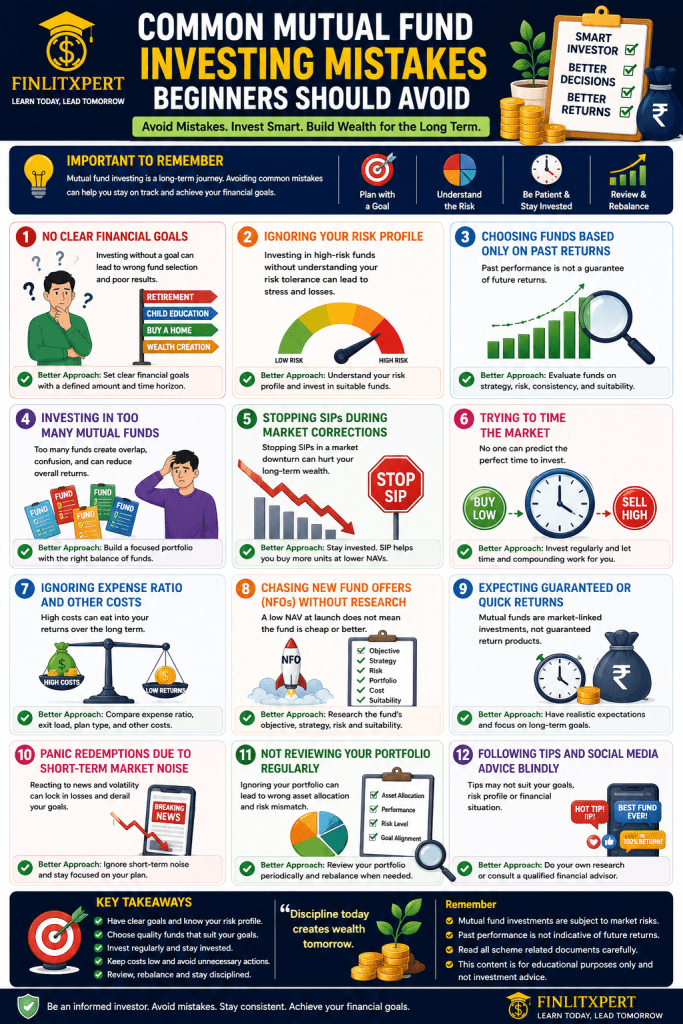
Example: How a Beginner Can Start Investing in Mutual Funds
Understanding mutual fund investing becomes easier with a practical example. Let us consider a hypothetical beginner named Rahul, who has recently started earning a regular income and wants to begin investing for his long-term financial goals. Instead of selecting a mutual fund simply on the basis of recent returns, Rahul follows a structured, goal-based investment process.
Step 1: Define the Financial Goal
Rahul first identifies why he wants to invest. Suppose he wants to build a corpus for a long-term financial goal that is approximately 10 years away. Defining the goal and investment horizon helps him understand how much risk he may be able to take and which broad categories of mutual funds may be suitable for further evaluation.
Step 2: Assess the Risk Profile
Before choosing a mutual fund, Rahul evaluates his risk tolerance, financial responsibilities, income stability, existing savings, and ability to handle market fluctuations. Since investments such as equity mutual funds can experience significant short-term volatility, he makes sure that the level of risk he takes is consistent with his financial situation and investment horizon.
Step 3: Build a Financial Safety Net
Rahul does not invest all his available savings immediately. Before committing money to long-term market-linked investments, he maintains an appropriate emergency fund and considers adequate insurance protection based on his needs.
This reduces the possibility of having to redeem long-term investments unexpectedly during a financial emergency.
Step 4: Complete KYC
Rahul completes the applicable Know Your Customer (KYC) requirements required for mutual fund investing. He ensures that his PAN, identity and address details, bank account information, and other required information are properly registered and verified according to the prevailing process.
Once the required verification is complete, he can proceed with eligible mutual fund transactions through authorized investment channels.
Step 5: Choose a Suitable Mutual Fund Category
Based on his long-term goal, risk profile, and investment horizon, Rahul evaluates suitable mutual fund categories rather than immediately choosing a particular scheme.
He studies factors such as the investment objective, asset allocation, Riskometer, portfolio strategy, benchmark, expense ratio, and expected level of volatility. The appropriate category will depend on the individual investor’s circumstances; a fund suitable for one beginner may not necessarily be suitable for another.https://www.finlitxpert.com/finlitxpert-course-registration/
Step 6: Research and Select a Mutual Fund Scheme
After identifying an appropriate category, Rahul compares suitable schemes within that category.
Instead of selecting the fund with the highest recent return, he reviews its investment objective, portfolio, benchmark, risk level, expense ratio, exit load, consistency, fund management approach, and other relevant information.
He also reads the Scheme Information Document (SID), Key Information Memorandum (KIM), and other official disclosures before making his decision.
Step 7: Choose Between Direct and Regular Plans
Rahul then decides whether a Direct Plan or Regular Plan is appropriate for him.
If he is comfortable researching, selecting, monitoring, and managing mutual funds independently, he may consider a Direct Plan, which generally has a lower expense ratio because distributor commissions are not included.
If he prefers assistance from a mutual fund distributor, he may consider a Regular Plan while understanding that distribution-related costs generally result in a higher expense ratio.
Step 8: Choose Between Growth and IDCW
Because Rahul’s objective is long-term wealth accumulation and he does not require periodic distributions from the investment, he evaluates the Growth option.
Under the Growth option, income and gains remain invested in the scheme and are reflected in the NAV, allowing the investment to potentially benefit from compounding over time.
The appropriate choice between Growth and IDCW, however, depends on each investor’s financial goals, cash-flow requirements, and tax considerations.
Step 9: Start with an Affordable SIP
Suppose Rahul determines that he can comfortably invest ₹3,000 every month without affecting his essential expenses, emergency savings, or other financial obligations.
He starts a monthly SIP of ₹3,000 in the selected mutual fund scheme rather than waiting until he has accumulated a large amount of money.
A SIP helps him invest regularly and can provide the benefit of rupee cost averaging by purchasing more units when the NAV is lower and fewer units when the NAV is higher. However, SIPs do not guarantee profits or protect against market losses.https://www.finlitxpert.com/
Step 10: Increase the SIP as Income Grows
As Rahul’s income increases over the years, he periodically reviews his financial capacity and considers increasing his SIP contribution.
For example, if financially feasible, he may increase his investment amount periodically instead of keeping it unchanged throughout his working life. Increasing contributions over time can potentially help him work toward larger financial goals, although actual outcomes depend on investment performance and other factors.
Step 11: Avoid Reacting to Short-Term Market Movements
Suppose the stock market declines significantly after Rahul begins investing. Instead of immediately stopping his SIP or redeeming his investments out of fear, he reviews whether his financial goal, risk profile, investment horizon, and selected scheme remain appropriate.
He understands that market volatility is a normal part of equity investing and avoids making investment decisions solely because of short-term news or market movements.
However, staying invested should not be interpreted as ignoring genuine changes in financial circumstances or problems with a selected investment.
Step 12: Review the Portfolio Periodically
Rahul reviews his investment portfolio periodically rather than checking the NAV several times every day.
During the review, he checks whether his mutual fund remains aligned with his financial goal, risk profile, and investment horizon. He also reviews asset allocation, portfolio overlap, scheme-related changes, costs, and progress toward his target.
If necessary, he makes changes based on meaningful financial reasons rather than short-term performance.
A Simple Illustration
Suppose Rahul invests ₹3,000 per month through SIP for 10 years. His total contribution over this period would be ₹3,60,000, excluding any changes in the SIP amount.
The eventual value of his investment could be higher or lower than the total amount invested depending on the performance of the mutual fund and market conditions. Any projected return shown through an SIP calculator is only an illustration and should not be interpreted as a guaranteed future return.
This example demonstrates that a beginner does not necessarily need a large amount of money or the ability to predict market movements to start investing in mutual funds. A more practical approach is to define clear financial goals, understand risk, build an emergency fund, complete KYC, select suitable investments, start with an affordable amount, invest consistently, and review the portfolio periodically.
The exact mutual fund, investment amount, asset allocation, and investment method suitable for each investor will differ according to individual circumstances. Beginners should avoid copying another investor’s portfolio without assessing their own financial goals and risk profile.
Mutual fund investments are subject to market risks, and returns are not guaranteed. Read all scheme-related documents carefully before investing. This example is for educational and illustrative purposes only and should not be considered a recommendation of any particular mutual fund scheme or an assurance of future returns.https://www.finlitxpert.com/
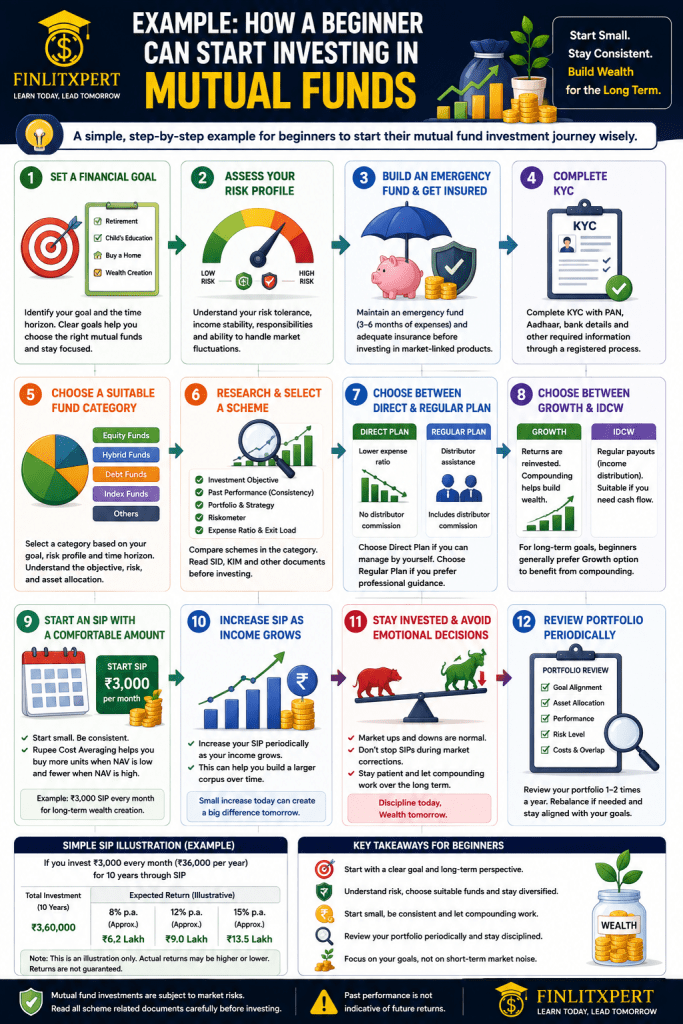
How to Track and Review Your Mutual Fund Portfolio
Investing in mutual funds is not a one-time activity. After making your investments, it is important to track and review your mutual fund portfolio periodically to ensure that it continues to align with your financial goals, risk profile, investment horizon, and overall asset allocation. However, portfolio monitoring does not mean checking the NAV every day or reacting to every short-term market movement.
A structured portfolio review helps you understand whether your investments are progressing toward your goals, whether your asset allocation remains appropriate, and whether any meaningful changes require action. The objective should be to make informed, goal-based decisions rather than emotional decisions driven by short-term market volatility.
Track Your Mutual Fund Investments in One Place
The first step is to maintain a consolidated view of your mutual fund investments. If you invest across multiple Asset Management Companies (AMCs), keeping track of individual folios separately can become difficult.
Depending on the services available, investors may use official AMC websites or apps, consolidated account statements, RTA-supported services such as MF Central, or other authorized investment platforms to view eligible mutual fund holdings.
A consolidated portfolio view can help you monitor your invested amount, current value, scheme-wise allocation, transactions, SIPs, and other relevant investment details more efficiently.
Always use official or authorized platforms and protect sensitive information such as passwords, OTPs, and banking credentials.https://www.finlitxpert.com/finlitxpert-course-registration/
Review Your Financial Goals
Every mutual fund investment should ideally be connected to a financial goal. During a portfolio review, check whether each investment still serves the purpose for which it was originally selected.
For example, you may have investments for retirement, a child’s education, purchasing a home, or another long-term objective. Over time, the target amount, time remaining, or your financial circumstances may change.
Ask whether you are investing enough to stay on track toward each goal and whether the selected investments remain suitable for the remaining investment horizon.
If your income has increased, you may also consider whether increasing your SIP contributions is appropriate based on your financial capacity and goals.
Check Your Asset Allocation
Asset allocation refers to how your investment portfolio is distributed across asset classes such as equity, debt, and other permitted assets.
Market movements can change your original allocation over time. For example, if equity markets rise significantly, the equity portion of your portfolio may become larger than originally planned. This can increase the overall risk of the portfolio beyond your intended level.
During a portfolio review, compare your current asset allocation with your target allocation based on your financial goals, risk tolerance, and investment horizon.
If the allocation has moved significantly away from your target, you may consider rebalancing. Rebalancing can involve directing new investments toward underweighted asset classes or, where appropriate, switching or redeeming investments. Before doing so, consider exit loads, taxes, and other transaction implications.
Evaluate Fund Performance Against the Right Benchmark
Performance is an important part of reviewing a mutual fund, but it should be evaluated correctly.
Do not judge a fund solely because it has delivered lower returns over a few months or because another fund has recently produced higher returns. Instead, compare the scheme with its appropriate benchmark and relevant peer category over meaningful periods.
Also evaluate how consistently the fund has performed across different market conditions rather than focusing only on one-year returns.
For passive funds such as index funds and ETFs, factors such as tracking error and tracking difference may also be relevant when evaluating how effectively the fund follows its underlying index.
Remember that past performance does not guarantee future returns.
Review Risk, Not Just Returns
A mutual fund that generates high returns may also be taking higher levels of risk. Therefore, portfolio reviews should consider both return and risk.
Check whether the scheme’s current risk level remains consistent with your risk profile and financial goals. Review the Riskometer and any significant changes in the scheme’s investment strategy or portfolio characteristics.
For example, changes in sector concentration, credit quality, market-cap exposure, duration, or other portfolio characteristics may alter the risk profile of a fund.
The objective is not simply to maximize returns but to take an appropriate level of risk for your financial situation.
Check for Portfolio Overlap
Holding several mutual funds does not necessarily mean that your portfolio is well diversified.
Two or more equity funds may own many of the same companies, creating significant portfolio overlap. This can result in unnecessary duplication without providing meaningful additional diversification.
During your review, check whether multiple funds in your portfolio have similar investment styles, objectives, or underlying holdings.
Every fund in your portfolio should ideally have a clear purpose. If several schemes perform essentially the same role, consider whether the portfolio has become unnecessarily complicated.
However, do not redeem funds solely to reduce the number of schemes without first considering suitability, taxes, exit loads, and your overall financial plan.
Monitor Expense Ratios and Other Costs
Investment costs can affect long-term returns, so review the expense ratios of your mutual fund schemes periodically.
Expense ratios can change, and the difference in costs between similar schemes may become meaningful over a long investment period.
Also review other applicable costs or implications, including exit loads, taxes, and differences between Direct and Regular Plans.
However, a lower expense ratio alone does not automatically make one fund better than another. Costs should be evaluated together with the scheme’s investment strategy, risk, performance, portfolio characteristics, and suitability for your goals.
Check for Important Changes in the Mutual Fund
Certain changes within a mutual fund may justify a closer review.
These may include a change in fund manager, investment strategy, benchmark, fundamental attributes, expense structure, merger of schemes, significant portfolio changes, or changes in the fund’s risk profile.
A fund manager change alone does not necessarily mean that you should immediately exit the scheme. Similarly, temporary underperformance does not automatically indicate that a fund has become unsuitable.
Evaluate whether the change materially affects the original reason you invested in the scheme.
Review Your SIPs
If you invest through SIPs, periodically review whether your SIP amount is still sufficient for your financial goals.
As income increases, inflation and the future cost of financial goals may also rise. A SIP amount that was appropriate several years ago may no longer be sufficient to achieve the same target.
If financially feasible, consider increasing your SIP contribution periodically based on your income, goals, and overall financial plan.
Also check whether SIP mandates are active and whether installments are being processed successfully. Missed SIPs due to expired mandates, insufficient bank balance, or outdated banking details can disrupt your investment plan.
Avoid Reviewing Your Portfolio Too Frequently
Tracking your portfolio is important, but checking it too frequently can encourage emotional decision-making.
Daily or weekly NAV movements are normal and usually provide little meaningful information for long-term investors. Frequent monitoring may tempt investors to switch funds, stop SIPs, or redeem investments based on temporary market movements.
For many long-term investors, a structured review once or twice a year may be sufficient, although the appropriate frequency depends on individual circumstances.
An additional review may be useful after a major life event, such as a significant change in income, financial responsibilities, goals, or investment horizon.https://www.finlitxpert.com/finlitxpert-traderx-live-2026/\
Know When to Consider Changing a Fund
A mutual fund should not be changed simply because it underperforms for a short period.
However, a review may be necessary if there is persistent and meaningful underperformance relative to an appropriate benchmark and peers, a significant change in the fund’s investment strategy, a material increase in risk, excessive portfolio overlap, or if the scheme no longer matches your financial goals.
Before switching or redeeming, consider the reason for the change, available alternatives, tax consequences, exit load, and the effect on your overall asset allocation.
Frequent fund switching in search of the latest top-performing scheme can be counterproductive.
Rebalance When Necessary
Over time, different asset classes may grow at different rates, causing your portfolio to move away from its intended asset allocation.
Suppose your target allocation is 60% equity and 40% debt. After a strong equity market rally, the allocation may shift significantly toward equity. This could expose your portfolio to more risk than originally intended.
Rebalancing helps restore the portfolio toward its target allocation.
Where appropriate, rebalancing may be achieved by directing new investments toward underweighted asset classes rather than immediately selling existing investments. This approach may help reduce unnecessary transactions, although the most suitable method depends on individual circumstances.
Always consider taxation and exit loads before making rebalancing transactions.https://www.finlitxpert.com/finlitxpert-course-registration/
Keep Your Nomination and Personal Details Updated
Portfolio management also includes maintaining accurate investment records.
Periodically check whether your PAN, KYC status, bank account details, email address, mobile number, nomination details, and other required information are current across your mutual fund folios.
Keeping these records updated can help prevent problems with transactions, communication, and transmission of investments.
Follow the latest regulatory requirements regarding nomination or other investor-service requirements applicable to mutual fund folios.
A Simple Portfolio Review Checklist
A beginner can use a simple checklist during every portfolio review:
- Are my investments still aligned with my financial goals?
- Am I investing enough to reach those goals?
- Is my asset allocation still appropriate?
- Are my funds performing reasonably against relevant benchmarks and peers?
- Has the risk profile of any fund changed significantly?
- Is there unnecessary overlap between my mutual funds?
- Have expense ratios or other costs changed materially?
- Have there been important changes in the fund or its investment strategy?
- Should I increase my SIP as my income grows?
- Does my portfolio need rebalancing?
- Are my KYC, bank, contact, and nomination details updated?
The purpose of reviewing your mutual fund portfolio is not to continuously search for the highest-returning fund. It is to ensure that your investments remain suitable for your goals and that your overall investment strategy stays on track.
A disciplined investor should track progress, review investments periodically, rebalance when necessary, and avoid making frequent changes based solely on short-term market movements.
Mutual fund investments are subject to market risks, and past performance does not guarantee future returns. Before making significant changes to your portfolio, consider your financial goals, risk profile, tax implications, exit loads, and relevant scheme documents.
Are Mutual Funds Safe for Beginners?
Mutual funds can be a suitable investment option for beginners, but they should not be considered completely risk-free. Mutual funds invest in market-linked assets such as equities, bonds, money market instruments, or a combination of different securities. Therefore, the value of a mutual fund investment can rise or fall depending on the performance of its underlying investments and prevailing market conditions.
The level of risk varies significantly from one mutual fund to another. An equity fund may experience substantial short-term market fluctuations, while certain debt or liquid funds may generally have lower volatility but still carry risks such as interest-rate risk, credit risk, and liquidity risk. Therefore, whether a mutual fund is “safe” for a beginner depends largely on choosing a scheme that is appropriate for the investor’s financial goals, risk tolerance, and investment horizon.https://www.finlitxpert.com/
Mutual Funds Are Regulated in India
Mutual funds in India operate within a regulatory framework established by the Securities and Exchange Board of India (SEBI). Asset Management Companies (AMCs), trustees, custodians, and other entities involved in the mutual fund ecosystem are subject to applicable regulations and disclosure requirements.
This regulatory framework is designed to promote transparency, investor protection, proper disclosure, and professional management.
However, regulation does not mean that mutual fund investments are guaranteed against market losses. SEBI regulation provides a structured framework for how mutual funds operate, but investors still bear the investment risks associated with the underlying securities.
Diversification Can Help Reduce Concentration Risk
One of the important features of mutual funds is diversification.
Instead of investing all your money in a single stock or security, a mutual fund generally invests across a portfolio of securities according to its investment objective. This can help reduce the impact that poor performance by one individual investment may have on the overall portfolio.
For example, if one company in a diversified equity fund performs poorly, the performance of other holdings may partially offset its impact.
However, diversification reduces certain types of risk; it does not eliminate market risk. During a broad market decline, even a diversified mutual fund portfolio can lose value.
Professional Fund Management
Mutual funds are managed by professional fund managers who make investment decisions according to the scheme’s stated investment objective and strategy.
For beginners who may not have the time, experience, or knowledge to research individual stocks or bonds, professional management can make investing more accessible.
Fund managers and their research teams analyze securities, manage portfolios, monitor risks, and make investment decisions within the framework of the scheme.
However, professional management does not guarantee profits or prevent losses. Fund performance can vary depending on market conditions, investment decisions, costs, and other factors.
Different Mutual Funds Have Different Levels of Risk
A common mistake among beginners is assuming that all mutual funds carry the same level of risk.
They do not.
Equity mutual funds primarily invest in stocks and can experience significant market volatility, particularly over shorter periods.
Debt mutual funds primarily invest in fixed-income securities but may still face interest-rate risk, credit risk, liquidity risk, and other risks.
Hybrid funds invest across multiple asset classes, such as equity and debt, and their risk depends on the specific asset allocation and investment strategy.
Index funds aim to track a particular market index and therefore generally carry risks associated with the underlying index.
Liquid and overnight funds may generally experience lower volatility than equity funds, but they should still not be described as completely risk-free.
Beginners should understand the specific category and risk characteristics before investing.https://www.finlitxpert.com/finlitxpert-course-registration/
Check the Riskometer Before Investing
SEBI requires mutual fund schemes to disclose a Riskometer that helps investors understand the level of risk associated with a scheme.
The Riskometer classifies schemes across prescribed risk levels, ranging from lower-risk categories to very high risk, depending on the applicable methodology.
Before investing, beginners should check the latest Riskometer of the scheme and consider whether that level of risk is compatible with their own ability and willingness to tolerate losses and market fluctuations.
The highest-returning fund is not necessarily the most suitable fund for every investor.
Match the Fund with Your Investment Horizon
Investment horizon plays an important role in managing mutual fund risk.
Money that may be required in the near future generally should not be exposed to inappropriate levels of market volatility. Investing short-term money in a highly volatile equity fund, for example, can create problems if the market falls just when the money is needed.
For long-term goals, investors may have more time to tolerate market fluctuations, depending on their risk profile and asset allocation.
The mutual fund category should therefore be selected according to both the goal and the time available to achieve it.
SIP Does Not Make a Mutual Fund Risk-Free
Systematic Investment Plans (SIPs) are popular among beginners because they allow investors to invest a fixed amount at regular intervals.
SIPs can encourage investment discipline and may provide the benefit of rupee cost averaging because a fixed investment amount generally purchases more units when NAVs are lower and fewer units when NAVs are higher.
However, investing through SIP does not eliminate market risk or guarantee positive returns.
If the underlying mutual fund performs poorly, the value of SIP investments can also decline. SIP is an investment method, not a guarantee against losses.
Avoid Expecting Guaranteed Returns
Most mutual funds are market-linked investments, and their returns are not guaranteed.
Beginners should be cautious of anyone promising fixed, assured, or guaranteed high returns from ordinary market-linked mutual fund investments.
Historical returns shown by a mutual fund or investment platform indicate past performance and should not be interpreted as an assurance of future results.
Actual returns depend on market performance, portfolio composition, investment duration, expenses, and several other factors.
Protect Yourself from Fraud and Unauthorized Platforms
Investment safety also depends on how and where you invest.
Always use official or authorized channels, such as the official website or app of an AMC, recognized mutual fund transaction platforms, or legitimate intermediaries as applicable.
Verify website addresses and applications before entering financial information.
Never share OTPs, passwords, PINs, or banking credentials with unauthorized individuals. Be cautious of unsolicited messages, social media advertisements, or individuals promising unusually high or guaranteed returns.
Understanding investment risk is important, but protecting yourself from fraud and unauthorized financial activity is equally important.
Start with an Amount You Can Afford
Beginners do not need to invest a large amount immediately.
Starting with an affordable SIP or investment amount can help you gain experience while developing a disciplined investment habit.
Before investing aggressively, consider maintaining an appropriate emergency fund and adequate insurance protection based on your circumstances.
Do not invest money required for essential expenses or near-term financial obligations in a mutual fund that carries unsuitable market risk.
As your income, knowledge, and financial capacity increase, you can periodically review and adjust your investments.
How Can Beginners Invest More Safely?
Beginners can manage mutual fund investment risk more effectively by following a few basic principles:
- Define clear financial goals before investing.
- Understand your personal risk profile.
- Maintain an appropriate emergency fund.
- Choose a mutual fund category suitable for your investment horizon.
- Check the scheme’s Riskometer.
- Diversify appropriately rather than concentrating investments unnecessarily.
- Avoid choosing funds solely on recent high returns.
- Invest through official or authorized channels.
- Understand expense ratios, exit loads, and tax implications.
- Review your portfolio periodically without reacting to daily market movements.
- Read the Scheme Information Document (SID), Key Information Memorandum (KIM), and other relevant disclosures.
So, are mutual funds safe for beginners?
Mutual funds can provide beginners with a regulated, diversified, and professionally managed way to participate in financial markets, but they are not risk-free or guaranteed-return products.
Their suitability and level of risk depend on the type of fund selected, the underlying investments, the investor’s financial goals, risk tolerance, investment horizon, and overall investment strategy.
For beginners, the objective should not be to search for a completely “safe” mutual fund or the fund offering the highest historical return. A better approach is to understand the risks, choose investments that match your goals, start with an affordable amount, diversify appropriately, remain disciplined, and review your portfolio periodically.
Mutual fund investments are subject to market risks. Read all scheme-related documents carefully before investing. Past performance does not guarantee future returns.Understanding how to invest in mutual funds online can make the investment process more convenient for beginners.https://www.finlitxpert.com/finlitxpert-course-registration/
Frequently Asked Questions About Investing in Mutual Funds
What is the minimum amount required to start investing in mutual funds?
The minimum investment amount varies depending on the mutual fund scheme and Asset Management Company (AMC). Many schemes allow investors to start a Systematic Investment Plan (SIP) with a relatively small amount, while the minimum lump sum investment may be different. Always check the latest minimum investment requirement in the scheme’s official documents before investing.
Can a beginner invest in mutual funds?
Yes, beginners can invest in mutual funds after understanding their financial goals, risk tolerance, and investment horizon. Mutual funds provide access to professionally managed and diversified portfolios, but they are market-linked investments and are not risk-free. Beginners should understand the scheme, check its Riskometer, and read relevant documents before investing.
How do I start investing in mutual funds?
A beginner can start by defining financial goals, assessing risk tolerance, maintaining an appropriate emergency fund, completing KYC, selecting a suitable mutual fund category and scheme, and choosing between Direct and Regular Plans and Growth and IDCW options. You can then invest through SIP or lump sum using an official or authorized investment channel.
Is KYC mandatory for investing in mutual funds?
Yes, investors generally need to comply with applicable Know Your Customer (KYC) requirements before investing in mutual funds in India. The process typically involves verification of prescribed identity, address, PAN, and other required details according to prevailing regulations.
What is SIP in a mutual fund?
SIP stands for Systematic Investment Plan. It is a method of investing a chosen amount in a mutual fund at regular intervals, such as monthly. SIP can encourage disciplined investing and provide the benefit of rupee cost averaging, but it does not guarantee profits or protect investors from market losses.
Is SIP better than a lump sum investment?
Neither SIP nor lump sum is universally better. SIP may be suitable for investors who receive regular income and want to invest gradually, while lump sum investing may be considered when a larger amount is available for investment. The appropriate method depends on your financial situation, risk tolerance, available capital, investment horizon, and goals.
Can I lose money in mutual funds?
Yes. Mutual funds are market-linked investments, and their value can rise or fall depending on the performance of the underlying assets and market conditions. Different mutual fund categories carry different levels and types of risk. Diversification can help manage certain risks, but it cannot eliminate the possibility of investment losses.
Are mutual funds safe for beginners?
Mutual funds operate within a regulated framework in India and provide professional management and diversification, but they are not completely risk-free. Their suitability for beginners depends on selecting a fund that matches the investor’s financial goals, risk profile, and investment horizon. Beginners should always check the scheme’s Riskometer before investing.
Which type of mutual fund is best for beginners?
There is no single mutual fund category that is best for every beginner. The appropriate choice depends on the investor’s financial goal, investment horizon, risk tolerance, liquidity requirements, and overall asset allocation. A beginner should understand the characteristics and risks of equity, debt, hybrid, index, liquid, and other fund categories before choosing.
What is the difference between Direct and Regular Mutual Fund Plans?
Direct and Regular Plans generally belong to the same mutual fund scheme and have the same underlying portfolio and investment objective. However, Direct Plans are purchased without a distributor and generally have a lower expense ratio. Regular Plans involve a mutual fund distributor and include distribution-related expenses, resulting in a generally higher expense ratio.
What is the difference between Growth and IDCW options?
Under the Growth option, income and gains remain invested in the scheme and are reflected in the NAV, which may support long-term compounding. Under IDCW (Income Distribution cum Capital Withdrawal), the scheme may make distributions subject to the availability of distributable surplus and applicable rules. IDCW payouts are not guaranteed and generally result in an adjustment to the NAV.
Can I withdraw my mutual fund investment at any time?
Many open-ended mutual funds allow investors to redeem units on business days, subject to applicable scheme rules. However, exit loads, lock-in periods, taxation, or other restrictions may apply. For example, ELSS has a statutory lock-in period. Always check the specific scheme conditions before investing or redeeming.
How long should I stay invested in mutual funds?
There is no single ideal holding period for every mutual fund. Your investment duration should depend on your financial goal, the type of fund, and your risk profile. Equity-oriented funds are generally more suitable for longer investment horizons because they can experience significant short-term volatility, while other categories may serve different time horizons and objectives.
How are mutual fund returns calculated?
Mutual fund returns reflect changes in the value of your investment over time, including the effect of NAV movements and applicable distributions where relevant. Returns may be expressed using measures such as absolute return, annualized return, or CAGR depending on the investment period. For investments involving multiple cash flows, such as SIPs, XIRR is commonly used to evaluate performance.
Are mutual fund returns guaranteed?
No. Returns from ordinary market-linked mutual funds are not guaranteed. The value of the investment depends on the performance of the underlying securities and market conditions. Past performance should not be interpreted as an assurance of future returns.
What is NAV in a mutual fund?
NAV stands for Net Asset Value. It represents the per-unit value of a mutual fund scheme after considering the value of its assets and liabilities according to applicable valuation rules. A lower NAV does not necessarily mean that a mutual fund is cheaper or better than a fund with a higher NAV.
What is an expense ratio?
The expense ratio represents recurring expenses charged to a mutual fund scheme for managing and operating the fund, subject to applicable regulations. These costs are reflected in the scheme’s NAV rather than generally being billed separately to investors. Higher recurring expenses can affect long-term returns, so investors should consider the expense ratio when comparing suitable schemes.
What is an exit load in mutual funds?
An exit load is a charge that may apply if investors redeem or switch units within a specified period. The percentage, applicable period, and conditions vary by scheme. Some schemes may have no exit load under specified circumstances. Investors should check the latest scheme documents before investing or redeeming.
Are mutual fund investments taxable in India?
Yes, mutual fund investments can have tax implications. Tax treatment depends on factors such as the type of mutual fund, portfolio composition, acquisition date, holding period, nature of income or gains, and prevailing tax laws. IDCW distributions may also have tax implications. Since tax rules can change, investors should verify the latest provisions or consult a qualified tax professional.
Is each SIP installment taxed separately?
For determining the acquisition date and holding period, each SIP installment is generally treated as a separate investment. Therefore, when units are redeemed, different SIP installments may have different holding periods and potentially different tax treatment under prevailing rules.
Can I stop or change my SIP?
Generally, investors can modify, pause, or cancel SIPs subject to the facilities, processing timelines, and terms offered by the AMC or investment platform. However, stopping a SIP simply because markets have temporarily declined may not always be appropriate if your financial goal and investment strategy remain unchanged.
Can I increase my SIP amount later?
Yes. Investors can generally increase their investment contributions by modifying their SIP arrangements or using facilities such as a Step-Up SIP where available. Increasing your SIP as your income grows can potentially help you work toward larger financial goals, subject to your budget and financial circumstances.
Should I invest in multiple mutual funds?
Holding multiple funds can provide diversification when the funds serve different purposes, but investing in too many similar schemes may create unnecessary portfolio overlap. Each mutual fund in your portfolio should ideally have a clear role based on your goals, asset allocation, risk profile, and investment strategy.
How often should I review my mutual fund portfolio?
For many long-term investors, a structured review once or twice a year may be sufficient, although the appropriate frequency depends on individual circumstances. Additional reviews may be useful after significant changes in financial goals, income, responsibilities, risk tolerance, or the characteristics of a mutual fund scheme.
Should I stop my SIP when the market falls?
A market decline alone is generally not a sufficient reason to stop a SIP if your financial goals, risk profile, investment horizon, and selected scheme remain appropriate. SIPs invest at different NAV levels and may purchase more units when NAVs are lower. However, rupee cost averaging does not guarantee profits or prevent losses.
Can I invest in mutual funds without a Demat account?
Yes. A Demat account is generally not mandatory for investing in many mutual fund schemes. Investors can hold mutual fund units in non-Demat form through AMCs, RTAs, or other permitted channels. Certain exchange-traded products, such as ETFs, generally require a Demat and trading account for exchange transactions.
Where can I invest in mutual funds online?
Investors may invest through official AMC websites or apps, eligible centralized mutual fund platforms such as MF Central, or authorized investment platforms and intermediaries. The available plan type—Direct or Regular—may depend on the investment channel. Always verify that you are using an official or authorized platform.
What documents should I read before investing in a mutual fund?
Investors should review relevant documents and disclosures such as the Scheme Information Document (SID), Key Information Memorandum (KIM), Riskometer, expense ratio, exit load, investment objective, portfolio information, and other applicable disclosures before investing.
What should I do if my mutual fund is underperforming?
Do not immediately redeem a fund because of short-term underperformance. Compare its performance with the appropriate benchmark and relevant peers over meaningful periods and review factors such as investment strategy, risk, portfolio changes, and fund management. Consider changing a fund only after evaluating whether it remains suitable for your financial goals and overall portfolio.
What is the most important rule for a beginner investing in mutual funds?
There is no single rule that guarantees investment success, but beginners should focus on a disciplined, goal-based approach. Define your goals, understand your risk profile, choose suitable investments, start with an affordable amount, diversify appropriately, control costs, avoid chasing short-term returns, remain patient, and review your portfolio periodically.
Mutual fund investments are subject to market risks. Read all scheme-related documents carefully before investing. The information provided in these FAQs is for educational purposes and should not be considered a recommendation of any particular mutual fund scheme or a guarantee of future returns.https://www.finlitxpert.com/finlitxpert-course-registration/
Conclusion: Start Your Mutual Fund Investment Journey Wisely
Investing in mutual funds can be an effective way to work toward your financial goals, whether you are planning for long-term wealth creation, retirement, your child’s education, buying a home, or other important financial milestones. However, successful mutual fund investing is not about finding the fund with the highest recent return or trying to predict every market movement. It begins with understanding your goals, assessing your risk profile, selecting suitable investments, and following a disciplined financial plan.
If you are a beginner, start by defining clear financial goals and determining how much time you have to achieve them. Build an appropriate emergency fund, maintain adequate insurance protection based on your needs, complete the required KYC process, and understand the different types of mutual funds before investing.
Choose a mutual fund category that matches your financial goal, investment horizon, and ability to tolerate risk. Before selecting a particular scheme, evaluate its investment objective, asset allocation, Riskometer, expense ratio, exit load, benchmark, portfolio characteristics, and other relevant information. Avoid choosing a fund solely because it has recently generated high returns, as past performance does not guarantee future results.
You should also understand important investment choices such as Direct versus Regular Plans and Growth versus IDCW options. Direct Plans generally have lower expense ratios because distributor commissions are not included, while Regular Plans involve distribution-related costs. Similarly, Growth and IDCW options serve different financial needs. Your choice should depend on your investment knowledge, need for assistance, cash-flow requirements, financial goals, and individual circumstances.
When deciding between SIP and lump sum investing, remember that neither method is universally better. A Systematic Investment Plan (SIP) can help you invest regularly and develop financial discipline, while a lump sum investment may be appropriate when you have a larger amount available and the strategy suits your financial plan. The right approach depends on your available capital, income pattern, risk tolerance, and investment horizon.
You do not need to wait until you have a large amount of money to begin your investment journey. Starting with an affordable amount and investing consistently can be more practical than delaying your financial goals while waiting for the “perfect” time to enter the market. As your income and financial capacity increase, you can periodically review whether increasing your investment contributions is appropriate.
Once you start investing, avoid making emotional decisions based on short-term market movements. Market volatility is a normal part of investing, particularly in equity-oriented mutual funds. Stopping SIPs, redeeming investments in panic, or frequently switching funds based on recent performance can disrupt a well-planned long-term investment strategy.
At the same time, long-term investing does not mean ignoring your portfolio completely. Review your mutual fund investments periodically to ensure that they remain aligned with your financial goals, risk profile, investment horizon, and target asset allocation. Check for unnecessary portfolio overlap, significant changes in a scheme, investment costs, SIP adequacy, and whether rebalancing is required.
Always invest through official or authorized channels and protect your personal and financial information. Never share passwords, OTPs, PINs, or banking credentials with unauthorized individuals, and be cautious of anyone promising guaranteed or unusually high returns from market-linked mutual fund investments.
The most important step is to begin with knowledge rather than haste. Understand what you are investing in, why you are investing, how much risk you are taking, and how the investment fits into your overall financial plan.
Mutual fund investing is a journey, not a shortcut to instant wealth. A goal-based approach, appropriate diversification, disciplined investing, cost awareness, patience, and periodic portfolio reviews can help you make more informed investment decisions over the long term.
Start with an amount you can comfortably afford, continue learning, increase your investments when financially appropriate, and remain focused on your long-term objectives rather than short-term market noise.
Before investing, carefully read the Scheme Information Document (SID), Key Information Memorandum (KIM), Riskometer, expense ratio, exit load, and other relevant scheme-related documents. Mutual fund investments are subject to market risks, and returns are not guaranteed. Past performance does not guarantee future results. If you are uncertain about the suitability of an investment or need personalized advice, consider consulting an appropriately qualified or registered financial professional.Before learning how to invest in mutual funds, it is important to understand your financial goals, risk tolerance and investment horizon.