
Direct vs Regular Mutual Funds: Complete Guide 2026

Introduction: Direct vs Regular Mutual Funds
Mutual funds are one of the most popular investment options for individuals who want to build wealth over time through professionally managed portfolios. However, when choosing a mutual fund scheme, beginners often come across two options: Direct Plan and Regular Plan.
Both Direct and Regular plans invest in the same underlying portfolio of securities and are managed by the same fund management team. The key difference lies in how you invest and the costs involved. In a Direct Plan, you invest directly with the mutual fund without involving a distributor, while a Regular Plan is purchased through an intermediary or mutual fund distributor.
Because Regular Plans generally include distribution-related expenses, their expense ratios are typically higher than those of Direct Plans. This difference in cost can affect long-term returns. However, choosing between Direct and Regular Mutual Funds should not be based on cost alone. Your investment knowledge, ability to select suitable funds, need for guidance, risk profile, and financial goals are also important factors.
In this beginner-friendly guide, we will explain Direct vs Regular Mutual Funds, their key differences, expense ratios, potential impact on returns, advantages and disadvantages, and the factors you should consider before choosing the right option for your investment journey.Understanding Direct vs Regular Mutual Funds helps investors choose the right investment plan based on their financial goals, investment knowledge and long-term strategy.SEBI – Securities and Exchange Board of India

What Is a Direct Mutual Fund?
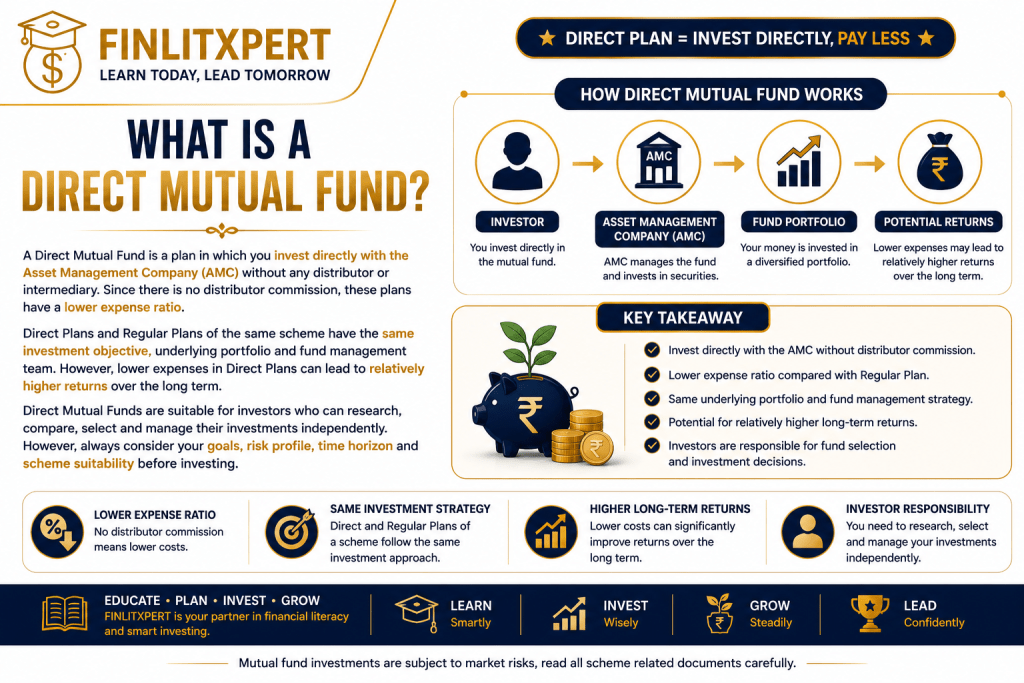
A Direct Mutual Fund is a mutual fund plan in which investors invest directly with the Asset Management Company (AMC) without using a mutual fund distributor or other commission-based intermediary. Direct Plans were introduced in India to provide investors with an option to invest in mutual fund schemes without distributor commissions being built into the plan’s expenses.
A Direct Plan and the Regular Plan of the same mutual fund scheme generally have the same investment objective, underlying portfolio and fund management team. However, a Direct Plan usually has a lower expense ratio because it does not include distribution commissions associated with Regular Plans.
Because of the lower expense ratio, a Direct Plan generally has a different Net Asset Value (NAV) and may generate relatively higher returns than the Regular Plan of the same scheme over time, assuming the underlying portfolio remains the same. Even a small difference in annual expenses can become significant over a long investment period due to compounding.
Direct Mutual Funds may be suitable for investors who are comfortable researching and comparing mutual fund schemes, assessing their own financial goals and risk profile, selecting suitable funds and managing their investments independently. However, choosing a Direct Plan does not automatically mean choosing the right mutual fund. Investors still need to consider factors such as investment objectives, risk, time horizon, asset allocation and scheme suitability before investing.Before investing, always compare Direct vs Regular Mutual Funds carefully, including their expense ratios, investment route and suitability.AMFI – Association of Mutual Funds in India
KEY TAKEAWAY
Direct Mutual Fund = Invest directly without distributor commission.
- Lower expense ratio compared with the Regular Plan of the same scheme
- Same underlying portfolio and fund management strategy
- Potential for relatively higher long-term returns due to lower expenses
- Investors are responsible for fund selection and investment decisions
What Is a Regular Mutual Fund?
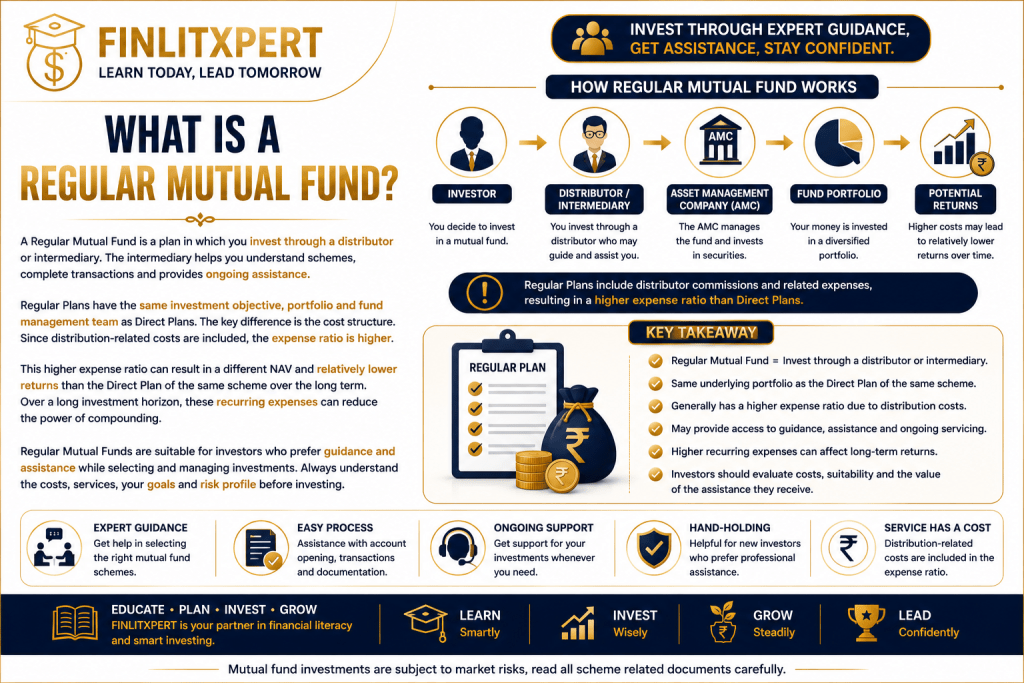
A Regular Mutual Fund is a mutual fund plan in which an investor invests through an intermediary, such as a mutual fund distributor or another authorized distribution channel. The intermediary may help the investor understand available schemes, complete transactions and provide ongoing assistance related to the investment.
A Regular Plan and the Direct Plan of the same mutual fund scheme generally have the same investment objective, underlying portfolio and fund management team. The main difference is the cost structure. Regular Plans typically have a higher expense ratio because distribution-related commissions and expenses are included in the scheme’s operating costs.
This higher expense ratio can result in the Regular Plan having a different Net Asset Value (NAV) and relatively lower returns than the Direct Plan of the same scheme over time, assuming all other factors remain the same. The difference may appear small in the short term, but over a long investment horizon, the impact of recurring expenses can become more significant because of compounding.
Regular Mutual Funds may be suitable for investors who prefer assistance while selecting and managing mutual fund investments, especially those who are not comfortable researching schemes independently. However, investors should understand the nature and scope of the service being provided, the costs involved, their financial goals and risk profile before making an investment decision.The choice between Direct vs Regular Mutual Funds should be based on your financial goals, risk profile and need for investment assistance.https://www.finlitxpert.com/
KEY TAKEAWAY
Regular Mutual Fund = Invest through a distributor or intermediary.
- Same underlying portfolio as the Direct Plan of the same scheme
- Generally has a higher expense ratio due to distribution-related costs
- May provide access to assistance with investing and ongoing servicing
- Higher recurring expenses can affect long-term returns
- Investors should evaluate costs, suitability and the value of the assistance they receive
Direct vs Regular Mutual Funds: Key Differences
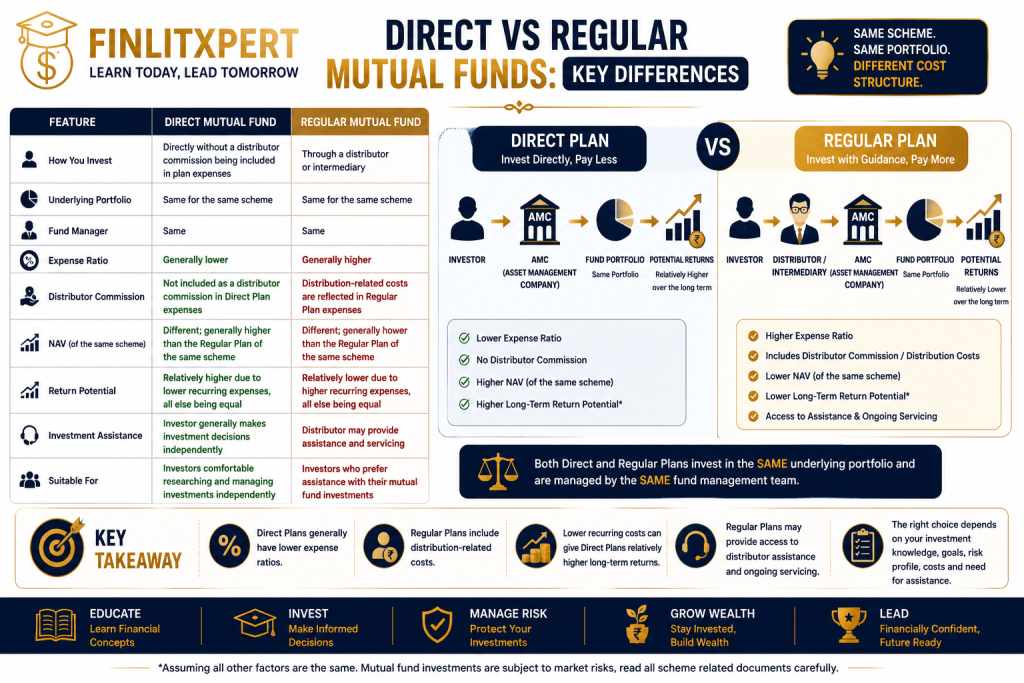
The main difference between Direct and Regular Mutual Funds lies in how investors purchase the scheme and the costs associated with each plan. A Direct Plan allows investors to invest directly with the Asset Management Company (AMC) or through platforms offering Direct Plans, without distributor commissions being included in the plan expenses. A Regular Plan, on the other hand, is purchased through a mutual fund distributor or intermediary and generally includes distribution-related costs within its expense ratio.
For the same mutual fund scheme, Direct and Regular Plans generally follow the same investment objective, hold the same underlying portfolio and are managed by the same fund management team. However, because their expense ratios differ, their Net Asset Values (NAVs) and investment returns also differ.
Direct Plans typically have a lower expense ratio, which means a smaller portion of the scheme’s assets is used to cover recurring expenses. Over a long investment period, this cost difference can contribute to relatively higher returns through the effect of compounding. Regular Plans generally have a higher expense ratio but may provide investors with access to assistance from a distributor for transactions, scheme selection and ongoing servicing.
Therefore, the choice between Direct vs Regular Mutual Funds should not be based only on which plan has delivered higher returns. Investors should also consider their investment knowledge, ability to research and select suitable funds, financial goals, risk profile, time horizon, costs and whether they need professional assistance.Many beginners compare Direct vs Regular Mutual Funds to understand which plan is more suitable for long-term wealth creation.https://www.finlitxpert.com/finlitxpert-course-registration/
Direct vs Regular Mutual Funds Comparison
| Feature | Direct Mutual Fund | Regular Mutual Fund |
|---|---|---|
| How You Invest | Directly without a distributor commission being included in plan expenses | Through a distributor or intermediary |
| Underlying Portfolio | Same for the same scheme | Same for the same scheme |
| Fund Manager | Same | Same |
| Expense Ratio | Generally lower | Generally higher |
| Distributor Commission | Not included as a distributor commission in Direct Plan expenses | Distribution-related costs are reflected in Regular Plan expenses |
| NAV | Different; generally higher than the Regular Plan of the same scheme | Different; generally lower than the Direct Plan of the same scheme |
| Return Potential | Relatively higher due to lower recurring expenses, all else being equal | Relatively lower due to higher recurring expenses, all else being equal |
| Investment Assistance | Investor generally makes investment decisions independently | Distributor may provide assistance and servicing |
| Suitable For | Investors comfortable researching and managing investments independently | Investors who prefer assistance with their mutual fund investments |
KEY TAKEAWAY
Direct and Regular Plans of the same mutual fund scheme generally invest in the same underlying portfolio and are managed by the same fund management team.
The major differences are:
- Direct Plans generally have lower expense ratios.
- Regular Plans include distribution-related costs.
- Lower recurring costs can give Direct Plans relatively higher long-term returns.
- Regular Plans may provide access to distributor assistance and ongoing servicing.
- The right choice depends on your investment knowledge, goals, risk profile, costs and need for assistance.
Understanding Expense Ratio in Direct and Regular Plans
The expense ratio is an important factor to understand when comparing Direct vs Regular Mutual Funds. It represents the annual operating expenses of a mutual fund scheme as a percentage of its average assets under management. These expenses may include investment management fees, administrative expenses and other permitted operating costs, and they are reflected in the scheme’s Net Asset Value (NAV).
For the same mutual fund scheme, a Direct Plan generally has a lower expense ratio than its Regular Plan because the Direct Plan does not include distribution commission expenses. A Regular Plan is distributed through intermediaries, and distribution-related expenses contribute to its higher expense ratio.
Although the difference in expense ratios may appear small, its effect can become more noticeable over a long investment period. Lower recurring expenses allow a larger portion of the investment value to remain invested and participate in compounding. Therefore, assuming the same underlying portfolio and all other factors remain equal, the Direct Plan may generate relatively higher long-term returns than the Regular Plan.
However, investors should not select a mutual fund based only on the lowest expense ratio. Fund suitability, investment objective, risk level, portfolio quality, consistency, time horizon and alignment with financial goals are also important. A low-cost fund that does not match an investor’s needs is not automatically a suitable investment.This Direct vs Regular Mutual Funds guide explains the key differences, benefits, costs and practical considerations for investors.https://www.finlitxpert.com/finlitxpert-course-registration/
How Expense Ratio Can Affect Long-Term Returns
Consider a simplified hypothetical example. Suppose two plans of the same mutual fund scheme earn a 12% annual return before expenses. If the Direct Plan has an expense ratio of 0.75% and the Regular Plan has an expense ratio of 1.50%, the simplified return after deducting these assumed expenses would be approximately 11.25% for the Direct Plan and 10.50% for the Regular Plan.
A difference of only 0.75 percentage points may appear small in a single year, but when an investment remains invested for many years, compounding can widen the difference in accumulated value.
This example is only for educational illustration. Actual mutual fund returns, expense ratios, NAV calculations, taxes and investment outcomes can vary, and future returns are not guaranteed.
| Particulars | Direct Plan | Regular Plan |
|---|---|---|
| Hypothetical Return Before Expenses | 12.00% | 12.00% |
| Assumed Expense Ratio | 0.75% | 1.50% |
| Simplified Return After Expenses* | 11.25% | 10.50% |
| Cost Difference | Lower | Higher |
| Long-Term Effect | More of the return remains invested | Higher recurring costs can reduce accumulated value |
*Simplified illustration for educational purposes only. Actual mutual fund returns and NAV calculations do not work as a guaranteed fixed return minus a fixed expense ratio, and investment outcomes may vary.
KEY TAKEAWAY
A lower expense ratio means lower recurring fund expenses, which can make a meaningful difference over long investment periods.
- Direct Plans generally have lower expense ratios than Regular Plans of the same scheme.
- Regular Plans include distribution-related expenses.
- Even a small annual cost difference can compound over time.
- Lower costs can contribute to relatively higher long-term returns, all else being equal.
- Never choose a mutual fund based on expense ratio alone—suitability, risk and financial goals matter too.

Direct vs Regular Mutual Funds: Returns Comparison
When comparing Direct vs Regular Mutual Funds, investors often notice that the Direct Plan of a scheme has historically shown slightly higher returns than the Regular Plan of the same scheme. This does not mean that the Direct Plan invests in better securities or follows a different investment strategy. For the same scheme, both plans generally have the same underlying portfolio, investment objective and fund management team.
The primary reason for the difference in returns is the expense ratio. Direct Plans generally have lower recurring expenses because distributor commissions are not included in Direct Plan expenses. Regular Plans, on the other hand, include distribution-related costs, resulting in a higher expense ratio.
Since mutual fund expenses are reflected in the scheme’s NAV, a lower expense ratio allows a larger portion of the portfolio’s returns to remain with investors. As a result, the Direct Plan can generate relatively higher net returns than the Regular Plan of the same scheme, assuming all other factors remain equal.
The annual difference may appear small, but over longer investment periods, compounding can make the difference in accumulated wealth more noticeable. However, investors should remember that mutual fund returns are market-linked and not guaranteed. The actual outcome depends on market performance, portfolio returns, expenses, investment duration and other factors.This Direct vs Regular Mutual Funds guide explains the key differences, benefits, costs and practical considerations for investors.https://www.finlitxpert.com/
Example of Return Difference Between Direct and Regular Plans
Consider a hypothetical example in which ₹1,00,000 is invested for 10 years.
Assume, purely for illustration, that a Direct Plan delivers an annualized net return of 11.25%, while the Regular Plan of the same scheme delivers 10.50%. If these assumed annualized returns remained constant for the entire 10-year period, ₹1,00,000 would grow to approximately ₹2.90 lakh in the Direct Plan and approximately ₹2.71 lakh in the Regular Plan.
The difference would be around ₹19,000 after 10 years on the same initial investment. Over a longer period or with larger investments, the difference could become more significant because of compounding.
These figures are hypothetical and are used only to demonstrate how a difference in recurring costs and net returns may affect long-term investment value. They do not represent guaranteed or expected returns from any mutual fund scheme.https://www.finlitxpert.com/
| Particulars | Direct Plan | Regular Plan |
|---|---|---|
| Initial Investment | ₹1,00,000 | ₹1,00,000 |
| Illustrative Annualized Net Return | 11.25% | 10.50% |
| Investment Period | 10 Years | 10 Years |
| Approximate Future Value | ₹2.90 Lakh | ₹2.71 Lakh |
| Approximate Difference | Around ₹19,000 more in this illustration | — |
IMPORTANT: This is a simplified hypothetical illustration for educational purposes only. The assumed returns are not guaranteed and do not represent the performance of any specific mutual fund scheme. Actual returns, expense ratios, NAVs, taxes and investment outcomes may vary.
KEY TAKEAWAY
Why can Direct Plans show higher returns than Regular Plans of the same scheme?
- Both generally invest in the same underlying portfolio.
- Both are managed according to the same investment strategy.
- Direct Plans generally have lower expense ratios.
- Lower recurring expenses can result in relatively higher net returns.
- Small annual differences can become larger over time through compounding.
- Mutual fund returns are market-linked and never guaranteed.

Direct vs Regular Mutual Funds: Example with ₹1 Lakh Investment
A practical example can make the long-term difference between Direct and Regular Mutual Funds easier to understand. Since both plans of the same mutual fund scheme generally invest in the same underlying portfolio, the difference in their investment value primarily arises from differences in recurring expenses.
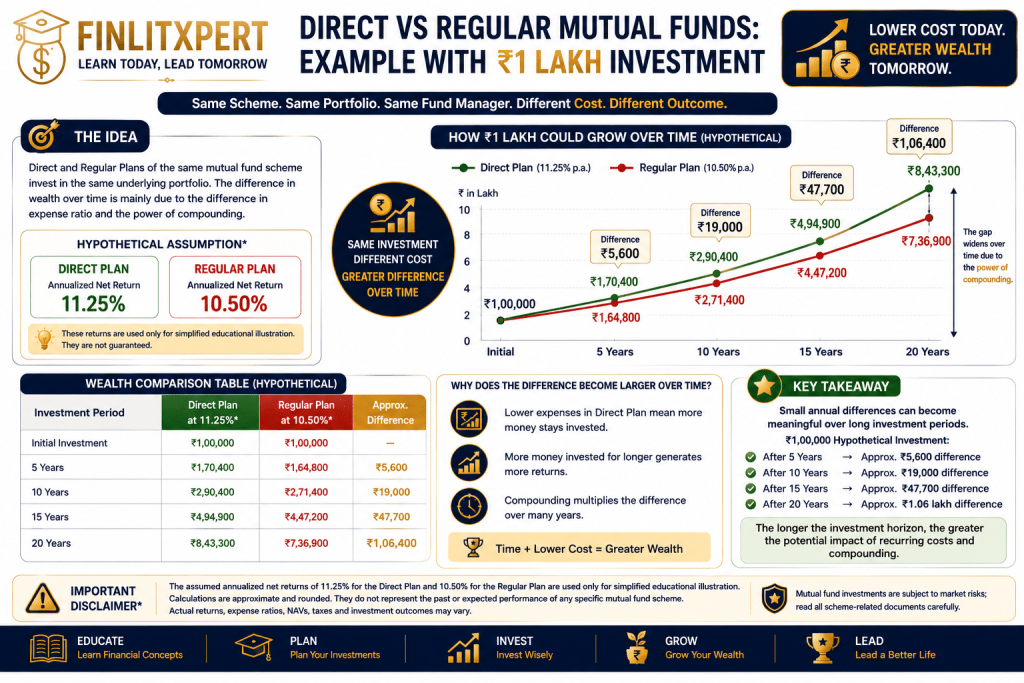
Suppose an investor makes a one-time investment of ₹1,00,000. For this hypothetical illustration, assume that the Direct Plan generates an annualized net return of 11.25%, while the Regular Plan generates 10.50%.
In the early years, the difference between the two investment values may appear relatively small. However, as the investment period becomes longer, compounding can gradually widen the gap. Lower recurring expenses allow more of the investment value to remain invested and potentially compound over time.
This does not mean that Direct Plans guarantee higher returns. Mutual fund returns are market-linked, and actual performance can vary. The example below simply demonstrates how a hypothetical difference in annualized net returns can affect the future value of the same initial investment over different time periods.This Direct vs Regular Mutual Funds guide explains the key differences, benefits, costs and practical considerations for investors.https://www.finlitxpert.com/finlitxpert-course-registration/
How ₹1 Lakh Could Grow Over 5, 10, 15 and 20 Years
| Investment Period | Direct Plan at 11.25%* | Regular Plan at 10.50%* | Approx. Difference |
|---|---|---|---|
| Initial Investment | ₹1,00,000 | ₹1,00,000 | — |
| 5 Years | ₹1,70,400 | ₹1,64,800 | ₹5,600 |
| 10 Years | ₹2,90,400 | ₹2,71,400 | ₹19,000 |
| 15 Years | ₹4,94,900 | ₹4,47,200 | ₹47,700 |
| 20 Years | ₹8,43,300 | ₹7,36,900 | ₹1,06,400 |
In this simplified illustration, both investors start with the same ₹1,00,000 investment. After five years, the difference between the two accumulated values is relatively modest at approximately ₹5,600.
After 10 years, the gap increases to around ₹19,000. By 15 years, it grows to approximately ₹47,700, and after 20 years, the difference reaches roughly ₹1.06 lakh.
This widening gap demonstrates the power of compounding. When the difference in net annual returns continues year after year, even a seemingly small percentage difference can have a meaningful impact on accumulated wealth over a long investment horizon.
However, investors should not assume that these exact returns will continue every year. Actual mutual fund performance fluctuates with market conditions, and expense ratios can also change. The example is intended only to explain the mathematical impact of a hypothetical return difference.https://www.finlitxpert.com/finlitxpert-course-registration/
Why Does the Difference Become Larger Over Time?
Compounding means that investment returns can generate additional returns over time. When recurring expenses are lower, a larger portion of the investment value remains invested and participates in future growth.
For the same mutual fund scheme, a Direct Plan generally has a lower expense ratio than its Regular Plan. Therefore, assuming all other factors remain equal, the difference in recurring costs can gradually create a difference in NAV and accumulated investment value.
The longer the investment horizon, the more opportunity compounding has to magnify this difference. This is why investors should understand the long-term impact of costs when comparing Direct vs Regular Mutual Funds.
KEY TAKEAWAY
Small annual differences can become meaningful over long investment periods.
₹1,00,000 Hypothetical Investment:
- After 5 Years → Approx. ₹5,600 difference
- After 10 Years → Approx. ₹19,000 difference
- After 15 Years → Approx. ₹47,700 difference
- After 20 Years → Approx. ₹1.06 lakh difference
The longer the investment horizon, the greater the potential impact of recurring costs and compounding.
These figures are hypothetical and do not represent guaranteed mutual fund returns.
*The assumed annualized net returns of 11.25% for the Direct Plan and 10.50% for the Regular Plan are used only for simplified educational illustration. Calculations are approximate and rounded. They do not represent the past or expected performance of any specific mutual fund scheme. Actual returns, expense ratios, NAVs, taxes and investment outcomes may vary. Mutual fund investments are subject to market risks; read all scheme-related documents carefully.
Advantages and Disadvantages of Direct Mutual Funds
Direct Mutual Funds can be an attractive option for investors who prefer to manage their investments independently and want to reduce recurring investment costs. Because Direct Plans do not include distributor commissions in their plan expenses, they generally have lower expense ratios than Regular Plans of the same mutual fund scheme.
However, lower costs do not automatically make Direct Plans suitable for every investor. Investors choosing Direct Mutual Funds usually need to take greater responsibility for selecting suitable schemes, understanding risk, maintaining proper asset allocation, reviewing their portfolio and avoiding emotional investment decisions.
Before choosing a Direct Plan, it is important to understand both its advantages and disadvantages.This Direct vs Regular Mutual Funds guide explains the key differences, benefits, costs and practical considerations for investors.https://www.finlitxpert.com/finlitxpert-traderx-live-2026/
Advantages of Direct Mutual Funds
One of the biggest advantages of Direct Mutual Funds is their lower expense ratio. Since distributor commissions are not included in Direct Plan expenses, the recurring cost is generally lower than that of the Regular Plan of the same scheme.
Lower recurring expenses allow a larger portion of the investment value to remain invested. Over long periods, this cost advantage can contribute to relatively higher net returns through compounding, assuming all other factors remain equal.
Direct Plans also give investors greater control over their investment decisions. Investors can independently research schemes, compare funds, select investments according to their financial goals and manage their portfolios without depending on a distributor.
For knowledgeable and disciplined investors who are comfortable evaluating mutual funds and managing their own portfolios, Direct Plans can provide a cost-efficient way to invest.
KEY ADVANTAGES OF DIRECT MUTUAL FUNDS
- Lower Expense Ratio — Direct Plans generally have lower recurring expenses than Regular Plans of the same scheme.
- No Distributor Commission in Plan Expenses — Distribution commissions are not included in the expenses of Direct Plans.
- Potential for Relatively Higher Net Returns — Lower recurring costs can contribute to better long-term net returns, all else being equal.
- Greater Investment Control — Investors can independently select, monitor and manage their mutual fund investments.
- Suitable for Self-Directed Investors — Direct Plans may suit investors who have sufficient knowledge, time and confidence to make their own investment decisions.
- Long-Term Cost Efficiency — Even a small reduction in recurring expenses can become meaningful over long investment periods due to compounding.
Disadvantages of Direct Mutual Funds
The main challenge of investing through Direct Plans is that investors generally need to make their own investment decisions. Choosing a mutual fund involves more than comparing past returns. Investors need to understand their financial goals, risk tolerance, investment horizon, asset allocation and the characteristics of different mutual fund categories.
Without adequate knowledge, an investor may select an unsuitable scheme, chase recent performance, invest in too many similar funds or make emotional decisions during market volatility. These mistakes can have a much greater impact on investment outcomes than the savings achieved through a lower expense ratio.
Direct investors must also take responsibility for periodically reviewing their portfolios, rebalancing when necessary and ensuring that their investments continue to align with their financial goals.
Therefore, Direct Mutual Funds may not be the most suitable option for investors who lack the knowledge, time or confidence required to manage their investments independently.This Direct vs Regular Mutual Funds guide explains the key differences, benefits, costs and practical considerations for investors.https://www.finlitxpert.com/finlitxpert-course-registration/
POTENTIAL DISADVANTAGES OF DIRECT MUTUAL FUNDS
- Requires Investment Knowledge — Investors need to understand mutual fund categories, risks and scheme suitability.
- Self-Selection Responsibility — Choosing the right fund and asset allocation is primarily the investor’s responsibility.
- Limited Distributor Hand-Holding — Investors do not receive the distributor assistance associated with a Regular Plan.
- Requires Portfolio Monitoring — Investments should be reviewed periodically to ensure they remain aligned with financial goals.
- Risk of Behavioural Mistakes — Chasing returns, panic selling or frequently switching funds can negatively affect long-term outcomes.
- Not Ideal for Every Beginner — Investors who are unsure about fund selection or financial planning may benefit from obtaining appropriate professional guidance.
KEY TAKEAWAY
Direct Mutual Funds offer an important cost advantage, but lower cost alone does not guarantee better investment decisions.
DIRECT PLAN MAY BE SUITABLE IF YOU:
✓ Can research and compare mutual funds independently
✓ Understand your risk profile and financial goals
✓ Can create and maintain appropriate asset allocation
✓ Have the discipline to stay invested during market volatility
✓ Can periodically review your portfolio
THINK CAREFULLY IF YOU:
✗ Choose funds only by looking at recent returns
✗ Do not understand mutual fund risks or categories
✗ Frequently change investments based on market movements
✗ Need regular assistance with investment decisions
The right mutual fund plan should balance cost efficiency with your knowledge, financial goals, risk profile and need for guidance.

Advantages and Disadvantages of Regular Mutual Funds
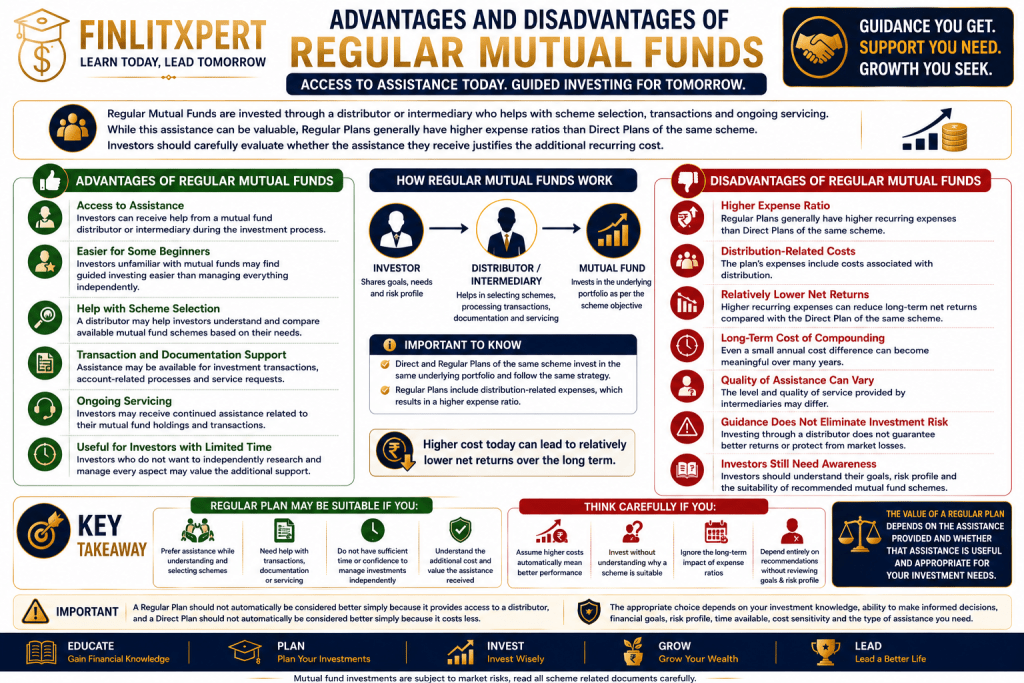
Regular Mutual Funds may be suitable for investors who prefer assistance while selecting, investing in and managing mutual fund schemes. In a Regular Plan, the investment is made through a mutual fund distributor or intermediary who may help with scheme selection, transactions, documentation and ongoing servicing.
However, this distribution model comes with additional costs. Regular Plans generally have higher expense ratios than Direct Plans of the same mutual fund scheme because distribution-related expenses are included in the plan’s costs. Over a long investment period, these higher recurring expenses can affect net returns and accumulated wealth.
Therefore, investors should evaluate both the benefits and limitations of Regular Mutual Funds before deciding whether the assistance they receive justifies the additional recurring cost.This Direct vs Regular Mutual Funds guide explains the key differences, benefits, costs and practical considerations for investors.https://www.finlitxpert.com/finlitxpert-course-registration/
Advantages of Regular Mutual Funds
One of the main advantages of Regular Mutual Funds is access to assistance from a mutual fund distributor or intermediary. This can be useful for investors who are unfamiliar with mutual fund categories, investment procedures or the process of selecting schemes according to their financial needs.
A distributor may assist investors with understanding available mutual fund options, completing transactions, maintaining investment records and handling service-related requirements. This support can make the investment process easier for beginners or investors who do not have sufficient time or confidence to manage everything independently.
Regular Plans may also provide ongoing servicing, which can be valuable when investors need assistance with transactions or administrative matters. However, the nature and quality of assistance can vary, so investors should understand exactly what services they are receiving.Understanding Direct vs Regular Mutual Funds helps investors choose the right investment plan based on their financial goals, investment knowledge and long-term strategy.https://www.finlitxpert.com/
KEY ADVANTAGES OF REGULAR MUTUAL FUNDS
- Access to Assistance — Investors can receive help from a mutual fund distributor or intermediary during the investment process.
- Easier for Some Beginners — Investors unfamiliar with mutual funds may find guided investing easier than managing everything independently.
- Help with Scheme Selection — A distributor may help investors understand and compare available mutual fund schemes based on their stated needs.
- Transaction and Documentation Support — Assistance may be available for investment transactions, account-related processes and service requests.
- Ongoing Servicing — Investors may receive continued assistance related to their mutual fund holdings and transactions.
- Useful for Investors with Limited Time — Investors who do not want to independently research and manage every aspect of their mutual fund investments may value the additional support.
Disadvantages of Regular Mutual Funds
The most significant disadvantage of Regular Mutual Funds is their higher expense ratio compared with Direct Plans of the same scheme. Distribution-related expenses are included in Regular Plan costs, which means a larger portion of the scheme’s assets is used to cover recurring expenses.
Because Direct and Regular Plans of the same scheme generally invest in the same underlying portfolio, this additional cost can result in the Regular Plan generating relatively lower net returns over time, assuming all other factors remain equal. The annual difference may appear small, but compounding can make its long-term impact more significant.
Another important consideration is the quality and scope of the assistance provided. Paying higher recurring costs does not automatically guarantee comprehensive financial planning, unbiased advice or better investment outcomes. Investors should understand the role of the intermediary, evaluate the services received and avoid selecting schemes solely on the basis of recommendations without understanding their suitability.
Regular Plan investors should still understand their financial goals, risk profile, investment horizon and the basic characteristics of the schemes in which they invest.Understanding Direct vs Regular Mutual Funds helps investors choose the right investment plan based on their financial goals, investment knowledge and long-term strategy.https://www.finlitxpert.com/finlitxpert-course-registration/
POTENTIAL DISADVANTAGES OF REGULAR MUTUAL FUNDS
- Higher Expense Ratio — Regular Plans generally have higher recurring expenses than Direct Plans of the same scheme.
- Distribution-Related Costs — The plan’s expenses include costs associated with distribution.
- Relatively Lower Net Returns — Higher recurring expenses can reduce long-term net returns compared with the Direct Plan of the same scheme, all else being equal.
- Long-Term Cost of Compounding — Even a small annual cost difference can become meaningful over many years.
- Quality of Assistance Can Vary — The level and quality of service provided by intermediaries may differ.
- Guidance Does Not Eliminate Investment Risk — Investing through a distributor does not guarantee better returns or protect investors from market losses.
- Investors Still Need Awareness — Investors should understand their goals, risk profile and the suitability of recommended mutual fund schemes.
KEY TAKEAWAY
Regular Mutual Funds combine mutual fund investing with access to distributor assistance, but this convenience generally comes with higher recurring costs.
REGULAR PLAN MAY BE SUITABLE IF YOU:
✓ Prefer assistance while understanding and selecting mutual fund schemes
✓ Need help with transactions, documentation or servicing
✓ Do not have sufficient time or confidence to manage investments independently
✓ Understand the additional recurring cost and value the assistance received
THINK CAREFULLY IF YOU:
✗ Assume higher costs automatically mean better investment performance
✗ Invest without understanding why a particular scheme is suitable for you
✗ Ignore the long-term impact of expense ratios
✗ Depend entirely on recommendations without reviewing your goals and risk profile
The value of a Regular Plan depends not only on the assistance provided but also on whether that assistance is useful and appropriate for your investment needs.
IMPORTANT
A Regular Plan should not automatically be considered better simply because it provides access to a distributor, and a Direct Plan should not automatically be considered better simply because it costs less.
The appropriate choice depends on your investment knowledge, ability to make informed decisions, financial goals, risk profile, time available for portfolio management, cost sensitivity and the type of assistance you need.https://www.finlitxpert.com/
Who Should Choose Direct Mutual Funds?
Direct Mutual Funds may be suitable for investors who have the knowledge, time and confidence to make their own investment decisions without relying on a mutual fund distributor. Since Direct Plans generally have lower expense ratios than Regular Plans of the same scheme, they can offer a cost advantage that may contribute to relatively higher long-term net returns, all else being equal.
However, choosing a Direct Plan involves more than simply selecting the option with the lowest expense ratio. Investors need to identify suitable mutual fund categories, compare schemes, understand risk, maintain appropriate asset allocation and periodically review whether their investments remain aligned with their financial goals.
Therefore, Direct Mutual Funds are generally more appropriate for self-directed investors who can independently manage both the technical and behavioural aspects of long-term investing.Understanding Direct vs Regular Mutual Funds helps investors choose the right investment plan based on their financial goals, investment knowledge and long-term strategy.https://www.finlitxpert.com/finlitxpert-traderx-live-2026/
Direct Mutual Funds May Be Suitable for These Investors
- INVESTORS WITH MUTUAL FUND KNOWLEDGE
Direct Plans may suit investors who understand basic mutual fund concepts such as equity, debt and hybrid funds, risk levels, expense ratios, asset allocation, investment horizons and scheme suitability.
- SELF-DIRECTED INVESTORS
Investors who are comfortable researching, comparing and selecting mutual fund schemes independently may prefer Direct Plans.
- COST-CONSCIOUS LONG-TERM INVESTORS
Because Direct Plans generally have lower expense ratios than Regular Plans of the same scheme, investors focused on reducing recurring costs may benefit from the cost efficiency of Direct investing.
- INVESTORS WHO CAN ASSESS THEIR OWN RISK PROFILE
Direct investors should be able to evaluate their risk tolerance, financial goals and investment horizon before selecting suitable mutual fund categories.
- INVESTORS WHO CAN MAINTAIN ASSET ALLOCATION
Selecting individual funds is only one part of investing. Investors should also know how much to allocate across equity, debt and other suitable asset classes according to their financial plan.
- DISCIPLINED LONG-TERM INVESTORS
Direct Plans may suit investors who can remain disciplined during market volatility and avoid emotional decisions such as panic selling, chasing recent returns or frequently switching funds.
- INVESTORS WHO CAN REVIEW THEIR PORTFOLIO PERIODICALLY
Investors should be capable of reviewing fund performance, portfolio overlap, asset allocation and goal alignment periodically without reacting unnecessarily to short-term market movements.
Direct Mutual Fund Self-Check: Is a Direct Plan Right for You?
DIRECT PLAN SELF-CHECK
Ask yourself:
✓ Do I understand the basic types of mutual funds and their risks?
✓ Can I identify my financial goals and investment time horizon?
✓ Do I understand my risk tolerance?
✓ Can I select suitable mutual fund categories instead of simply choosing recent top performers?
✓ Can I create and maintain appropriate asset allocation?
✓ Can I compare schemes using more than past returns alone?
✓ Can I stay disciplined during major market volatility?
✓ Can I periodically review and rebalance my portfolio when necessary?
✓ Am I comfortable managing investments without relying on distributor assistance?
If you can confidently handle most of these responsibilities, a Direct Plan may be worth considering.
If you are unsure about several of these areas, seeking appropriate professional guidance before making investment decisions may be more suitable.https://www.finlitxpert.com/finlitxpert-course-registration/
Example of an Investor Who May Prefer a Direct Plan
Consider an investor who understands mutual fund categories, has clearly defined long-term financial goals, knows their risk profile and has created an appropriate asset allocation strategy.
The investor is comfortable researching schemes independently, understands that recent high returns do not guarantee future performance and can remain invested during market volatility without making impulsive decisions.
Such an investor may prefer Direct Mutual Funds because the additional distributor assistance available through a Regular Plan may not be necessary for their needs. The lower expense ratio of a Direct Plan can then provide a cost advantage over the long term.
However, this example does not mean that every experienced investor must choose Direct Plans. The appropriate choice depends on individual needs, knowledge and the type of assistance required.Understanding Direct vs Regular Mutual Funds helps investors choose the right investment plan based on their financial goals, investment knowledge and long-term strategy.
KEY TAKEAWAY
DIRECT MUTUAL FUNDS MAY BE SUITABLE FOR YOU IF YOU CAN:
✓ Research and compare mutual funds independently
✓ Understand your financial goals and risk profile
✓ Select suitable funds and maintain proper asset allocation
✓ Understand the impact of costs and expense ratios
✓ Stay disciplined during market volatility
✓ Review your portfolio periodically
✓ Make informed decisions without depending on distributor assistance
REMEMBER:
Choosing a Direct Plan can reduce recurring costs, but lower costs cannot compensate for unsuitable fund selection, poor asset allocation or emotional investment decisions.
The goal is not simply to choose the cheapest plan—it is to choose an investment approach that you can manage effectively over the long term.
IMPORTANT
Being a beginner does not automatically mean that you must choose a Regular Plan, and being an experienced investor does not automatically mean that you must choose a Direct Plan.
Your choice should depend on your investment knowledge, ability to evaluate suitable schemes, financial goals, risk profile, time available for portfolio management and need for assistance.https://www.finlitxpert.com/

Who Should Choose Regular Mutual Funds?
Regular Mutual Funds may be suitable for investors who prefer assistance when selecting, investing in and managing mutual fund schemes. In a Regular Plan, investors invest through a mutual fund distributor or intermediary who may help them understand available schemes, complete transactions, handle service-related requirements and provide ongoing support.
Regular Plans generally have higher expense ratios than Direct Plans of the same scheme because distribution-related expenses are included in the plan costs. Therefore, investors choosing a Regular Plan should consider whether the assistance and servicing they receive provide sufficient value for the additional recurring cost.
For investors who lack the time, knowledge or confidence to independently research mutual funds and manage their portfolios, a Regular Plan may offer a more assisted investment experience. However, investing through a distributor does not eliminate market risk or guarantee that every recommended scheme will be suitable. Investors should still understand their financial goals, risk profile and the basic reasons behind their investment decisions.Understanding Direct vs Regular Mutual Funds helps investors choose the right investment plan based on their financial goals, investment knowledge and long-term strategy.https://www.finlitxpert.com/finlitxpert-course-registration/
Regular Mutual Funds May Be Suitable for These Investors
- BEGINNERS WHO NEED ASSISTANCE
Regular Plans may be suitable for beginners who are unfamiliar with mutual fund categories, investment processes, risk levels and scheme selection and would prefer assistance while getting started.
- INVESTORS WHO ARE NOT CONFIDENT ABOUT FUND SELECTION
Investors who find it difficult to compare mutual fund schemes or determine which categories may align with their financial goals may value assistance from a distributor or intermediary.
- INVESTORS WITH LIMITED TIME
Some investors may not have sufficient time to independently research schemes, track investments, handle transactions and manage service-related requirements. They may prefer the convenience of an assisted investment process.
- INVESTORS WHO NEED TRANSACTION AND SERVICING SUPPORT
A Regular Plan may be useful for investors who prefer assistance with investment transactions, documentation, account-related processes and ongoing service requests.
- INVESTORS WHO VALUE HUMAN INTERACTION
Some investors feel more comfortable discussing their investment-related questions with a person rather than managing the entire process independently through digital platforms.
- INVESTORS WHO MAY NEED BEHAVIOURAL SUPPORT
Market volatility can lead to emotional decisions such as panic selling or chasing recent performance. Access to appropriate guidance may help some investors maintain greater investment discipline, although this depends on the quality of the assistance provided.
- INVESTORS WHO UNDERSTAND THE COST OF ASSISTANCE
Regular Plans may be appropriate for investors who understand that distribution-related expenses contribute to a higher expense ratio and believe the assistance and servicing they receive justify that additional recurring cost.https://www.finlitxpert.com/
Regular Mutual Fund Self-Check: Is a Regular Plan Right for You?
REGULAR PLAN SELF-CHECK
Ask yourself:
✓ Am I unsure how to select suitable mutual fund categories or schemes?
✓ Do I need assistance understanding my investment options?
✓ Would I prefer help with transactions, documentation or servicing?
✓ Do I have limited time to research and manage mutual fund investments independently?
✓ Do I value having a person available to discuss investment-related questions?
✓ Am I more likely to stay disciplined if I receive appropriate guidance during market volatility?
✓ Do I understand that Regular Plans generally have higher expense ratios than Direct Plans of the same scheme?
✓ Have I evaluated whether the assistance I receive provides reasonable value for the additional recurring cost?
If you value ongoing assistance and understand the associated costs, a Regular Plan may be worth considering.
If you can confidently research, select and manage suitable mutual funds independently, you may also compare whether a lower-cost Direct Plan better suits your needs.Understanding Direct vs Regular Mutual Funds helps investors choose the right investment plan based on their financial goals, investment knowledge and long-term strategy.
Example of an Investor Who May Prefer a Regular Plan
Consider a beginner who wants to invest in mutual funds for long-term financial goals but does not yet understand the differences between equity, debt and hybrid funds, how to assess risk or how to compare schemes.
The investor has limited time to research mutual funds independently and prefers assistance with understanding available options, completing transactions and handling ongoing service requirements.
Such an investor may prefer a Regular Plan if the assistance provided is useful and helps them make more informed and disciplined investment decisions. The investor should, however, understand that the Regular Plan generally has a higher expense ratio than the Direct Plan of the same scheme.
As the investor gains knowledge and experience, they can periodically reassess whether the services and assistance received continue to justify the additional recurring cost.https://www.finlitxpert.com/finlitxpert-course-registration/
What Should You Check Before Choosing a Regular Plan?
BEFORE CHOOSING A REGULAR PLAN, ASK:
- What specific assistance or services will I receive?
- Does the person assisting me understand my financial goals, risk profile and investment horizon?
- Do I understand why a particular mutual fund scheme is being suggested?
- Have the risks and costs been clearly explained to me?
- Do I understand that the Regular Plan has a higher expense ratio than the Direct Plan of the same scheme?
- Am I receiving meaningful ongoing assistance rather than only transaction support?
- Does the value of the assistance justify the additional recurring cost for my needs?
Never invest in a mutual fund only because someone recommends it. Understand the scheme, its risks and why it may or may not be suitable for your financial goals.
KEY TAKEAWAY
REGULAR MUTUAL FUNDS MAY BE SUITABLE FOR YOU IF YOU:
✓ Prefer assistance with understanding and selecting mutual funds
✓ Need help with transactions, documentation or servicing
✓ Have limited time or confidence to manage investments independently
✓ Value human interaction and ongoing support
✓ Understand the higher recurring cost of a Regular Plan
✓ Believe the assistance received provides meaningful value https://www.finlitxpert.com/
REMEMBER:
A higher expense ratio does not automatically mean better advice or better investment performance.
The key question is whether the assistance you receive helps you make suitable, informed and disciplined investment decisions that justify the additional recurring cost.
IMPORTANT
Choosing a Regular Plan does not remove investment risk, and choosing a Direct Plan does not automatically make someone a better investor.
Direct and Regular Plans are different routes to invest in the same mutual fund scheme. The appropriate route depends on your knowledge, confidence, financial goals, risk profile, need for assistance and willingness to bear the associated costs.

How to Identify a Direct or Regular Mutual Fund Plan
Many first-time investors are unsure whether they have invested in a Direct Plan or a Regular Plan. Fortunately, identifying the type of mutual fund plan is usually straightforward once you know what to look for.
The easiest way to identify a plan is by checking its official scheme name. In India, mutual fund schemes clearly mention whether they are Direct or Regular. You can also verify the plan type through your investment platform, account statement, Consolidated Account Statement (CAS) or the official website of the respective Asset Management Company (AMC).
Knowing whether you hold a Direct or Regular Plan is important because both plans of the same mutual fund scheme generally invest in the same underlying portfolio but differ in expense ratios, Net Asset Value (NAV) and long-term net returns due to differences in recurring costs.Understanding Direct vs Regular Mutual Funds helps investors choose the right investment plan based on their financial goals, investment knowledge and long-term strategy.SEBI – Securities and Exchange Board of India
Check the Scheme Name
The official scheme name is the simplest way to identify the plan.
Examples:
ABC Flexi Cap Fund – Direct Plan – Growth
ABC Flexi Cap Fund – Regular Plan – Growth
If the scheme name contains the words “Direct Plan”, it is a Direct Mutual Fund.
If the scheme name contains the words “Regular Plan”, it is a Regular Mutual Fund.
Always refer to the complete official scheme name before investing.
Check Your Investment Platform
Most mutual fund investment platforms clearly display whether your investment is in a Direct Plan or a Regular Plan.
You can usually verify this information by viewing:
- Portfolio page
- Investment details
- Holdings section
- Scheme details
- Transaction history
The plan type is normally shown together with the scheme name.
Check Your Account Statement or CAS
Your mutual fund account statement or Consolidated Account Statement (CAS) generally displays the complete scheme name exactly as registered.
Look carefully for:
- Direct Plan
or
- Regular Plan
The statement also shows folio number, units held, NAV, investment value and transaction history, making it one of the most reliable ways to verify your investment.
Verify on the AMC Website
If you are unsure about your investment, you can verify the scheme directly through the official website of the Asset Management Company (AMC).
Using your folio details or account information, you can usually confirm:
- Scheme name
- Plan type
- Growth or IDCW option
- NAV
- Holdings
Always use the official AMC website when verifying scheme information.AMFI – Association of Mutual Funds in India
Direct vs Regular Is Different from Growth vs IDCW
Many beginners confuse Direct and Regular Plans with Growth and IDCW options. These are different concepts.The choice between Direct vs Regular Mutual Funds should be based on your financial goals, risk profile and need for investment assistance.
Direct and Regular describe how you invest in the mutual fund.
Growth and IDCW describe how investment gains are treated within the scheme.
For example:
ABC Flexi Cap Fund – Direct Plan – Growth
ABC Flexi Cap Fund – Direct Plan – IDCW
ABC Flexi Cap Fund – Regular Plan – Growth
ABC Flexi Cap Fund – Regular Plan – IDCW
These combinations are possible because the plan type and payout option are separate choices.
Beginner Checklist
BEFORE YOU INVEST, CHECK:
✓ Does the scheme name clearly mention Direct Plan or Regular Plan?
✓ Have you confirmed the plan type on your investment platform?
✓ Have you verified the complete scheme name?
✓ Do you understand the difference between Direct/Regular and Growth/IDCW?
✓ Are you investing in the plan you actually intended to choose?
Taking a few minutes to verify these details can help avoid mistakes before investing.
| Check | Direct Plan | Regular Plan |
|---|---|---|
| Scheme Name | Contains Direct Plan | Contains Regular Plan |
| Investment Route | Directly with the AMC or a Direct investment platform | Through a distributor or intermediary |
| Expense Ratio | Generally Lower | Generally Higher |
| Portfolio | Same scheme portfolio | Same scheme portfolio |
| Fund Manager | Same | Same |
| Growth/IDCW | Available | Available |
KEY TAKEAWAY
Identifying a Direct or Regular Mutual Fund Plan is usually simple.
Remember these three steps:
✓ Read the complete scheme name.
✓ Verify the plan on your investment platform or account statement.
✓ Understand that Direct/Regular and Growth/IDCW are different concepts.
A small verification before investing can help ensure you choose the plan that matches your investment decision.

Can You Switch from Regular to Direct Mutual Funds?
Yes, it is generally possible to switch from a Regular Mutual Fund Plan to the Direct Plan of the same mutual fund scheme. However, many investors misunderstand what this “switch” actually means.
From a taxation and transaction perspective, switching from a Regular Plan to a Direct Plan is generally treated as a redemption of units from the Regular Plan followed by a fresh purchase into the Direct Plan. Because of this, the transaction may have tax implications and, if applicable, exit load implications.
Therefore, investors should not switch solely because they discover that Direct Plans generally have lower expense ratios. Before switching, it is important to understand the tax impact, exit load, investment horizon, financial goals and whether the expected long-term cost savings outweigh the immediate costs of switching.Many beginners compare Direct vs Regular Mutual Funds to understand which plan is more suitable for long-term wealth creation.https://www.finlitxpert.com/finlitxpert-course-registration/
How Does Switching from Regular to Direct Work?
When you switch from a Regular Plan to the Direct Plan of the same mutual fund scheme, your investment is not simply “converted.”
Instead, the process generally involves two separate transactions:
Step 1:
Your units in the Regular Plan are redeemed.
Step 2:
The redemption amount is invested into the Direct Plan of the same scheme.
Although the underlying investment objective and portfolio may remain the same, the transaction itself is generally treated as a redemption followed by a fresh investment for taxation purposes.
Can Capital Gains Tax Apply?
Yes. Because switching is generally treated as a redemption, capital gains tax may apply depending on factors such as:
- The type of mutual fund (for example, equity-oriented or debt-oriented)
- How long the investment was held
- The applicable tax rules at the time of redemption
The exact tax treatment depends on the relevant tax laws in force when the transaction takes place. Investors should calculate the potential tax impact before deciding to switch.
Can Exit Load Apply?
Possibly.
If the Regular Plan units are redeemed before the applicable exit load period has expired, the mutual fund may deduct an exit load according to the scheme’s terms.
Not every scheme has an exit load, and the exit load period and percentage differ from one mutual fund scheme to another.
Always check the Scheme Information Document (SID), Key Information Memorandum (KIM) or the latest scheme details before initiating a switch.
When Might Switching Make Sense?
A switch may be worth considering when:
✓ You understand how Direct Plans work.
✓ You are comfortable managing your investments independently.
✓ The long-term savings from lower recurring expenses are expected to outweigh any immediate tax or exit load costs.
✓ You have evaluated your financial goals, investment horizon and portfolio strategy.
However, every investor’s situation is different. A decision that is appropriate for one investor may not be suitable for another.https://www.finlitxpert.com/finlitxpert-traderx-live-2026/
When Should You Think Carefully Before Switching?
You may want to evaluate the decision more carefully if:
- A significant capital gains tax may become payable.
- An exit load still applies.
- You are close to achieving your investment goal.
- You still prefer ongoing assistance from a distributor or intermediary.
- You are switching only because someone said Direct Plans are always better.
Switching should be part of a broader investment decision rather than a reaction to a single factor.
Simple Switching Process
REGULAR PLAN
↓
Redeem Units
↓
Redemption Proceeds
↓
Purchase Direct Plan
↓
DIRECT PLAN
Common Mistakes While Switching
Avoid these common mistakes:
✗ Ignoring capital gains tax.
✗ Forgetting to check exit load.
✗ Assuming switching is free.
✗ Switching without understanding Direct Plans.
✗ Switching only because of lower expense ratios.
✗ Not reviewing your financial goals before switching.
KEY TAKEAWAY
Switching from a Regular Plan to a Direct Plan is generally possible, but it should not be viewed as a simple plan conversion.
Remember:
✓ It is generally treated as a redemption followed by a fresh investment.
✓ Capital gains tax may apply.
✓ Exit load may apply.
✓ Lower expense ratios can benefit long-term investing, but taxes and switching costs should also be considered.
✓ Evaluate the overall impact before making your decision.
The best choice is the one that supports your long-term financial goals after considering costs, taxes, investment knowledge and the need for assistance.
IMPORTANT
Tax laws, mutual fund regulations, exit load structures and scheme terms can change over time. Before switching from a Regular Plan to a Direct Plan, review the latest Scheme Information Document (SID), Key Information Memorandum (KIM), applicable tax rules and consult a qualified tax or financial professional if needed.https://www.finlitxpert.com/

Common Myths About Direct and Regular Mutual Funds
There are many misconceptions about Direct and Regular Mutual Funds. Some investors believe that Direct Plans are always the best choice, while others assume that Regular Plans invest in lower-quality portfolios or that higher NAV automatically means a better fund.
These beliefs can lead to poor investment decisions because they focus on isolated facts instead of the complete picture. In reality, choosing between Direct and Regular Mutual Funds requires understanding investment costs, portfolio suitability, financial goals, risk profile, investment knowledge and the value of professional assistance.Understanding Direct vs Regular Mutual Funds helps investors choose the right investment plan based on their financial goals, investment knowledge and long-term strategy.
Let’s separate common myths from factual information.
Myth 1: Direct Mutual Funds Are Always Better
FACT:
Direct Plans generally have lower expense ratios than Regular Plans of the same scheme, which can contribute to relatively higher long-term net returns.
However, lower costs alone do not make Direct Plans automatically better for every investor.
Investors who are unable to select suitable funds, maintain proper asset allocation or remain disciplined during market volatility may not benefit from choosing a Direct Plan solely because it costs less.
The best choice depends on the investor—not only on the expense ratio.
Myth 2: Regular Mutual Funds Invest in Lower-Quality Portfolios
FACT:
This is incorrect.
For the same mutual fund scheme, Direct and Regular Plans generally invest in exactly the same underlying portfolio.
They also have:
- the same investment objective
- the same fund manager
- the same securities
- the same investment strategy
The difference lies primarily in the expense ratio and distribution-related costs—not the quality of investments.https://www.finlitxpert.com/finlitxpert-traderx-live-2026/
Myth 3: Direct and Regular Plans Invest in Different Funds
FACT:
No.
A Direct Plan and the Regular Plan are simply two different investment routes for the same mutual fund scheme.
The portfolio, fund manager and investment strategy generally remain the same.
Only the plan structure and recurring expenses differ.
Myth 4: Higher NAV Means a Better Mutual Fund
FACT:
A higher NAV does not indicate that a mutual fund is better or more expensive.
NAV simply represents the per-unit value of the mutual fund on a given day.
Many excellent funds have lower NAVs, while some funds with higher NAVs may not necessarily deliver better long-term performance.
Investment decisions should be based on suitability, portfolio quality, financial goals, risk profile and consistency rather than NAV alone.
Myth 5: Beginners Should Never Invest in Direct Plans
FACT:
Not necessarily.
Some beginners are willing to learn, research and manage their investments independently.
Others may prefer assistance through a Regular Plan while they build investment knowledge.
The appropriate choice depends on the individual’s confidence, knowledge, available time and willingness to manage investments—not simply on whether they are a beginner.https://www.finlitxpert.com/finlitxpert-course-registration/
Myth 6: Switching to Direct Plans Always Saves Money
FACT:
Not always.
Switching from a Regular Plan to a Direct Plan may trigger capital gains tax and, where applicable, exit load.
The long-term savings from lower recurring expenses should be compared with the immediate costs of switching before making a decision.
Every situation is different.
Myth 7: Lower Expense Ratio Guarantees Higher Returns
FACT:
A lower expense ratio can improve net returns, all else being equal.
However, mutual fund returns also depend on:
- Market performance
- Portfolio construction
- Asset allocation
- Investment duration
- Risk management
- Investor behaviour
Lower costs are beneficial, but they do not guarantee superior investment performance.
Myth vs Fact Comparison Table
| Myth | Reality |
|---|---|
| Direct Plans are always better | The right choice depends on the investor’s needs and knowledge. |
| Regular Plans invest in different portfolios | Both plans generally invest in the same portfolio. |
| Higher NAV means a better fund | NAV alone does not indicate fund quality. |
| Beginners must choose Regular Plans | Suitability depends on the individual, not experience alone. |
| Direct Plans always save money | Taxes and exit loads may affect switching decisions. |
| Lower expense ratio guarantees better returns | Costs matter, but they are only one part of investment performance. |
Beginner Checklist
Before believing investment advice on social media or from friends, ask:
✓ Is the information factually correct?
✓ Does it apply to my financial goals?
✓ Have I understood the costs involved?
✓ Am I considering taxes and exit loads?
✓ Have I verified the information using reliable sources?
✓ Am I making this decision because it suits me—or because someone said one option is always better?
KEY TAKEAWAY
The biggest investment mistakes often begin with common myths.
Remember:
✓ Direct Plans are not automatically better.
✓ Regular Plans are not automatically worse.
✓ Higher NAV does not mean a better fund.
✓ Lower expense ratios do not guarantee higher returns.
✓ Choose the investment route that matches your knowledge, financial goals, risk profile and need for assistance.
Good investing starts with facts—not assumptions.
IMPORTANT
Avoid making investment decisions based solely on social media posts, advertisements or popular opinions.
Always evaluate mutual funds using reliable information, understand the associated costs and risks, and ensure that the investment is suitable for your personal financial goals and risk tolerance.https://www.finlitxpert.com/

Frequently Asked Questions (FAQs) About Direct vs Regular Mutual Funds
Choosing between Direct and Regular Mutual Funds often raises several common questions, especially for first-time investors. Below are answers to some of the most frequently asked questions to help you understand the differences, costs, suitability and investment implications of both plans. These answers are intended for educational purposes and should not be considered personalized investment advice.
Which is better: Direct or Regular Mutual Funds?
Neither option is universally better. Direct Plans generally have lower expense ratios and may offer relatively higher long-term net returns, all else being equal. Regular Plans may be suitable for investors who value assistance with scheme selection, transactions and ongoing servicing. The appropriate choice depends on your investment knowledge, financial goals, risk profile, available time and need for guidance.
Are Direct Mutual Funds safe?
Yes. A Direct Plan and the Regular Plan of the same mutual fund scheme generally invest in the same underlying portfolio and are managed according to the same investment strategy. The investment risk comes from the underlying securities and market movements, not from whether the plan is Direct or Regular.
Do Direct and Regular Mutual Funds invest in different portfolios?
No. For the same mutual fund scheme, Direct and Regular Plans generally invest in the same portfolio, follow the same investment objective and are managed by the same fund manager. The primary difference is the expense ratio and the investment route.
Why is the NAV different in Direct and Regular Plans?
The NAV differs because the expense ratios differ. Direct Plans generally have lower recurring expenses, while Regular Plans include distribution-related costs. Over time, this difference in expenses is reflected in different NAVs.
Why do Direct Mutual Funds generally show higher returns?
Direct Plans generally have lower expense ratios than Regular Plans of the same scheme. Lower recurring costs allow a larger portion of the investment value to remain invested, which can contribute to relatively higher net returns over the long term, assuming all other factors remain equal.
Can beginners invest in Direct Mutual Funds?
Yes. However, beginners should first assess whether they can independently research mutual funds, understand risk, maintain asset allocation and review their portfolio. Some beginners may prefer a Regular Plan if they value investment assistance, while others may be comfortable managing Direct Plans independently.
Can I switch from a Regular Plan to a Direct Plan?
Yes, it is generally possible. However, the switch is typically treated as a redemption from the Regular Plan followed by a fresh purchase into the Direct Plan. Depending on the circumstances, capital gains tax and exit load may apply.
Can I invest in both Direct and Regular Plans?
Yes. Investors can hold investments in both Direct and Regular Plans, provided they understand the cost differences and maintain a portfolio that aligns with their financial goals and overall investment strategy.
Which plan has a lower expense ratio?
For the same mutual fund scheme, the Direct Plan generally has a lower expense ratio because distributor commissions are not included in its plan expenses.
Does a Regular Plan guarantee better investment advice?
No. A Regular Plan provides access to a distributor or intermediary, but the quality and scope of assistance can vary. Investors should evaluate the value of the services they receive rather than assuming that higher costs automatically result in better advice or better investment outcomes.https://www.finlitxpert.com/
KEY TAKEAWAY
The answers to these common questions highlight one important principle:
There is no single plan that is right for every investor.
The appropriate choice depends on your financial goals, investment knowledge, risk profile, need for assistance and long-term investment strategy—not on popular opinions or marketing claims.
How can I identify whether my mutual fund is Direct or Regular?
Check the complete scheme name in your investment account, Consolidated Account Statement (CAS), or on the Asset Management Company (AMC) website. If the scheme name includes “Direct Plan,” it is a Direct Mutual Fund. If it includes “Regular Plan,” it is a Regular Mutual Fund.
Is SIP available in both Direct and Regular Mutual Funds?
Yes. Both Direct Plans and Regular Plans generally allow investments through a Systematic Investment Plan (SIP), subject to the scheme’s terms and minimum investment requirements.
Which plan is better for long-term investing?
For investors who can independently manage their investments, Direct Plans may provide a long-term cost advantage because of their generally lower expense ratios. However, investors who benefit from ongoing assistance may find that a Regular Plan better suits their needs despite the higher recurring cost.
Is the fund manager different for Direct and Regular Plans?
No. Direct and Regular Plans of the same mutual fund scheme are generally managed by the same fund manager and follow the same investment strategy.
Is taxation different for Direct and Regular Mutual Funds?
The applicable tax rules generally depend on the type of mutual fund and the nature of the transaction, not simply on whether the plan is Direct or Regular. However, switching between plans may have tax implications because it is generally treated as a redemption followed by a fresh investment.
Can I change from Direct to Regular later?
Yes. Subject to the applicable scheme rules and investment platform processes, investors can generally move between Direct and Regular Plans. As with other switches, investors should consider possible tax implications, exit load and the overall impact before making a decision.
Does a lower expense ratio guarantee better performance?
No. A lower expense ratio can improve net returns if all other factors remain equal, but mutual fund performance also depends on market conditions, portfolio construction, asset allocation, investment duration and investor behaviour.
Should I choose a Direct Plan only because it costs less?
No. Cost is an important consideration, but it should not be the only factor. You should also evaluate your financial goals, investment knowledge, risk profile, ability to manage investments independently and the value of any assistance you may require.
Can I hold both Direct and Regular Plans of the same mutual fund scheme?
In many cases, investors can hold both Direct and Regular Plans of the same mutual fund scheme through separate investments. Before doing so, consider whether maintaining both aligns with your portfolio strategy and investment objectives.
What is the most important factor when choosing between Direct and Regular Mutual Funds?
The most important factor is suitability. The right choice depends on your financial goals, risk tolerance, investment knowledge, ability to manage investments independently, investment time horizon and whether you value ongoing assistance enough to justify the additional recurring cost of a Regular Plan.
KEY TAKEAWAY
Most questions about Direct vs Regular Mutual Funds have the same underlying answer:
Choose the plan that best matches your needs—not the one that is simply cheaper or more popular.
A well-planned investment strategy, proper asset allocation, disciplined investing and regular portfolio review are generally more important than focusing on a single feature such as expense ratio.https://www.finlitxpert.com/finlitxpert-course-registration/
Conclusion
Choosing between Direct and Regular Mutual Funds is not about identifying one plan as universally better than the other. Instead, it is about selecting the investment route that best matches your financial goals, investment knowledge, risk profile, available time and need for assistance.
Direct Plans generally offer lower expense ratios, which can contribute to relatively higher long-term net returns when all other factors remain equal. However, investors choosing Direct Plans should be prepared to research schemes, build suitable asset allocation, review their portfolios and make disciplined investment decisions independently.
Regular Plans generally involve higher recurring costs because they include distribution-related expenses, but they may provide valuable assistance with scheme selection, transactions and ongoing servicing. For many investors, especially those who value guidance or have limited time, this support may justify the additional cost.
Ultimately, successful investing depends less on whether you choose a Direct or Regular Plan and more on selecting suitable mutual funds, staying invested for the long term, maintaining appropriate asset allocation and making informed decisions based on facts rather than common misconceptions.https://www.finlitxpert.com/finlitxpert-traderx-live-2026/
FINAL KEY TAKEAWAYS
✓ Direct and Regular Plans generally invest in the same underlying portfolio.
✓ The primary difference is the expense ratio and investment route.
✓ Direct Plans generally have lower recurring costs.
✓ Regular Plans may provide access to distributor assistance.
✓ Lower expense ratios can contribute to relatively higher long-term net returns, but they do not guarantee better performance.
✓ Suitability is more important than popularity.
✓ Financial goals, risk profile, investment knowledge and long-term discipline should guide your investment decisions.
✓ Always understand costs, taxes and risks before investing or switching plans.
Ready to become a smarter investor?
FINLITXPERT Academy is committed to helping individuals build strong financial knowledge through practical, easy-to-understand education on mutual funds, the stock market, personal finance and long-term wealth creation.
Explore our beginner-friendly courses, expert educational resources and financial literacy content designed to help you make informed investment decisions with confidence.
Learn Today. Lead Tomorrow.