
Index Funds vs Mutual Funds: Key Differences Explained (2026 Guide)

INTRODUCTION
Investing is one of the smartest ways to build long-term wealth, but choosing the right investment option can be confusing—especially for beginners. One of the most common questions investors ask is: “Should I invest in Index Funds or Mutual Funds?”
Although Index Funds are a type of Mutual Fund, they differ significantly in investment strategy, management style, costs, and expected returns. Understanding these differences is essential before making any investment decision.
In this comprehensive 2026 guide, you’ll learn what Index Funds and Mutual Funds are, how they work, their advantages and disadvantages, expense ratios, risk levels, taxation, and which option is best suited for your financial goals. Whether you’re a beginner or an experienced investor, this guide by FINLITXPERT Academy will help you make an informed investment decision.SEBI – Securities and Exchange Board of India

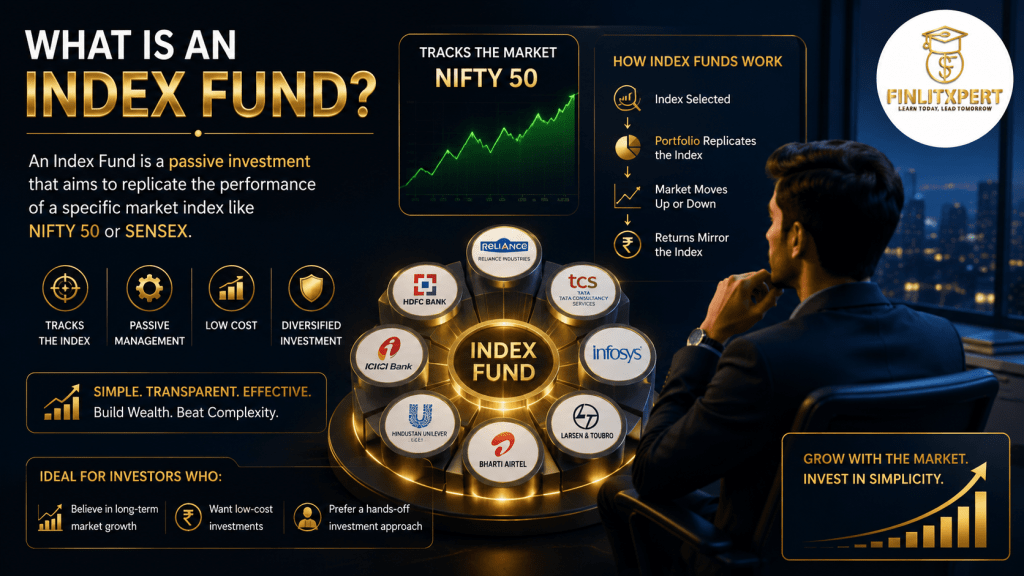
What is an Index Fund?
An Index Fund is a type of passive mutual fund designed to replicate the performance of a specific market index such as the Nifty 50, Sensex, or Nifty Next 50. Instead of trying to outperform the market, an Index Fund simply invests in the same stocks that make up the chosen index, maintaining nearly identical weightages.
Because these funds do not require a fund manager to actively select stocks, their operating costs are significantly lower than actively managed mutual funds. Over the long term, many Index Funds have delivered competitive returns while keeping investment costs minimal, making them an excellent choice for investors seeking simplicity, diversification, and low-cost wealth creation.https://www.finlitxpert.com/
What is a Mutual Fund?
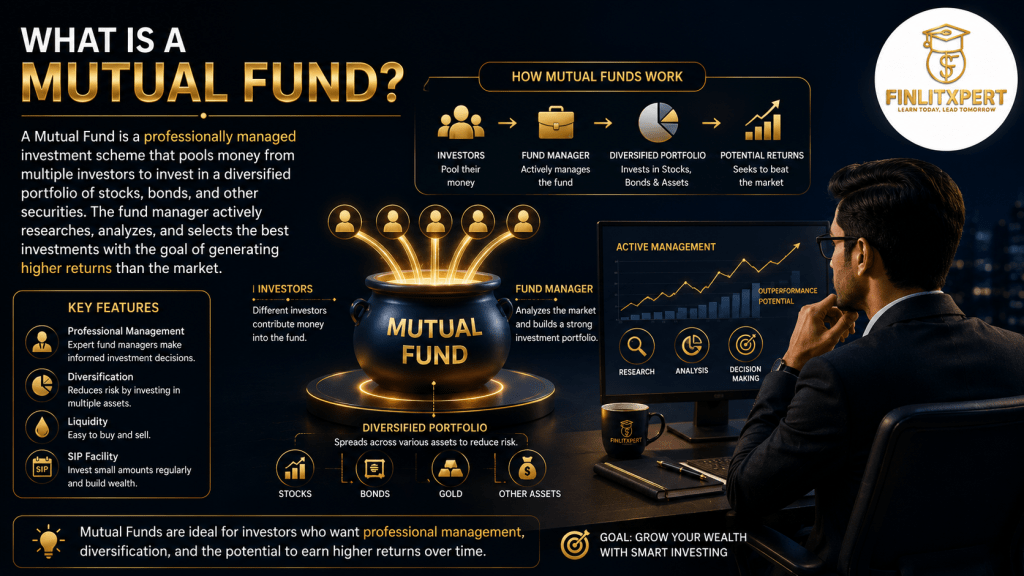
A Mutual Fund is a professionally managed investment vehicle that pools money from multiple investors and invests it in a diversified portfolio of financial assets such as stocks, bonds, money market instruments, and other securities.
Unlike Index Funds, most Mutual Funds are actively managed by experienced fund managers who continuously research the market, analyze companies, monitor economic trends, and make investment decisions with the objective of generating higher returns than the benchmark index.
When you invest in a Mutual Fund, your money is combined with that of thousands of other investors. This pooled capital allows the fund to purchase a wide range of securities, reducing the impact of poor performance from any single investment. Investors receive units of the fund based on the amount they invest, and the value of these units changes according to the Net Asset Value (NAV), which is calculated daily.
Mutual Funds are available in various categories, including Equity Funds, Debt Funds, Hybrid Funds, Sectoral Funds, ELSS Funds, International Funds, and more. This variety allows investors to choose funds based on their financial goals, investment horizon, and risk tolerance.
One of the biggest advantages of Mutual Funds is professional management. Investors who do not have the time or expertise to research the stock market can rely on experienced fund managers to make investment decisions on their behalf. However, this active management comes at a cost in the form of a higher expense ratio compared to Index Funds.
For beginners as well as experienced investors, Mutual Funds remain one of the most popular investment options for long-term wealth creation, retirement planning, children’s education, and achieving other financial goals.AMFI – Association of Mutual Funds in India
Index Funds vs Mutual Funds: Quick Comparison Table
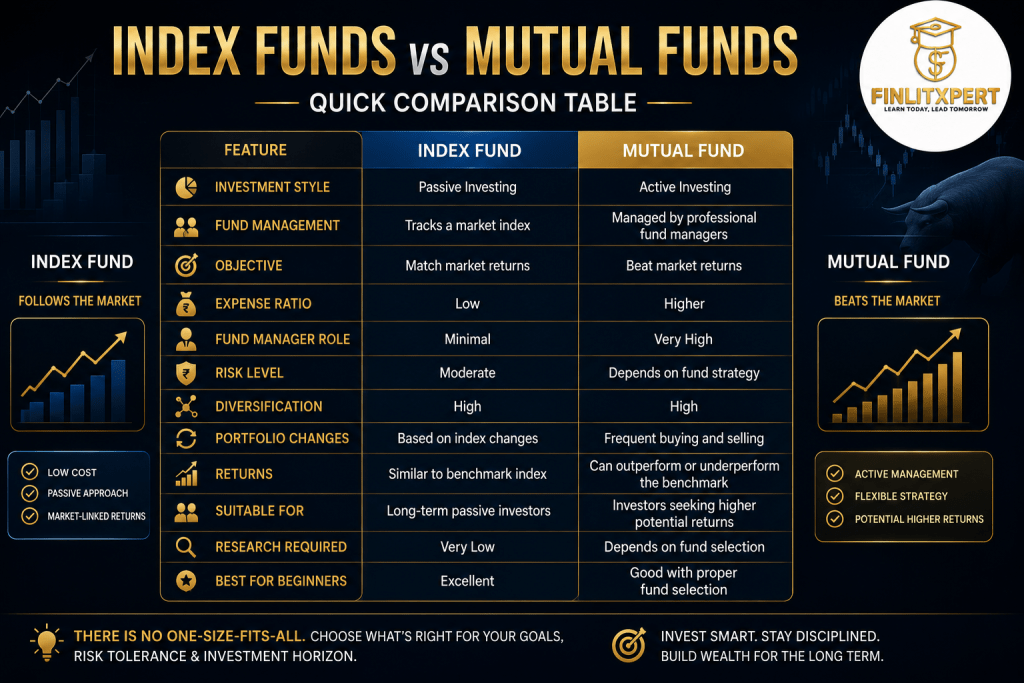
Choosing between an Index Fund and a Mutual Fund becomes much easier when you compare their key features side by side. While both investment options help investors build long-term wealth through diversification, they differ in management style, costs, returns, risks, and investment objectives.
The table below highlights the major differences between Index Funds and Actively Managed Mutual Funds, helping beginners understand which option aligns better with their financial goals.https://www.finlitxpert.com/finlitxpert-course-registration/
| Feature | Index Fund | Mutual Fund |
|---|---|---|
| Investment Style | Passive Investing | Active Investing |
| Fund Management | Tracks a market index | Managed by professional fund managers |
| Objective | Match market returns | Beat market returns |
| Expense Ratio | Low | Higher |
| Fund Manager Role | Minimal | Very High |
| Risk Level | Moderate | Depends on fund strategy |
| Diversification | High | High |
| Portfolio Changes | Based on index changes | Frequent buying and selling |
| Returns | Similar to benchmark index | Can outperform or underperform the benchmark |
| Suitable For | Long-term passive investors | Investors seeking higher potential returns |
| Research Required | Very Low | Depends on fund selection |
| Best For Beginners | Excellent | Good with proper fund selection |
There is no universal “best” option between Index Funds and Mutual Funds. If you prefer lower costs, simplicity, and market-linked returns, Index Funds are an excellent choice. On the other hand, if you believe experienced fund managers can generate better returns than the market and are comfortable paying slightly higher fees, actively managed Mutual Funds may be more suitable.
Ultimately, the right investment depends on your financial goals, investment horizon, risk tolerance, and personal investing style.
How Do Index Funds Work?
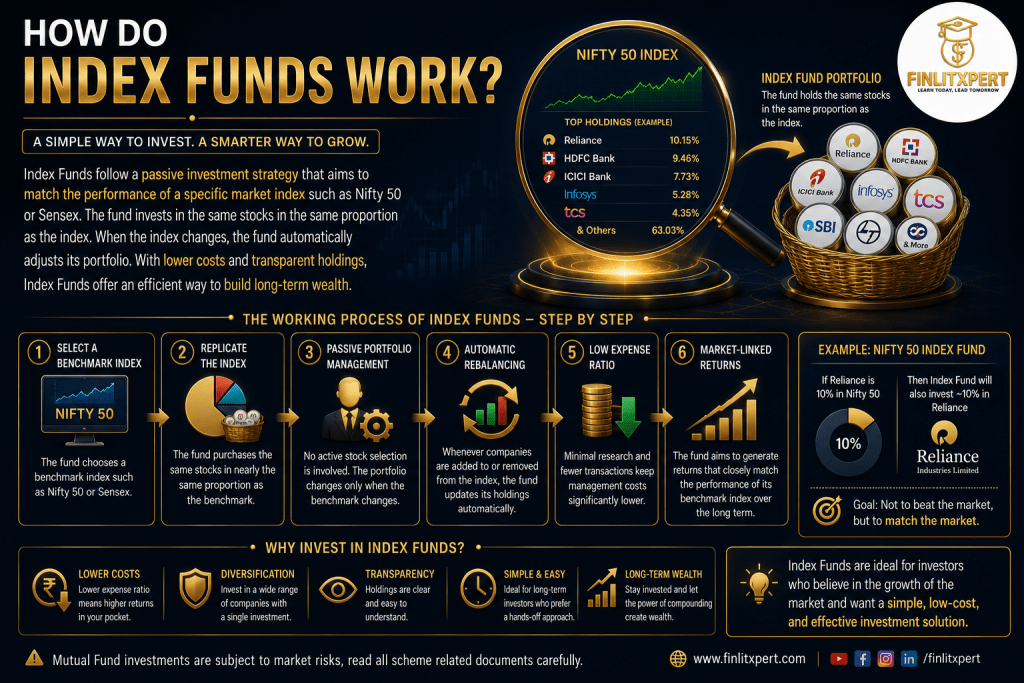
Index Funds follow a passive investment strategy designed to mirror the performance of a specific market index rather than outperform it. Instead of relying on a fund manager to actively select stocks, an Index Fund automatically invests in the same companies that are included in its benchmark index, maintaining nearly identical weightages.
For example, if an Index Fund tracks the Nifty 50 Index, it invests in all 50 companies that make up the Nifty 50. If Reliance Industries represents approximately 10% of the index, about 10% of the fund’s portfolio will also be invested in Reliance. The same principle applies to every other company in the index.
Whenever the index changes—such as the addition or removal of companies—the Index Fund updates its portfolio accordingly. This automatic rebalancing keeps the fund aligned with the benchmark while minimizing unnecessary trading.
Because Index Funds require very little active research, stock selection, or frequent buying and selling, their operating costs remain significantly lower than actively managed Mutual Funds. These lower costs reduce the expense ratio, allowing investors to retain a larger share of their long-term returns.
The primary objective of an Index Fund is not to beat the market but to match the market’s performance as closely as possible. Although there may be a small difference known as the tracking error due to fund expenses and operational factors, a well-managed Index Fund generally delivers returns that closely follow its benchmark index.
For long-term investors who value simplicity, diversification, transparency, and low investment costs, Index Funds provide an efficient and disciplined way to participate in the growth of the stock market without needing to constantly monitor individual stocks.https://www.finlitxpert.com/finlitxpert-traderx-live-2026/
Step 1: Select a Benchmark Index
The fund chooses a benchmark such as the Nifty 50 or Sensex.
Step 2: Replicate the Index
The fund purchases the same stocks in nearly the same proportion as the benchmark.
Step 3: Passive Portfolio Management
No active stock selection is involved. The portfolio changes only when the benchmark index changes.
Step 4: Automatic Rebalancing
Whenever companies are added to or removed from the benchmark index, the fund updates its holdings automatically.
Step 5: Low Expense Ratio
Minimal research and fewer transactions keep management costs significantly lower.
Step 6: Market-Linked Returns
The fund aims to generate returns that closely match the performance of its benchmark index over the long term.
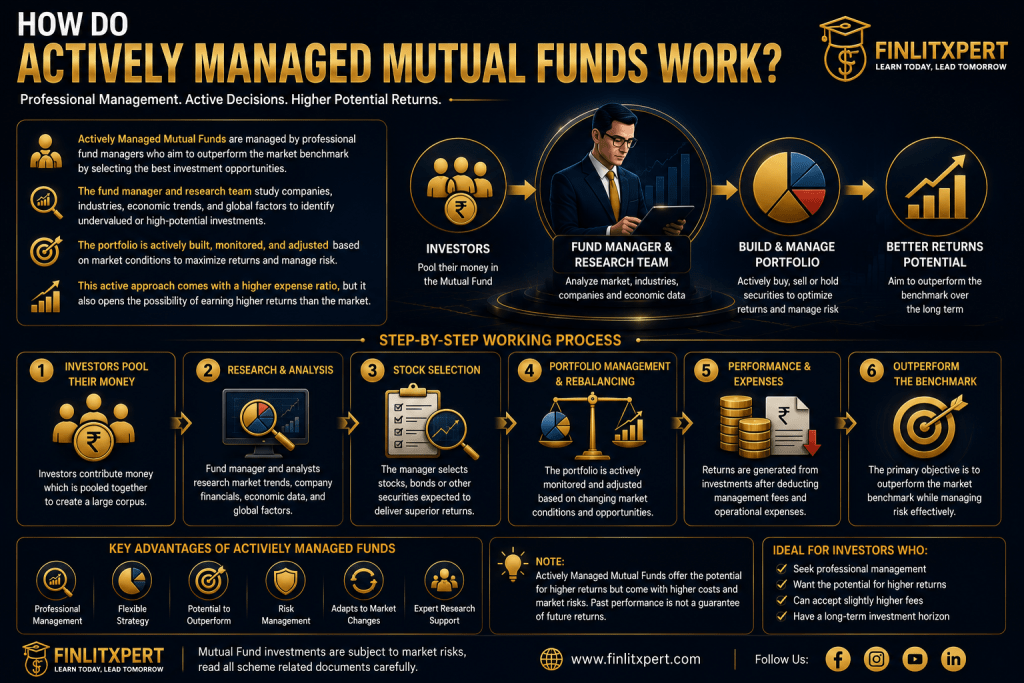
How Do Actively Managed Mutual Funds Work?
Actively Managed Mutual Funds are managed by professional fund managers whose primary objective is to outperform the market benchmark by carefully selecting investments. Unlike Index Funds, which simply replicate a market index, actively managed funds rely on continuous research, market analysis, and investment expertise to identify opportunities that may generate superior returns.
The process begins when investors pool their money into a Mutual Fund. This capital is then managed by a professional fund manager supported by a team of research analysts. They study company financial statements, industry trends, economic conditions, interest rates, corporate earnings, government policies, and global market developments before making investment decisions.
Based on this research, the fund manager actively buys, sells, or holds securities to maximize returns while managing risk. The portfolio is reviewed regularly and adjusted whenever market conditions or investment opportunities change. This flexibility allows actively managed funds to respond quickly to changing economic environments.
Because active management requires continuous research, frequent portfolio monitoring, and higher trading activity, these funds generally have a higher expense ratio than Index Funds. While the goal is to outperform the benchmark, there is no guarantee of doing so. Some actively managed funds consistently beat the market, while others may underperform after accounting for costs.
Actively Managed Mutual Funds are suitable for investors who prefer professional portfolio management and are willing to pay slightly higher fees in exchange for the possibility of earning better-than-market returns. Selecting funds with a strong long-term performance record, an experienced fund manager, and a consistent investment strategy can improve the likelihood of achieving long-term financial goals.https://www.finlitxpert.com/
Step 1: Investors pool their money into the Mutual Fund.
Step 2: Professional fund managers and research analysts study market trends, company fundamentals, and economic data.
Step 3: The fund manager selects stocks, bonds, or other securities expected to perform well.
Step 4: The portfolio is actively monitored and rebalanced based on changing market conditions.
Step 5: Investors receive returns based on the fund’s performance after deducting expenses.
Step 6: The objective is to outperform the benchmark while maintaining an appropriate level of risk.
Advantages of Index Funds
Index Funds have become one of the most popular investment choices for long-term investors because they offer a simple, transparent, and cost-effective way to participate in the stock market. Instead of relying on active stock selection, Index Funds automatically track a benchmark index such as the Nifty 50 or Sensex, allowing investors to benefit from overall market growth.
One of the biggest advantages of Index Funds is their low expense ratio. Since there is no need for continuous research, frequent trading, or active fund management, operational costs remain significantly lower than those of actively managed Mutual Funds. Lower costs mean investors keep a larger portion of their investment returns over time.
Another major benefit is diversification. A single Index Fund provides exposure to multiple companies across different sectors, reducing the risk associated with investing in individual stocks. This diversified approach helps smooth portfolio performance during periods of market volatility.
Index Funds are also highly transparent because their holdings closely match the benchmark index and are easy for investors to understand. There is no uncertainty about stock selection, making these funds ideal for beginners who want a straightforward investment strategy.
Historically, many Index Funds have delivered strong long-term returns by closely following the growth of the overall market. Combined with disciplined SIP investing and long-term holding, Index Funds can become a powerful tool for wealth creation.https://www.finlitxpert.com/finlitxpert-course-registration/
- Low Expense Ratio
Management costs are significantly lower than actively managed Mutual Funds.
- Broad Diversification
A single investment provides exposure to many companies across multiple sectors.
- Simple Investment Strategy
Easy to understand because the fund simply follows a market index.
- High Transparency
Portfolio holdings are publicly available and mirror the benchmark index.
- Lower Human Bias
Investment decisions are rule-based instead of depending on a fund manager’s judgment.
- Consistent Market Returns
Designed to closely match the performance of the benchmark index.
- Ideal for SIP Investors
Perfect for disciplined long-term investing through regular SIPs.
- Long-Term Wealth Creation
Market growth and compounding together can help build substantial wealth over time.

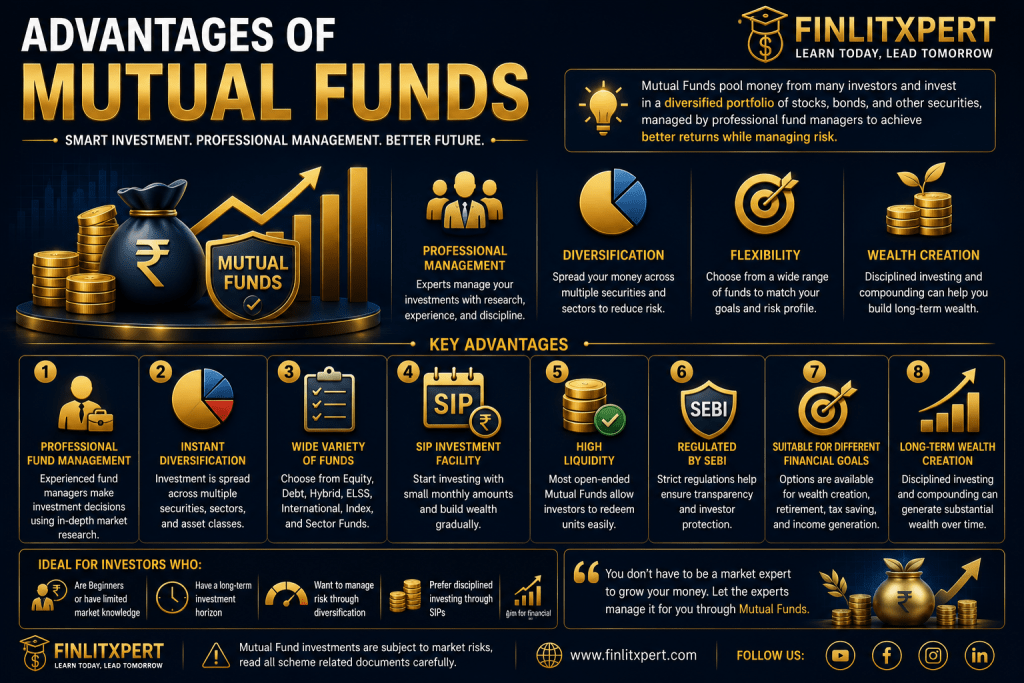
Advantages of Mutual Funds
Mutual Funds are one of the most popular investment options because they combine professional fund management, diversification, flexibility, and accessibility into a single investment product. Whether you are a beginner or an experienced investor, Mutual Funds offer solutions for different financial goals such as wealth creation, retirement planning, tax saving, children’s education, and regular income generation.
One of the biggest advantages of Mutual Funds is professional management. Experienced fund managers continuously research companies, analyze market trends, evaluate economic conditions, and make investment decisions on behalf of investors. This allows individuals with limited market knowledge to benefit from professional expertise.
Mutual Funds also provide instant diversification by investing across multiple companies, sectors, and asset classes. This reduces the impact of poor performance from any single investment and helps lower overall portfolio risk.
Another significant benefit is flexibility. Investors can choose from Equity Funds, Debt Funds, Hybrid Funds, Index Funds, ELSS Funds, International Funds, and Sectoral Funds depending on their financial objectives, risk appetite, and investment horizon.
Mutual Funds are highly accessible because investors can start investing with a small amount through Systematic Investment Plans (SIPs). Regular SIP investments encourage financial discipline and allow investors to benefit from rupee cost averaging and the power of long-term compounding.
Additionally, Mutual Funds are regulated by SEBI, providing transparency, investor protection, and strict compliance standards. With proper fund selection and long-term investing, Mutual Funds can become an effective tool for achieving financial goals while managing investment risk.https://www.finlitxpert.com/finlitxpert-traderx-live-2026/
- Professional Fund Management
Experienced fund managers make investment decisions using in-depth market research. - Instant Diversification
Investment is spread across multiple securities, sectors, and asset classes. - Wide Variety of Funds
Choose from Equity, Debt, Hybrid, ELSS, International, Index, and Sector Funds. - SIP Investment Facility
Start investing with small monthly amounts and build wealth gradually. - High Liquidity
Most open-ended Mutual Funds allow investors to redeem units easily. - Regulated by SEBI
Strict regulations help ensure transparency and investor protection. - Suitable for Different Financial Goals
Options are available for wealth creation, retirement, tax saving, and income generation. - Long-Term Wealth Creation
Disciplined investing and compounding can generate substantial wealth over time.
Disadvantages of Index Funds
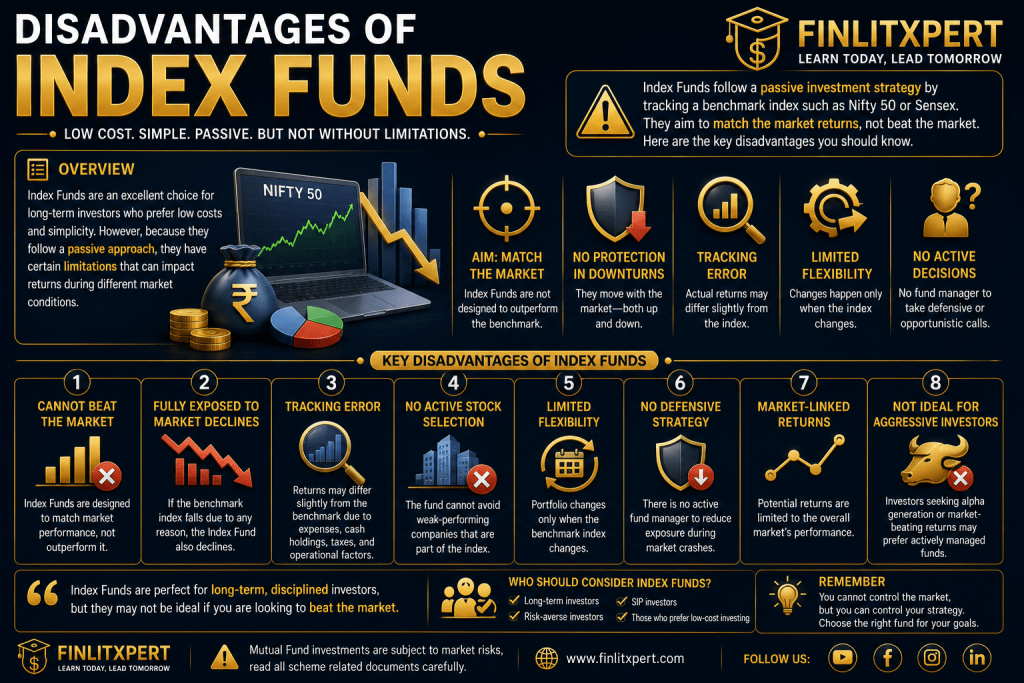
Although Index Funds are widely regarded as one of the best investment options for long-term wealth creation, they are not suitable for every investor. Since Index Funds follow a passive investment strategy, they simply replicate the performance of a benchmark index rather than trying to outperform it. As a result, investors should also understand their limitations before making an investment decision.
One of the biggest disadvantages of Index Funds is that they can never outperform the market because their primary objective is to match the benchmark index. Even if certain stocks have the potential to generate exceptional returns, the fund cannot significantly increase its allocation to those companies unless the benchmark itself changes.
Index Funds are also fully exposed to market downturns. When the benchmark index declines due to economic slowdowns, geopolitical events, or market corrections, the value of the Index Fund also falls. Unlike actively managed Mutual Funds, there is no fund manager making defensive investment decisions to reduce losses during volatile market conditions.
Another limitation is the presence of tracking error. Although Index Funds aim to replicate the benchmark, factors such as fund expenses, cash holdings, taxes, and portfolio rebalancing may cause actual returns to differ slightly from the index.
Because Index Funds follow a fixed investment strategy, they cannot take advantage of short-term market opportunities or avoid sectors that appear overvalued. Investors looking for tactical investment decisions or market-beating performance may find actively managed Mutual Funds more suitable.
Therefore, while Index Funds are excellent for disciplined long-term investors who prefer low costs and simplicity, they may not be the ideal choice for investors seeking higher-than-market returns or active portfolio management.https://www.finlitxpert.com/finlitxpert-course-registration/
- Cannot Beat the Market
Index Funds are designed to match market performance, not outperform it.
- Fully Exposed to Market Declines
If the benchmark index falls, the Index Fund also declines.
- Tracking Error
Returns may differ slightly from the benchmark due to expenses and operational factors.
- No Active Stock Selection
The fund cannot avoid weak-performing companies included in the index.
- Limited Flexibility
Portfolio changes only when the benchmark index changes.
- No Defensive Strategy
There is no active fund manager to reduce exposure during market crashes.
- Market-Linked Returns
Potential returns are limited to the overall market’s performance.
- Not Ideal for Aggressive Investors
Investors seeking alpha generation or market-beating returns may prefer actively managed funds.
Disadvantages of Mutual Funds
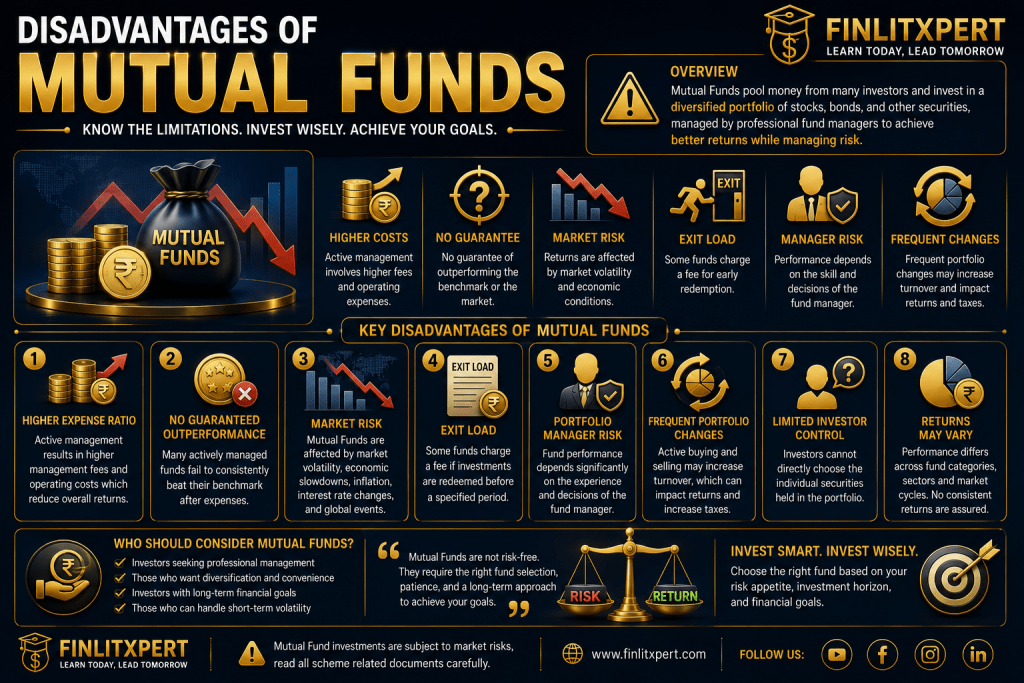
Although Mutual Funds offer professional management and diversification, they also have certain limitations that investors should understand before investing. Every investment carries some level of risk, and Mutual Funds are no exception.
One of the biggest disadvantages of actively managed Mutual Funds is their higher expense ratio. Since professional fund managers and research teams actively monitor the portfolio, management fees and operational costs are generally higher than those of Index Funds. These costs can reduce the investor’s overall returns over the long term.
Another drawback is that there is no guarantee of outperforming the market. While fund managers aim to generate higher returns than the benchmark, many actively managed funds underperform after accounting for expenses. Past performance is not a guarantee of future results.
Mutual Funds are also exposed to market risk. The value of investments may decline due to economic slowdowns, interest rate changes, inflation, geopolitical events, or poor market sentiment. Investors should be prepared for short-term fluctuations in Net Asset Value (NAV).
Some Mutual Funds may also have exit loads if investors redeem their units within a specified period. Additionally, frequent portfolio changes by fund managers may result in higher portfolio turnover, which can indirectly affect fund performance and taxation.
Finally, investors have little control over individual investment decisions because the fund manager determines which securities to buy or sell. Therefore, choosing the right Mutual Fund with a strong long-term track record, reasonable expense ratio, and experienced management team is essential for achieving investment goals.https://www.finlitxpert.com/finlitxpert-traderx-live-2026/
- Higher Expense Ratio
Active management results in higher management fees and operating costs.
- No Guaranteed Outperformance
Many actively managed funds fail to consistently beat their benchmark.
- Market Risk
Mutual Funds are affected by stock market volatility and economic conditions.
- Exit Load
Some funds charge a fee if investments are redeemed before a specified period.
- Portfolio Manager Risk
Fund performance depends significantly on the decisions of the fund manager.
- Frequent Portfolio Changes
Active buying and selling may increase turnover and affect returns.
- Limited Investor Control
Investors cannot directly choose the individual securities held in the portfolio.
- Returns May Vary
Performance differs across fund categories and market cycles.
Expense Ratio Comparison
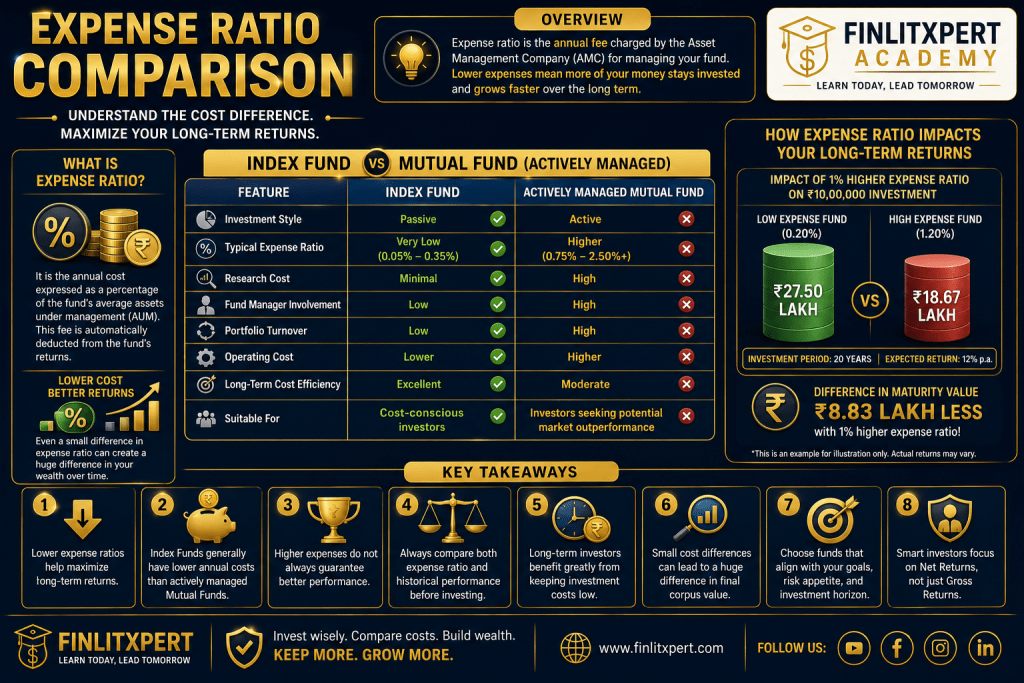
The expense ratio is one of the most important factors to consider when choosing between an Index Fund and an actively managed Mutual Fund. It represents the annual fee charged by the Asset Management Company (AMC) for managing your investment. This fee is deducted directly from the fund’s assets, so investors do not have to pay it separately. However, a higher expense ratio reduces your overall investment returns over time.
Index Funds generally have much lower expense ratios because they follow a passive investment strategy. Since these funds simply track a benchmark index such as the Nifty 50 or Sensex, they require minimal research, fewer portfolio changes, and lower management costs.
In contrast, actively managed Mutual Funds employ experienced fund managers and research teams who continuously analyze markets, select securities, and rebalance portfolios. This active management increases operational expenses, resulting in a higher expense ratio.
Although the difference between a 0.20% expense ratio and a 1.80% expense ratio may appear small, it can significantly impact long-term wealth due to the power of compounding. Over a period of 15 to 25 years, even a small difference in annual expenses can reduce the final investment value by several lakhs of rupees.
Therefore, investors should compare expense ratios along with fund performance, consistency, risk, and investment objectives before selecting any Mutual Fund or Index Fund. Lower costs generally improve long-term returns, especially for passive investors.https://www.finlitxpert.com/
| Feature | Index Fund | Actively Managed Mutual Fund |
|---|---|---|
| Investment Style | Passive | Active |
| Typical Expense Ratio | Very Low | Higher |
| Research Cost | Minimal | High |
| Fund Manager Involvement | Low | High |
| Portfolio Turnover | Low | High |
| Operating Cost | Lower | Higher |
| Long-Term Cost Efficiency | Excellent | Moderate |
| Suitable For | Cost-conscious investors | Investors seeking potential market outperformance |
✔ Lower expense ratios help maximize long-term returns.
✔ Index Funds generally have lower annual costs than actively managed Mutual Funds.
✔ Higher expenses do not always guarantee better performance.
✔ Always compare both expense ratio and historical performance before investing.
✔ Long-term investors benefit greatly from keeping investment costs low.
Returns Comparison: Which Gives Better Performance?
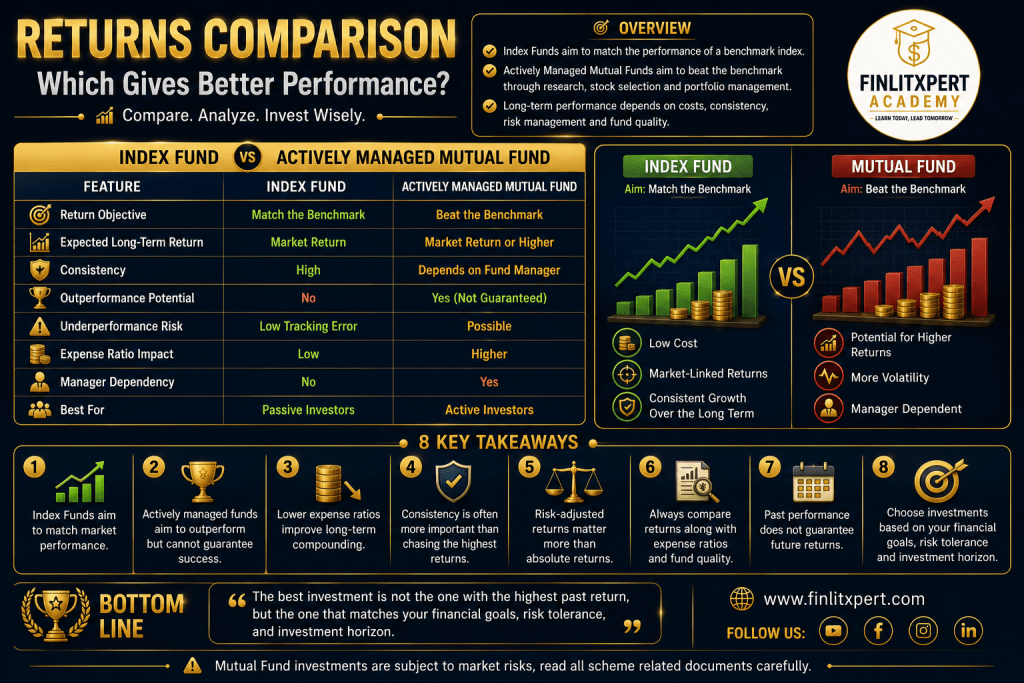
One of the most common questions investors ask is whether Index Funds or actively managed Mutual Funds generate better returns. The answer depends on several factors, including market conditions, investment horizon, expense ratio, and the fund manager’s ability to consistently outperform the benchmark.
Index Funds aim to match the performance of a benchmark index such as the Nifty 50 or Sensex. Since they simply replicate the index, their returns generally move in line with the overall market. They are designed to deliver market returns at a lower cost, making them an attractive option for long-term investors.
Actively Managed Mutual Funds, on the other hand, attempt to outperform the benchmark through research, stock selection, sector allocation, and portfolio management. A skilled fund manager may generate higher returns than the market during certain periods. However, not all actively managed funds consistently beat their benchmark, especially after accounting for higher expense ratios.
Over the long term, many studies have shown that a significant number of actively managed funds struggle to consistently outperform low-cost Index Funds after fees. This is one reason why passive investing has become increasingly popular among long-term investors around the world.
Rather than focusing only on historical returns, investors should evaluate consistency, risk-adjusted performance, expense ratio, investment objectives, and their own financial goals. A fund that delivers stable long-term growth with reasonable risk is often a better choice than one that experiences frequent ups and downs.
Ultimately, there is no single winner. Investors seeking simplicity, low costs, and market-linked returns may prefer Index Funds, while those willing to accept higher costs and manager risk for the possibility of outperforming the market may consider actively managed Mutual Funds.https://www.finlitxpert.com/
| Feature | Index Fund | Actively Managed Mutual Fund |
|---|---|---|
| Return Objective | Match the Benchmark | Beat the Benchmark |
| Expected Long-Term Return | Market Return | Market Return or Higher |
| Consistency | High | Depends on Fund Manager |
| Outperformance Potential | No | Yes (Not Guaranteed) |
| Underperformance Risk | Low Tracking Error | Possible |
| Expense Ratio Impact | Low | Higher |
| Manager Dependency | No | Yes |
| Best For | Passive Investors | Active Investors |
✔ Index Funds aim to match market performance.
✔ Actively managed Mutual Funds aim to outperform the market but cannot guarantee success.
✔ Lower expenses improve long-term compounding.
✔ Consistency is often more important than chasing the highest returns.
✔ Compare returns together with risk, expense ratio, and fund quality before investing.
✔ Long-term disciplined investing is usually more important than trying to time the market.
✔ Past performance does not guarantee future returns.
✔ Choose investments based on your financial goals, risk tolerance, and investment horizon.
Risk Comparison: Which Investment is Safer?
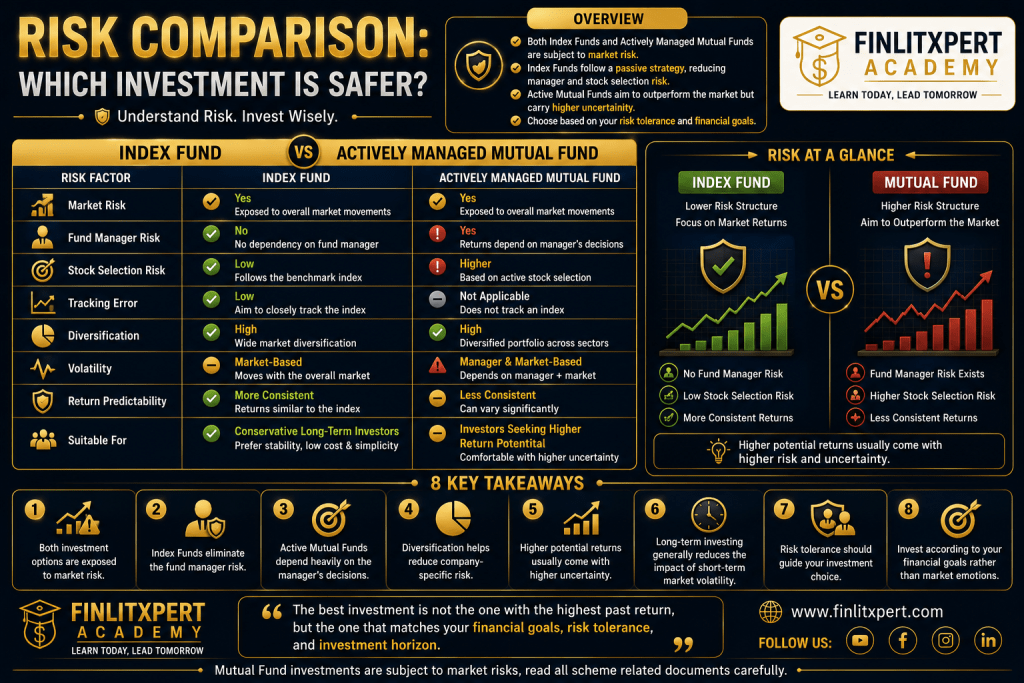
Risk is one of the most important factors to consider before investing in either an Index Fund or an actively managed Mutual Fund. While both invest in diversified portfolios of securities, the level and type of risk can differ depending on how the fund is managed.
Index Funds are generally considered relatively lower-risk because they simply track a benchmark index. They do not rely on a fund manager’s stock-picking decisions, which reduces the possibility of human error or poor investment choices. Their performance closely follows the market, making returns more predictable over the long term.
Actively Managed Mutual Funds carry an additional layer of manager risk. Since fund managers actively select stocks and adjust portfolios, their decisions can either outperform or underperform the benchmark. While skilled managers may generate higher returns, there is also a greater chance of making investment decisions that fail to beat the market.
Both Index Funds and Mutual Funds remain subject to market risk. During market downturns, the value of both investments can decline. However, diversification within these funds helps reduce company-specific risk compared to investing in individual stocks.
Investors should evaluate their risk tolerance, investment horizon, financial goals, and return expectations before making a decision. Conservative long-term investors often prefer the simplicity and consistency of Index Funds, while investors comfortable with higher uncertainty may choose actively managed Mutual Funds for their potential to generate excess returns.https://www.finlitxpert.com/finlitxpert-course-registration/
| Risk Factor | Index Fund | Actively Managed Mutual Fund |
|---|---|---|
| Market Risk | Yes | Yes |
| Fund Manager Risk | No | Yes |
| Stock Selection Risk | Low | Higher |
| Tracking Error | Low | Not Applicable |
| Diversification | High | High |
| Volatility | Market-Based | Manager & Market-Based |
| Return Predictability | More Consistent | Less Consistent |
| Suitable For | Conservative Long-Term Investors | Investors Seeking Higher Return Potential |
Who Should Invest in Index Funds?
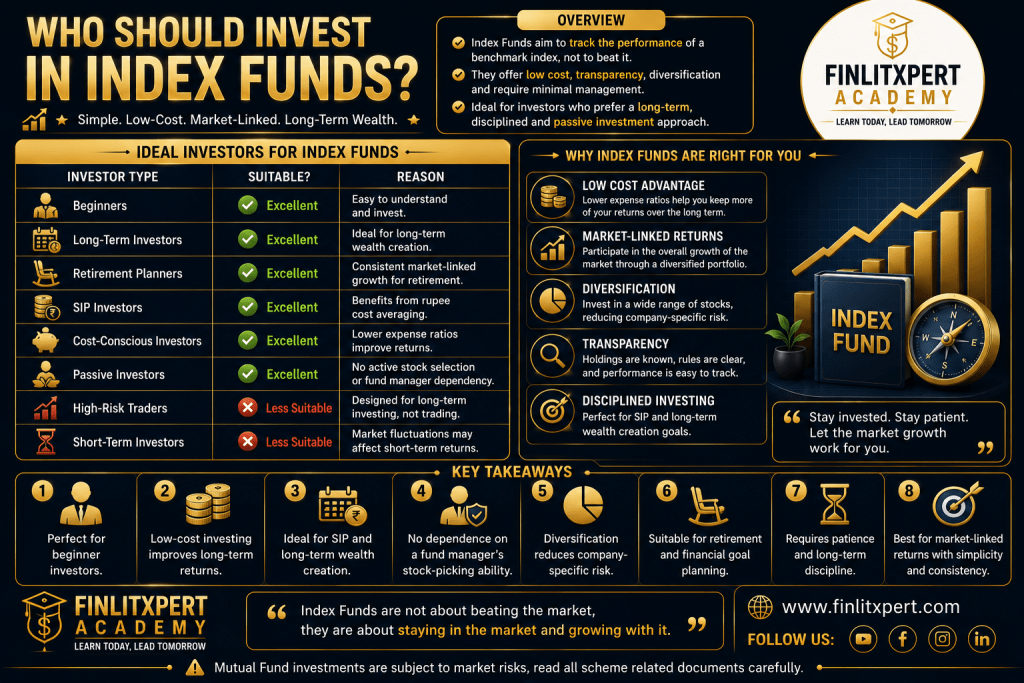
Index Funds are an excellent choice for investors who want a simple, low-cost, and disciplined approach to wealth creation. Since these funds aim to replicate the performance of a benchmark index rather than beat it, they require minimal active management and generally have lower expense ratios. This allows investors to keep more of their returns over the long term.
Index Funds are particularly suitable for beginners who are just starting their investment journey. They eliminate the need to analyze individual stocks or select fund managers, making investing easier and less stressful. Investors can participate in the overall growth of the market without constantly monitoring their portfolio.
Long-term investors who are saving for goals such as retirement, children’s education, wealth creation, or financial independence often benefit from Index Funds because of the power of compounding. Staying invested through market cycles can help generate steady long-term growth.
Cost-conscious investors also prefer Index Funds because lower expense ratios can significantly improve returns over decades. Even a small difference in annual costs can create a substantial difference in final wealth through compounding.
However, investors should remember that Index Funds do not protect against market declines. Their value will rise and fall with the market, making patience and a long-term perspective essential for success.https://www.finlitxpert.com/finlitxpert-traderx-live-2026/
| Investor Type | Suitable? | Reason |
|---|---|---|
| Beginners | ✅ Excellent | Easy to understand and invest |
| Long-Term Investors | ✅ Excellent | Ideal for wealth creation |
| Retirement Planners | ✅ Excellent | Consistent market-linked growth |
| SIP Investors | ✅ Excellent | Benefits from rupee cost averaging |
| Cost-Conscious Investors | ✅ Excellent | Lower expense ratios |
| Passive Investors | ✅ Excellent | No active stock selection required |
| High-Risk Traders | ❌ Less Suitable | Designed for long-term investing |
| Short-Term Investors | ❌ Less Suitable | Market fluctuations may affect short-term returns |
✔ Perfect for beginner investors.
✔ Low-cost investing improves long-term returns.
✔ Ideal for SIP and long-term wealth creation.
✔ No dependence on a fund manager’s stock-picking ability.
✔ Diversification reduces company-specific risk.
✔ Suitable for retirement and financial goal planning.
✔ Requires patience and long-term discipline.
✔ Best for investors seeking market-linked returns with simplicity.
Who Should Invest in Mutual Funds?
Actively Managed Mutual Funds are suitable for investors who seek the potential to earn returns above the market average and are comfortable relying on the expertise of professional fund managers. These funds are managed by experienced investment professionals who actively research companies, analyze market trends, and adjust portfolios to maximize returns.
Mutual Funds are ideal for investors who prefer a professionally managed portfolio without spending time researching individual stocks. They offer access to expert investment strategies, diversification, and various fund categories that cater to different financial goals and risk profiles.
Investors with moderate to high risk tolerance may benefit from actively managed Mutual Funds, especially if they believe skilled fund managers can identify opportunities that outperform benchmark indices over the long term. However, investors should remember that higher return potential also comes with greater uncertainty and higher expense ratios.
Goal-based investors saving for children’s education, buying a home, retirement, or long-term wealth creation can also benefit from Mutual Funds by selecting schemes aligned with their investment horizon and financial objectives. Choosing the right fund category is equally important as selecting the fund itself.
Before investing, individuals should evaluate the fund’s historical consistency, expense ratio, portfolio quality, risk-adjusted performance, and the experience of the fund management team. A well-selected Mutual Fund can become an effective tool for long-term financial growth when combined with disciplined investing.https://www.finlitxpert.com/finlitxpert-course-registration/
| Investor Type | Suitable? | Reason |
|---|---|---|
| Goal-Based Investors | ✅ Excellent | Multiple fund categories available |
| Moderate Risk Investors | ✅ Excellent | Balanced risk and return potential |
| Long-Term Wealth Builders | ✅ Excellent | Professional portfolio management |
| Retirement Investors | ✅ Excellent | Various retirement-oriented funds |
| Busy Professionals | ✅ Excellent | Expert-managed investments |
| Experienced Investors | ✅ Excellent | Opportunity to outperform benchmarks |
| Passive Investors | ⚠️ Moderate | May prefer Index Funds |
| Very Short-Term Investors | ❌ Less Suitable | Market volatility may affect returns |
✔ Suitable for investors seeking professional fund management.
✔ Offers the potential to outperform benchmark indices.
✔ Ideal for long-term financial goals.
✔ Available across multiple investment categories.
✔ Requires evaluating fund manager performance and consistency.
✔ Higher expense ratios may reduce long-term returns.
✔ Best suited for moderate to high risk tolerance.
✔ Consistent investing and regular portfolio review improve long-term outcomes.

Index Funds vs Mutual Funds: Which One Should You Choose?
Choosing between Index Funds and actively managed Mutual Funds depends on your financial goals, investment horizon, risk tolerance, and investing style. There is no universal “best” investment because different investors have different needs and objectives.
If you prefer a low-cost, passive investment strategy that aims to match overall market performance, Index Funds are an excellent choice. They offer simplicity, transparency, broad diversification, and lower expense ratios, making them ideal for beginners and long-term wealth creation.
On the other hand, if you believe experienced fund managers can identify market opportunities and generate returns above the benchmark, actively managed Mutual Funds may be suitable. They provide professional portfolio management and access to specialized investment strategies, although they usually come with higher costs and greater manager risk.
Many experienced investors choose not to limit themselves to one option. Instead, they build a diversified portfolio by combining Index Funds and actively managed Mutual Funds. This balanced approach can provide the stability of passive investing while allowing exposure to potential market outperformance through active management.
Ultimately, the right investment is the one that aligns with your financial goals, risk appetite, and investment timeline. Rather than chasing short-term performance, focus on disciplined investing, regular SIPs, diversification, and long-term wealth creation.https://www.finlitxpert.com/finlitxpert-traderx-live-2026/
Decision Guide
| If You Want… | Choose Index Funds | Choose Mutual Funds |
|---|---|---|
| Lower Costs | ✅ | ❌ |
| Passive Investing | ✅ | ❌ |
| Market-Linked Returns | ✅ | ✅ |
| Professional Fund Management | ❌ | ✅ |
| Potential to Beat the Market | ❌ | ✅ |
| Simple Investing | ✅ | ⚠️ |
| Goal-Based Investing | ✅ | ✅ |
| Long-Term Wealth Creation | ✅ | ✅ |
Quick Decision Matrix
| Investor Profile | Best Choice |
|---|---|
| Beginner Investor | ✅ Index Fund |
| Passive Investor | ✅ Index Fund |
| Cost-Conscious Investor | ✅ Index Fund |
| Long-Term SIP Investor | ✅ Both |
| Moderate Risk Investor | ✅ Mutual Fund |
| Experienced Investor | ✅ Mutual Fund |
| Diversified Portfolio Builder | ✅ Combination of Both |
✔ There is no single investment that is best for everyone.
✔ Index Funds are ideal for low-cost passive investing.
✔ Mutual Funds offer professional management and potential outperformance.
✔ Investment decisions should be based on goals, not recent performance.
✔ Diversification can reduce overall portfolio risk.
✔ Regular SIP investing builds long-term wealth.
✔ Stay invested through market cycles.
✔ The best investment strategy is one you can follow consistently for many years.

Frequently Asked Questions (FAQs) About Index Funds vs Mutual Funds
- Which is better: Index Funds or Mutual Funds?
Neither is universally better. Index Funds are ideal for investors seeking low-cost, passive investing with market-linked returns. Actively managed Mutual Funds are suitable for investors who want professional fund management and the potential to outperform the market. The right choice depends on your financial goals, risk tolerance, and investment horizon.
- Are Index Funds safer than Mutual Funds?
Both Index Funds and Mutual Funds are subject to market risk. However, Index Funds eliminate fund manager risk because they simply track a benchmark index. Actively managed Mutual Funds depend on the investment decisions of fund managers, which may increase performance variability.
- Do Index Funds have lower fees?
Yes. Index Funds generally have lower expense ratios because they follow a passive investment strategy. Lower costs can significantly improve long-term returns through the power of compounding.
- Can Mutual Funds outperform Index Funds?
Yes, some actively managed Mutual Funds can outperform their benchmark for certain periods. However, consistently beating the market over the long term is difficult, especially after accounting for higher expense ratios.
- Are Index Funds suitable for beginners?
Absolutely. Index Funds are among the best investment options for beginners because they are simple, diversified, transparent, and require minimal investment knowledge.
- Can I invest in both Index Funds and Mutual Funds?
Yes. Many investors combine both to create a diversified portfolio. Index Funds provide stability and low costs, while actively managed Mutual Funds offer the opportunity for potential outperformance.
- Which investment is better for SIP?
Both are excellent choices for SIP investing. Index Funds are suitable for investors seeking consistent market returns with lower costs, while Mutual Funds are suitable for those who believe skilled fund managers can generate higher long-term returns.
- Which investment is better for long-term wealth creation?
Both Index Funds and Mutual Funds can help build long-term wealth when combined with disciplined investing, regular SIPs, diversification, and patience. The key is staying invested through market cycles rather than trying to time the market.
Conclusion: Which Investment Strategy is Right for You?
Choosing between Index Funds and actively managed Mutual Funds is not about finding a universal winner—it’s about selecting the investment strategy that best aligns with your financial goals, risk tolerance, and investment horizon.
If you value simplicity, lower costs, transparency, and market-linked returns, Index Funds are an excellent choice for long-term wealth creation. Their passive investment approach makes them ideal for beginners, retirement planning, and investors who prefer a disciplined investment strategy.
If you are comfortable with higher costs and believe experienced fund managers can identify opportunities to outperform the market, actively managed Mutual Funds may be a suitable option. They provide professional portfolio management and access to specialized investment strategies across various asset classes and sectors.
For many investors, the most effective approach is not choosing one over the other but combining both. A diversified portfolio containing Index Funds and carefully selected Mutual Funds can balance stability with growth potential while reducing overall investment risk.
Remember that successful investing is rarely about predicting the market. Instead, it is built on consistent SIP investments, diversification, patience, disciplined decision-making, and staying invested for the long term. Time in the market is generally more valuable than trying to time the market.
Before making any investment decision, evaluate your financial objectives, emergency fund, risk tolerance, investment horizon, and asset allocation. If needed, consult a qualified financial advisor to build an investment plan that suits your personal circumstances.
✅ Start investing as early as possible.
✅ Invest consistently through SIPs.
✅ Diversify your portfolio wisely.
✅ Focus on long-term wealth creation.
✅ Compare expense ratios before investing.
✅ Avoid emotional investment decisions.
✅ Review your portfolio periodically.
✅ Stay disciplined during market volatility.
✅ Continue learning about personal finance and investing.
✅ Build wealth through patience, consistency, and informed decision-making.
Ready to begin your investment journey?
At FINLITXPERT Academy, we simplify stock market investing, mutual funds, personal finance, and wealth creation through practical, beginner-friendly education.
Whether you’re learning the basics or preparing to become a confident investor, our expert-led courses are designed to help you build long-term financial knowledge with confidence.
Learn Today. Lead Tomorrow.