
Types of Mutual Funds: Equity, Debt, Hybrid & More(2026)

Introduction
Mutual funds are one of the most popular investment options for individuals looking to build wealth and achieve their financial goals. However, not all mutual funds are the same. There are different types of mutual funds designed to meet different investment objectives, risk levels, and time horizons.
The major categories include equity mutual funds, debt mutual funds, and hybrid mutual funds, along with several other categories such as index funds, exchange-traded funds (ETFs), solution-oriented funds, and fund of funds. Each category invests in different types of assets and carries its own level of risk and potential return.
Understanding the different types of mutual funds can help investors choose investments that better match their financial goals, risk tolerance, and investment horizon. In this guide, we will explore the major types of mutual funds, how they work, their key characteristics, and the factors investors should consider before selecting a mutual fund category.https://www.finlitxpert.com/
What Are Mutual Funds?
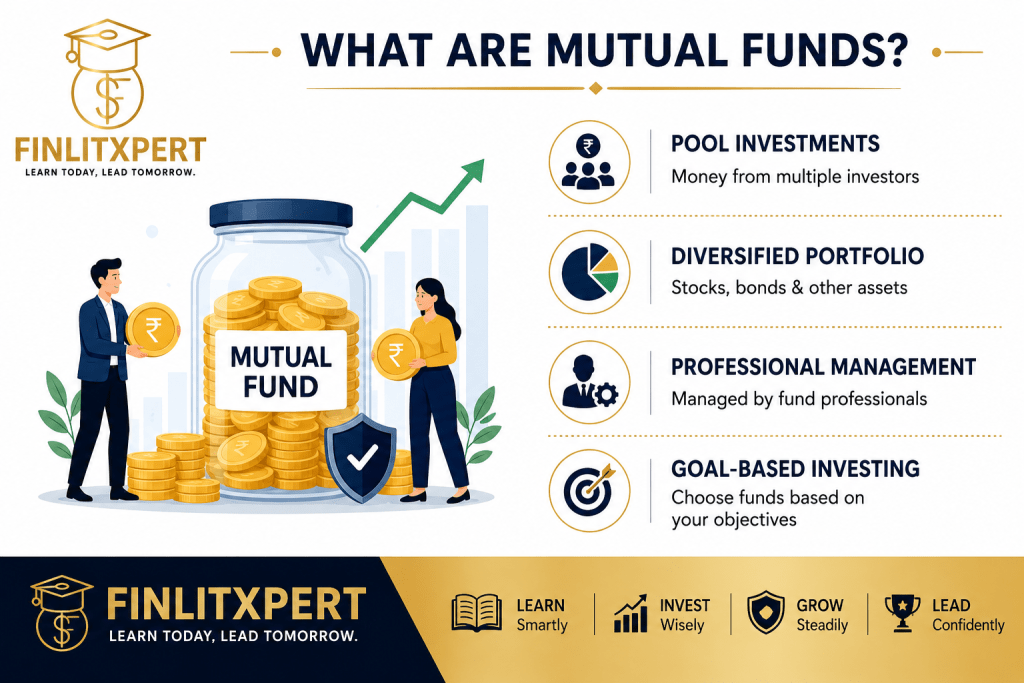
A mutual fund is an investment vehicle that pools money from multiple investors and invests it in a diversified portfolio of assets such as stocks, bonds, money market instruments, or a combination of different securities. These funds are managed by professional fund managers who make investment decisions according to the fund’s stated investment objective and strategy.
When investors invest in a mutual fund, they receive units of the scheme based on the applicable Net Asset Value (NAV). The value of their investment may increase or decrease depending on the performance of the underlying assets held by the fund.
Mutual funds make it possible for investors to access professionally managed and diversified portfolios without having to select and manage every individual security themselves. Since different types of mutual funds follow different investment strategies and invest in different asset classes, understanding these categories is important when selecting a fund that matches an investor’s financial goals, risk tolerance, and investment horizon.AMFI – Association of Mutual Funds in India
Why Understanding Different Types of Mutual Funds Is Important
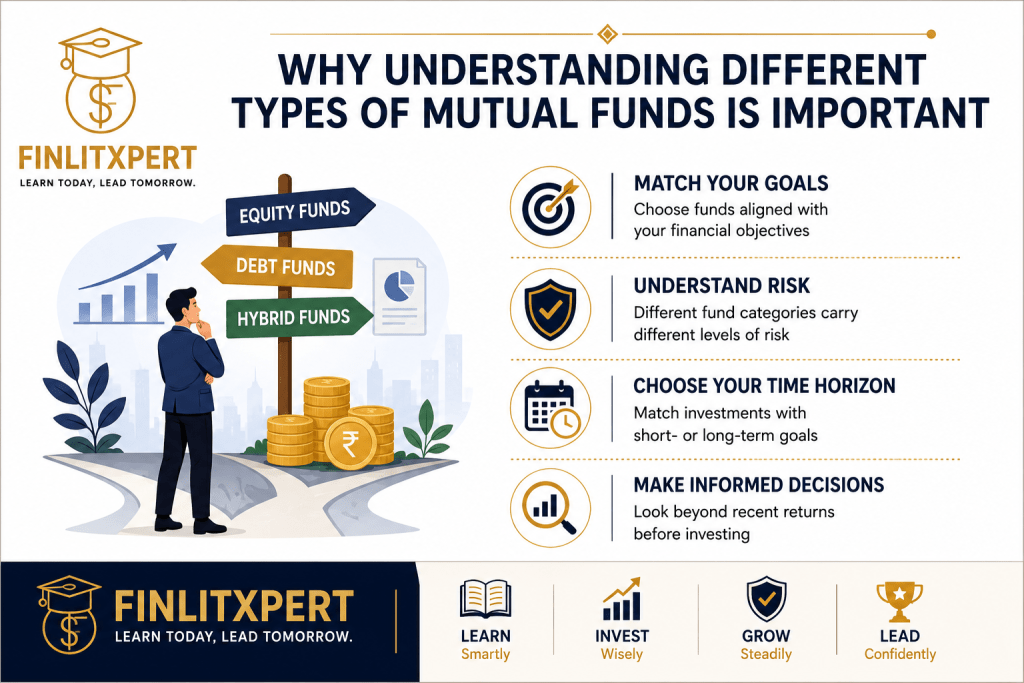
Understanding the different types of mutual funds is important because each fund category has a different investment objective, asset allocation, level of risk, and potential return. A mutual fund that may be suitable for one investor may not necessarily be appropriate for another.
For example, equity mutual funds primarily invest in shares of companies and generally offer higher long-term growth potential along with higher market risk. Debt mutual funds mainly invest in fixed-income securities and may be considered by investors seeking relatively lower volatility, while hybrid mutual funds combine equity and debt investments to provide a balance between growth potential and stability.
Choosing the right mutual fund category should therefore depend on factors such as your financial goals, risk tolerance, investment horizon, and liquidity requirements. Understanding these differences can help investors make more informed investment decisions rather than selecting a fund solely on the basis of recent returns.https://www.finlitxpert.com/finlitxpert-course-registration/
Types of Mutual Funds
Mutual funds can be classified into different categories based on the types of assets they invest in, their investment objectives, risk levels, and portfolio strategies. Understanding these categories helps investors identify which type of fund may be more suitable for their financial goals and investment preferences.
The three major categories are equity mutual funds, debt mutual funds, and hybrid mutual funds. Equity funds primarily invest in shares of companies and generally focus on long-term capital growth. Debt funds mainly invest in fixed-income instruments such as government securities, corporate bonds, and money market instruments. Hybrid funds invest in a combination of equity and debt to balance growth potential with portfolio stability.
Apart from these major categories, investors can also explore other types of mutual funds, including solution-oriented funds, index funds, exchange-traded funds (ETFs), money market funds, fund of funds (FoFs), and international or global funds. Each category has its own investment approach, risk-return characteristics, and suitability for different types of investors.https://www.finlitxpert.com/finlitxpert-traderx-live-2026/
- Equity Mutual Funds
- Debt Mutual Funds
- Hybrid Mutual Funds
- Solution-Oriented Mutual Funds
- Index Funds
- Exchange-Traded Funds (ETFs)
- Money Market Funds
- Fund of Funds (FoFs)
- International or Global Mutual Funds

Equity Mutual Funds
Equity mutual funds are mutual fund schemes that invest predominantly in equity shares and equity-related securities of companies. Their primary objective is generally to achieve long-term capital appreciation by participating in the growth of businesses across different sectors and market segments.
Since the value of equity investments can fluctuate with stock market movements, equity mutual funds usually carry a higher level of market risk compared with many debt-oriented funds. At the same time, they may offer higher growth potential over the long term. Therefore, they are generally more suitable for investors who have a relatively higher risk tolerance and a longer investment horizon.
Equity mutual funds are further classified according to factors such as the market capitalization of the companies they invest in, portfolio allocation strategy, investment theme, or tax-saving objective. Major categories include large-cap funds, mid-cap funds, small-cap funds, large & mid-cap funds, multi-cap funds, flexi-cap funds, ELSS, and sectoral or thematic funds.
Investors should select an equity fund category based on their financial goals, risk profile, investment horizon, and understanding of the fund’s investment strategy rather than choosing a scheme solely because of its recent performance.SEBI – Securities and Exchange Board of India
Types of Equity Mutual Funds
- Large-Cap Funds
- Mid-Cap Funds
- Small-Cap Funds
- Large & Mid-Cap Funds
- Multi-Cap Funds
- Flexi-Cap Funds
- ELSS (Equity Linked Savings Scheme)
- Sectoral and Thematic Funds

Debt Mutual Funds
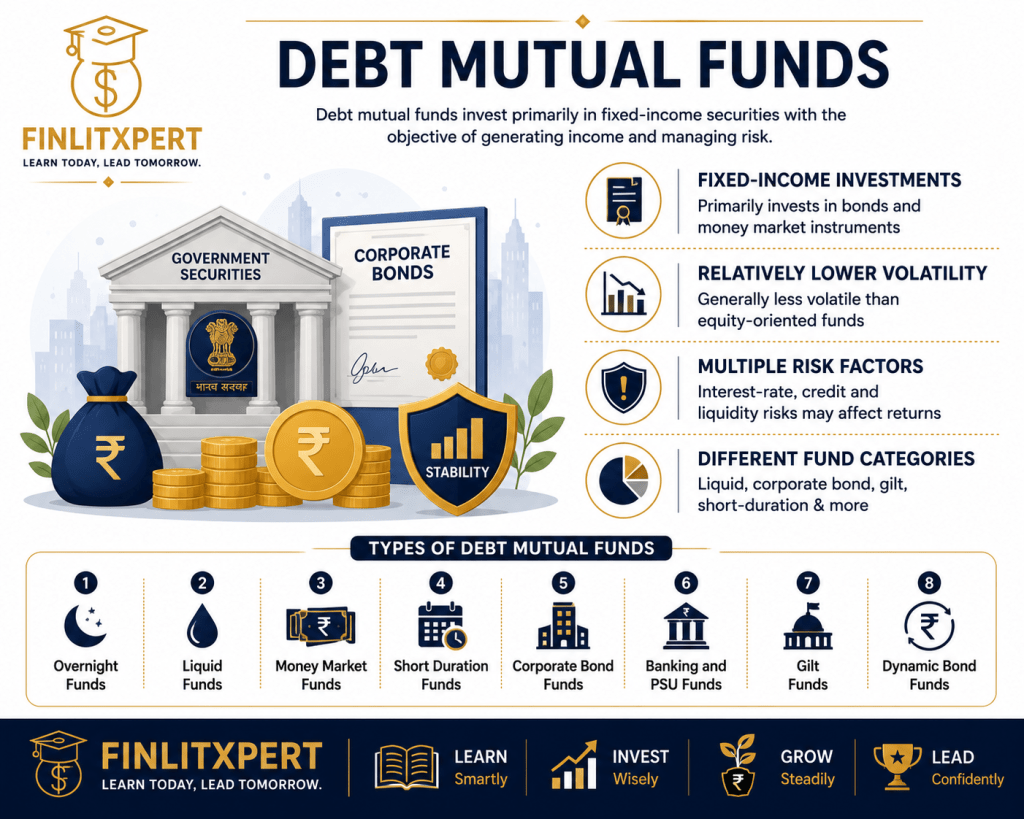
Debt mutual funds are mutual fund schemes that primarily invest in fixed-income securities such as government securities, corporate bonds, treasury bills, commercial papers, certificates of deposit, and other money market instruments. Their objective generally focuses on generating income and managing portfolio risk according to the maturity and credit profile of the securities held.
Compared with equity mutual funds, debt funds generally experience lower equity-market-related volatility, but they are not risk-free. Their performance can be affected by changes in interest rates, the credit quality of issuers, liquidity conditions, and the maturity profile of the portfolio. Different categories of debt funds therefore carry different levels and types of risk.
Debt mutual funds are classified into several categories based largely on the maturity duration and nature of the securities in which they invest. These include overnight funds, liquid funds, money market funds, short duration funds, corporate bond funds, banking and PSU funds, gilt funds, and dynamic bond funds.
Before selecting a debt mutual fund, investors should consider their investment horizon, liquidity requirements, risk tolerance, portfolio quality, interest-rate risk, and the specific investment strategy of the scheme. A debt fund should not be selected solely on the basis of past returns.https://www.finlitxpert.com/
Types of Debt Mutual Funds
- Overnight Funds
- Liquid Funds
- Money Market Funds
- Short Duration Funds
- Corporate Bond Funds
- Banking and PSU Funds
- Gilt Funds
- Dynamic Bond Funds
Hybrid Mutual Funds
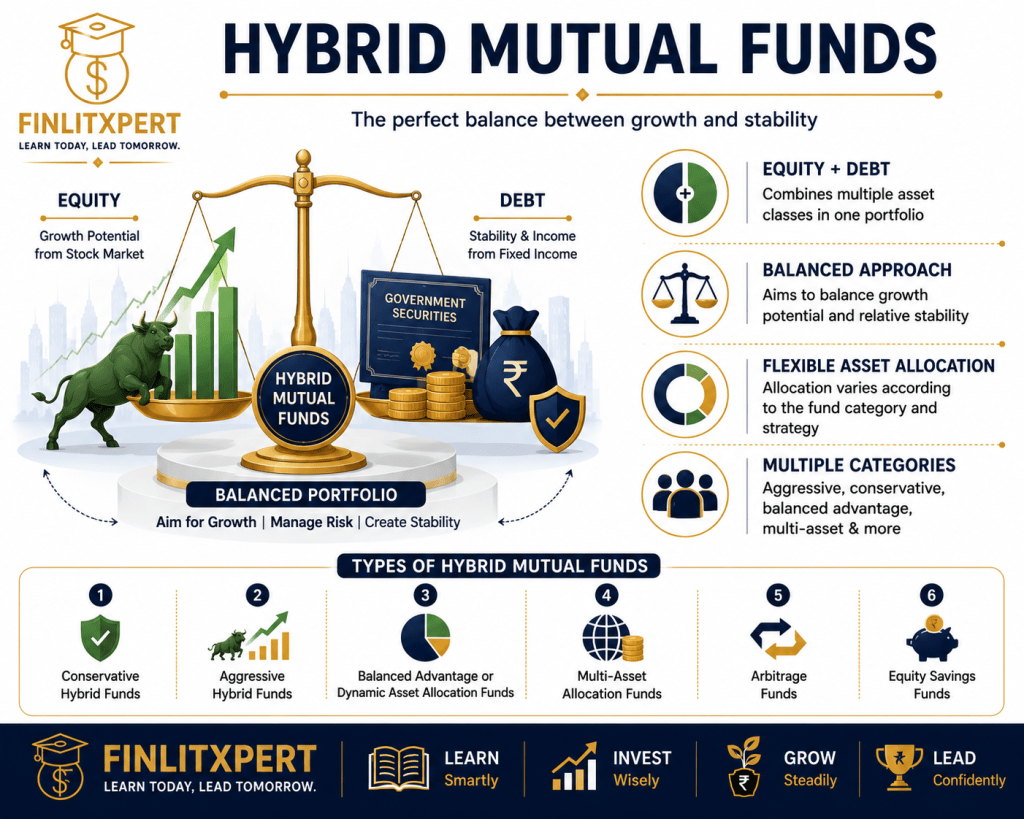
Hybrid mutual funds are mutual fund schemes that invest across more than one asset class, most commonly a combination of equity and debt securities. The objective is to combine the growth potential of equities with the relative stability and income potential of fixed-income investments within a single portfolio.
The allocation between equity and debt varies depending on the type and investment strategy of the hybrid fund. Some hybrid funds maintain a higher allocation to equities and may carry greater market risk, while others invest more heavily in debt instruments and generally follow a relatively conservative approach. Certain categories may also invest in additional asset classes such as gold or other permitted instruments.
Hybrid mutual funds are available in different categories, including conservative hybrid funds, aggressive hybrid funds, balanced advantage or dynamic asset allocation funds, multi-asset allocation funds, arbitrage funds, and equity savings funds. Each category follows a different asset allocation strategy and therefore has its own risk-return characteristics.
Before investing in a hybrid mutual fund, investors should understand the scheme’s asset allocation, investment strategy, risk level, and suitability for their financial goals and investment horizon. The presence of debt in a hybrid portfolio does not eliminate investment risk, and returns are not guaranteed.https://www.finlitxpert.com/finlitxpert-course-registration/
Types of Hybrid Mutual Funds
- Conservative Hybrid Funds
- Aggressive Hybrid Funds
- Balanced Advantage or Dynamic Asset Allocation Funds
- Multi-Asset Allocation Funds
- Arbitrage Funds
- Equity Savings Funds
Other Important Types of Mutual Funds
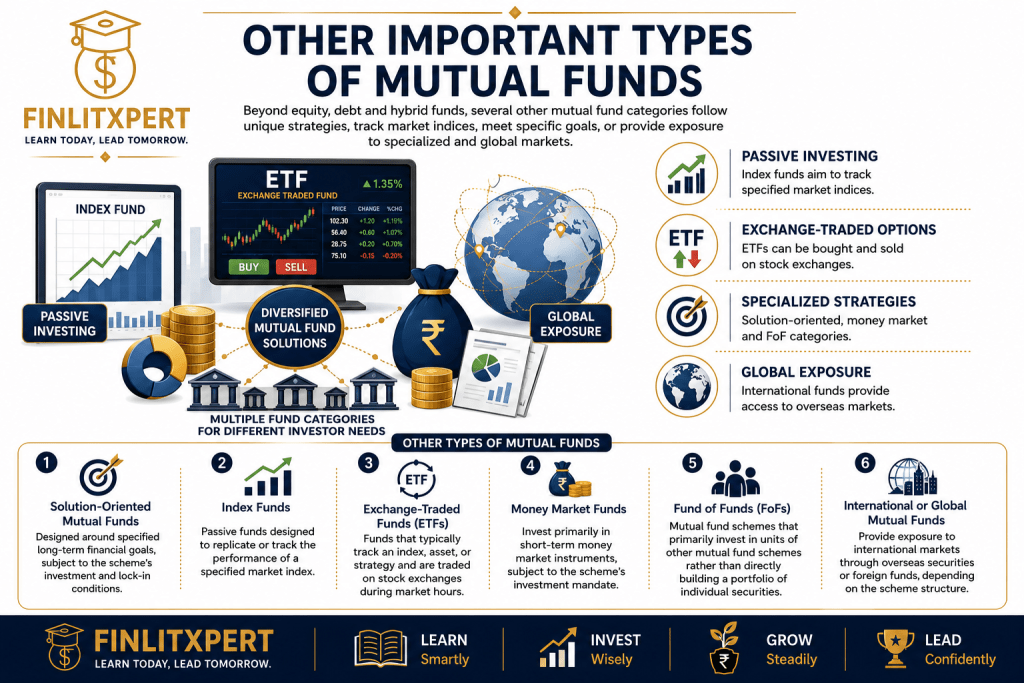
Apart from equity, debt, and hybrid funds, there are several other types of mutual funds designed to follow specific investment strategies, track market indices, meet particular financial goals, or provide exposure to specialized markets and asset classes.
These categories include solution-oriented mutual funds, index funds, exchange-traded funds (ETFs), money market funds, fund of funds (FoFs), and international or global mutual funds. Each category works differently and may serve a different purpose within an investor’s portfolio.
For example, index funds aim to replicate the performance of a specified market index, while ETFs are generally traded on stock exchanges during market hours. Fund of funds invest primarily in other mutual fund schemes, whereas international or global funds provide exposure to securities or funds outside the domestic market. Solution-oriented funds are structured around specified long-term goals, subject to the applicable scheme rules.
Understanding how these fund categories differ in terms of investment strategy, costs, liquidity, risk, and potential returns can help investors determine whether they are appropriate for their financial objectives and overall portfolio strategy.https://www.finlitxpert.com/finlitxpert-traderx-live-2026/
Other Types of Mutual Funds
- Solution-Oriented Mutual Funds
Designed around specified long-term financial goals, subject to the scheme’s investment and lock-in conditions. - Index Funds
Passive funds designed to replicate or track the performance of a specified market index. - Exchange-Traded Funds (ETFs)
Funds that typically track an index, asset, or strategy and are traded on stock exchanges during market hours. - Money Market Funds
Invest primarily in short-term money market instruments, subject to the scheme’s investment mandate. - Fund of Funds (FoFs)
Mutual fund schemes that primarily invest in units of other mutual fund schemes rather than directly building a portfolio of individual securities. - International or Global Mutual Funds
Provide exposure to international markets through overseas securities or foreign funds, depending on the scheme structure.
Equity vs Debt vs Hybrid Mutual Funds
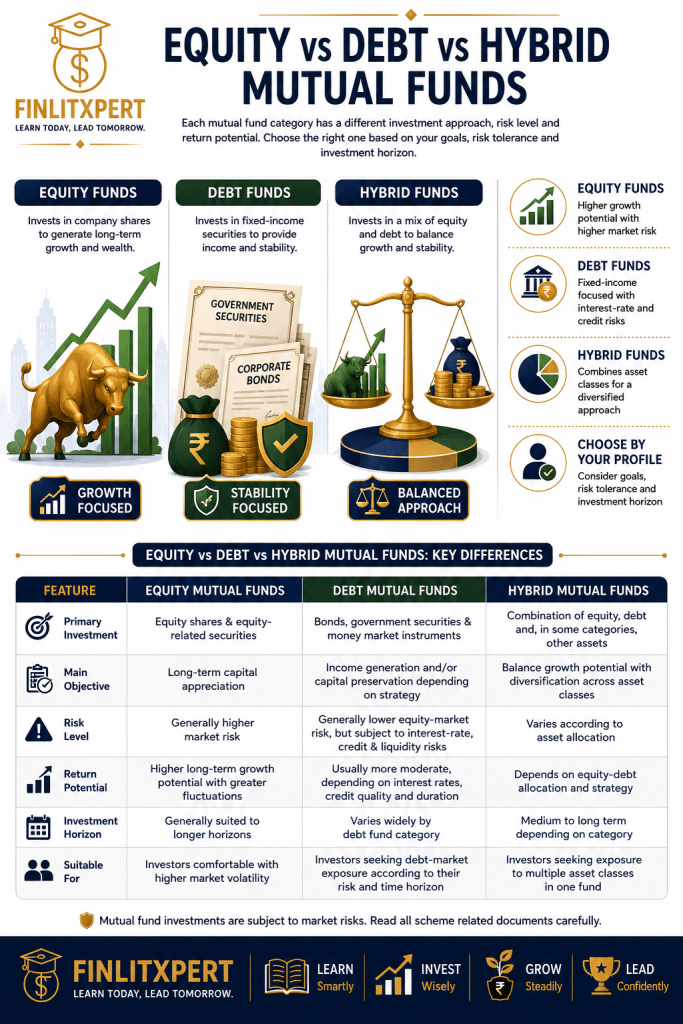
Equity, debt, and hybrid mutual funds differ mainly in the types of assets they invest in, their risk characteristics, return potential, and suitability for different investment goals. Understanding these differences can help investors select a mutual fund category that better matches their financial objectives, risk tolerance, and investment horizon.
Equity mutual funds primarily invest in company shares and generally aim for long-term capital appreciation. Since their performance is closely linked to stock market movements, they can experience significant fluctuations and are generally associated with higher market risk.
Debt mutual funds primarily invest in fixed-income and money market instruments such as government securities, corporate bonds, treasury bills, and other debt securities. They generally experience lower equity-market-related volatility than equity funds, although they remain exposed to risks such as interest-rate risk, credit risk, and liquidity risk.
Hybrid mutual funds invest across multiple asset classes, typically combining equity and debt. Their risk and return characteristics depend significantly on how the portfolio is allocated between these asset classes. Some hybrid categories are equity-oriented, while others follow a more conservative or dynamically managed allocation strategy.
There is no single mutual fund category that is suitable for every investor. The appropriate choice depends on factors such as financial goals, ability to tolerate market fluctuations, liquidity needs, and the expected investment period.https://www.finlitxpert.com/finlitxpert-course-registration/
Equity vs Debt vs Hybrid Mutual Funds: Key Differences
| Feature | Equity Mutual Funds | Debt Mutual Funds | Hybrid Mutual Funds |
|---|---|---|---|
| Primary Investment | Equity shares & equity-related securities | Bonds, government securities & money market instruments | Combination of equity, debt and, in some categories, other assets |
| Main Objective | Long-term capital appreciation | Income generation and/or capital preservation depending on strategy | Balance growth potential with diversification across asset classes |
| Risk Level | Generally higher market risk | Generally lower equity-market risk, but subject to interest-rate, credit & liquidity risks | Varies according to asset allocation |
| Return Potential | Higher long-term growth potential with greater fluctuations | Usually more moderate, depending on interest rates, credit quality and duration | Depends on equity-debt allocation and strategy |
| Investment Horizon | Generally suited to longer horizons | Varies widely by debt fund category | Medium to long term depending on category |
| Suitable For | Investors comfortable with higher market volatility | Investors seeking debt-market exposure according to their risk and time horizon | Investors seeking exposure to multiple asset classes in one fund |
How to Choose the Right Type of Mutual Fund
Choosing the right type of mutual fund depends on your financial goals, risk tolerance, investment horizon, liquidity needs, and overall investment strategy. Since different mutual fund categories invest in different asset classes and carry different levels of risk, investors should select a fund based on suitability rather than simply choosing the scheme with the highest recent returns.
Start by identifying your financial objective and the time available to achieve it. Investors with long-term goals and the ability to tolerate significant market fluctuations may consider suitable equity-oriented categories, while certain debt fund categories may be considered for goals where the investment horizon and risk profile are better aligned with fixed-income investments. Hybrid funds may be useful for investors seeking exposure to multiple asset classes within a single portfolio.
It is also important to understand the fund’s investment strategy, portfolio composition, risk indicators, expense ratio, exit load, and consistency of performance across different market conditions. Past performance should be evaluated carefully and should never be treated as a guarantee of future returns.
Before investing, read the scheme-related documents carefully and ensure that the selected mutual fund category is appropriate for your goals and risk profile. Investors who are uncertain about fund selection may consider seeking guidance from a qualified financial professional.https://www.finlitxpert.com/finlitxpert-traderx-live-2026/
Key Factors to Consider Before Choosing a Mutual Fund
- DEFINE YOUR FINANCIAL GOALS
Identify whether you are investing for wealth creation, retirement, education, or another financial objective. - UNDERSTAND YOUR RISK TOLERANCE
Choose a fund category with a level of risk you are financially and emotionally prepared to handle. - CONSIDER YOUR INVESTMENT HORIZON
Match the fund category with the amount of time available to achieve your financial goal. - CHECK THE FUND CATEGORY & STRATEGY
Understand where the fund invests and how its investment strategy works. - EVALUATE COSTS
Review the expense ratio, exit load, and other applicable costs before investing. - REVIEW PERFORMANCE & RISK
Evaluate long-term consistency and risk characteristics rather than relying only on recent returns. - CHOOSE AN INVESTMENT METHOD
Depending on your financial situation and objectives, investments may be made through SIP or lump-sum modes.

Common Mistakes to Avoid When Choosing Mutual Funds
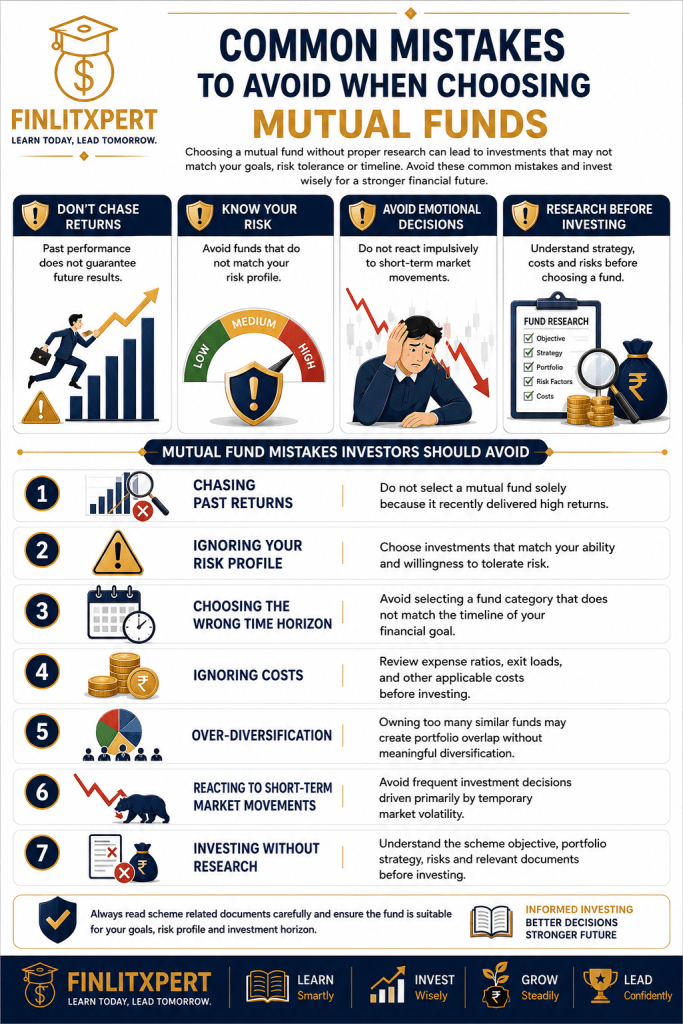
Choosing a mutual fund without proper research can lead to an investment that does not match your financial goals, risk tolerance, or investment horizon. One of the most common mistakes investors make is selecting a fund only because it has recently delivered high returns. Past performance alone does not indicate how a fund will perform in the future.
Investors may also choose an inappropriate fund category without fully understanding its investment strategy and associated risks. For example, selecting a high-risk equity fund for a short-term financial requirement could expose the investment to significant market fluctuations at the time the money is needed.
Other common mistakes include ignoring the expense ratio and exit load, investing without adequate diversification, frequently switching funds based on short-term market movements, and investing in multiple schemes with substantially overlapping portfolios.
Investors should also avoid making decisions solely on tips, advertisements, rankings, or recent performance. Before investing, it is important to read the scheme-related documents, understand the fund’s objective and risk factors, and evaluate whether the investment is suitable for your individual financial situation.https://www.finlitxpert.com/finlitxpert-course-registration/
Mutual Fund Mistakes Investors Should Avoid
- CHASING PAST RETURNS
Do not select a mutual fund solely because it recently delivered high returns. - IGNORING YOUR RISK PROFILE
Choose investments that match your ability and willingness to tolerate risk. - CHOOSING THE WRONG TIME HORIZON
Avoid selecting a fund category that does not match the timeline of your financial goal. - IGNORING COSTS
Review expense ratios, exit loads, and other applicable costs before investing. - OVER-DIVERSIFICATION
Owning too many similar funds may create portfolio overlap without meaningful diversification. - REACTING TO SHORT-TERM MARKET MOVEMENTS
Avoid frequent investment decisions driven primarily by temporary market volatility. - INVESTING WITHOUT RESEARCH
Understand the scheme objective, portfolio strategy, risks, and relevant documents before investing.
Frequently Asked Questions (FAQs)
What are the main types of mutual funds?
The main types of mutual funds include equity mutual funds, debt mutual funds, and hybrid mutual funds. Other important categories include index funds, exchange-traded funds (ETFs), solution-oriented funds, money market funds, fund of funds (FoFs), and international or global mutual funds. Each category follows a different investment strategy and has its own risk-return characteristics.
Which type of mutual fund is best for beginners?
There is no single mutual fund category that is best for every beginner. The appropriate choice depends on the investor’s financial goals, risk tolerance, investment horizon, and understanding of the investment. Beginners should first understand how different fund categories work and carefully review the scheme’s objectives, risks, costs, and investment strategy before investing.
Are equity mutual funds riskier than debt mutual funds?
Equity mutual funds generally carry higher market risk because they primarily invest in company shares whose prices can fluctuate significantly. Debt mutual funds usually have lower exposure to equity-market volatility, but they are not risk-free. They may be affected by interest-rate risk, credit risk, liquidity risk, and other factors depending on the securities held by the fund.
What is the difference between equity, debt, and hybrid mutual funds?
Equity mutual funds primarily invest in shares of companies and generally focus on long-term capital growth. Debt mutual funds mainly invest in fixed-income and money market securities. Hybrid mutual funds invest across multiple asset classes, typically combining equity and debt. Their risk and return characteristics depend on their underlying asset allocation and investment strategy.
Which type of mutual fund is suitable for long-term investment?
The suitability of a mutual fund for long-term investment depends on the investor’s goals and risk profile. Equity-oriented mutual funds are commonly considered for long-term wealth-creation objectives because of their exposure to equities and potential for capital appreciation, but they also involve significant market risk. Other fund categories may also be appropriate depending on the investor’s objectives, asset allocation, and risk tolerance.
Can I invest in different types of mutual funds through SIP?
Yes, SIP (Systematic Investment Plan) facilities are available in many mutual fund schemes, subject to the terms and conditions of the particular scheme. SIP allows investors to invest a specified amount at regular intervals rather than investing the entire amount at once. Investors should select the underlying mutual fund based on their financial goals, risk profile, and investment horizon rather than choosing a fund simply because a SIP facility is available.
How do I choose the right mutual fund category?
To choose an appropriate mutual fund category, consider your financial goals, risk tolerance, investment horizon, liquidity requirements, and overall asset allocation. You should also understand the fund’s investment objective, portfolio strategy, risk factors, expense ratio, exit load, and other applicable terms. Always read the scheme-related documents carefully before making an investment decision.
Conclusion
Understanding the different types of mutual funds is an important step toward making informed investment decisions. Equity mutual funds, debt mutual funds, hybrid mutual funds, index funds, ETFs, solution-oriented funds, fund of funds, and other categories each follow different investment strategies and carry different levels and types of risk.
There is no single mutual fund category that is best for every investor. The appropriate choice depends on individual financial goals, risk tolerance, investment horizon, liquidity requirements, and overall portfolio strategy. Equity-oriented funds may offer greater long-term growth potential with higher market volatility, debt funds provide exposure to fixed-income securities with their own interest-rate, credit, and liquidity risks, while hybrid funds combine multiple asset classes according to their investment strategy.
Before investing, investors should understand the fund category, investment objective, portfolio strategy, costs, risk factors, and applicable scheme conditions. Decisions should not be based solely on recent returns or market trends.
A well-informed and goal-based approach can help investors select mutual fund categories that are better aligned with their financial plans. Always read all scheme-related documents carefully before investing and consider professional guidance when necessary.
Disclaimer
Disclaimer: This article is intended solely for educational and informational purposes and should not be considered investment, financial, legal, or tax advice. Mutual fund investments are subject to market risks. The value of investments may rise or fall depending on market conditions, and past performance does not guarantee future results.
Investors should carefully read all scheme-related documents, understand the investment objectives, risk factors, costs, and terms of the relevant mutual fund scheme before investing. Consider your financial goals, risk tolerance, and investment horizon, and consult a qualified financial professional where necessary before making investment decisions.
FINLITXPERT Academy provides financial education and does not guarantee any investment returns or profits.